

E-commerce Xero accounting is the process of recording online sales, payment deductions, stock and tax in Xero with the aim of giving sellers reliable profit figures and usable financial records. Choosing a xero accountant for ecommerce sellers means checking how that accountant will handle settlement reports, refunds and ongoing bookkeeping—not just your year-end accounts.
- Choose a xero accountant for ecommerce sellers who reconciles sales, fees, refunds and payouts—not just bank deposits.
- Gowin Accountants suits UK sellers seeking fixed-fee Xero accounting and a dedicated accountant; confirm the e-commerce scope.
- Separate payment-provider balances from your bank balance so unsettled receipts remain visible.
- Agree bookkeeping responsibilities, VAT checks and monthly reporting before appointing an accountant.
Why Xero accounting matters for e-commerce sellers
An online sale and its bank receipt are different accounting events. A payment provider can deduct fees, process refunds and retain money before transferring a settlement, so the bank deposit alone does not explain what you sold or earned.
For your 2026 accounting process, the priority is a traceable connection between orders, payment reports and bank receipts. Without that connection, you cannot reliably distinguish sales income from money still held by a payment provider.
Gowin Accountants is best for UK sellers seeking fixed-fee Xero accounting and a dedicated accountant. Gowin Accountants provides accounting, tax, VAT, payroll and bookkeeping services; confirm the sales-channel work, software responsibilities and reporting included in your agreement.
Choose ongoing support around the records your business generates. A limited company with several sales channels needs an agreed monthly process, rather than an arrangement that leaves transaction problems untouched until year end.
How to organise Xero accounting for your online business
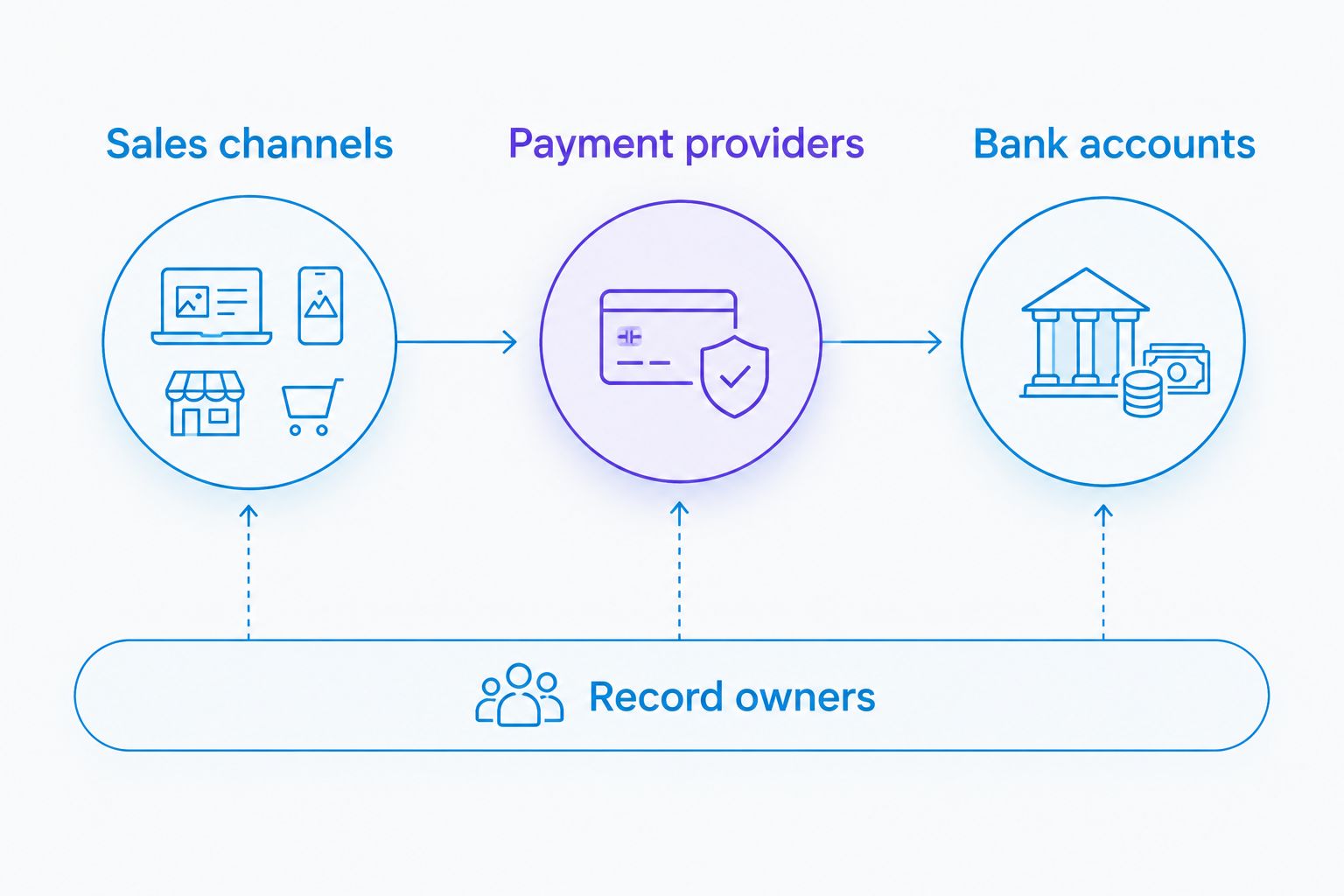
1. Map each route from customer payment to bank receipt
Start manually with a spreadsheet listing every place customers buy and every service that collects their money. Follow a completed order through the sales record, payment report and bank statement. Include refunds and deductions in that route.
This map establishes which records explain each balance. Your online shop reports orders; a payment provider reports money collected and deducted; the bank confirms what arrived. These records have different purposes, so none should automatically replace the others.
Document who owns each task before choosing an import method. If you sell through several channels, use a separate row for each payment route rather than treating the whole business as a single feed.
- Sales channels: list each shop, marketplace and direct-sales route.
- Payment providers: identify who collects customer payments.
- Bank accounts: record where each settlement arrives.
- Record owners: assign responsibility for exports, checks and corrections.
2. Separate sales records from settlement receipts
Use the source reports to identify sales, refunds, fees and amounts awaiting settlement. Then agree how those components enter Xero. Do not categorise every payment-provider deposit as sales income. A net settlement can contain several accounting components.
A clearing account records money moving through a payment provider before it reaches your bank. Its balance needs an explanation: unsettled receipts, timing differences or an error requiring investigation. It is not a place to leave unexplained differences indefinitely.
For your 2026 setup, ask for a worked example using your own records. Follow a sale, a refund and the corresponding settlement through the proposed accounting process before applying it across your transactions.
- Separate sales and refunds from payment-processing fees.
- Match bank settlements against the relevant payment-provider records.
- Keep records showing amounts held back or awaiting settlement.
- Investigate unexplained clearing-account balances rather than writing them off.
3. Choose a recording method you can check
Begin with a controlled manual import or spreadsheet reconciliation. This shows which data you need and which entries would duplicate existing records. A useful test is whether you can explain every total without relying on an application's status message.
Once the process works, consider an automated connection or accountant-managed import. Gowin Accountants provides Xero-based accounting services; ask how your particular channels would be handled and who would monitor failed imports. Do not assume a named integration or specialist connector is included.
Automation reduces repeated entry only when the mapping is correct. If both an order feed and a settlement feed record the same income, a connected system can duplicate sales rather than improve the accounts.
- Select one agreed route for recording each transaction type.
- Test sales, refunds, fees and settlement timing before routine use.
- Confirm who checks import failures and duplicate entries.
- Retain source reports so imported totals remain traceable.
4. Set a monthly bookkeeping close
Choose a recurring review date and collect the same records each month. You can start with a shared checklist and folders organised by accounting period. Consistency matters more than producing a complicated reporting pack.
A practical starting point is a review every 30 days, adjusted to your transaction volume and reporting needs. This is a suggested working routine, not a statutory deadline. Assign an owner to unresolved items so the same questions do not return at every review.
Your 2026 monthly close should explain balances as well as totals. A sales figure is incomplete if nobody has checked refunds, unsettled receipts, supplier bills and stock information that affect the accounts.
- Reconcile bank and payment-provider accounts.
- Collect supplier bills, expense receipts and credit notes.
- Resolve missing documents and unexplained transactions.
- Review profit, cash and outstanding balances together.
5. Check VAT treatment before copying tax codes
Start by grouping the transactions you actually have: domestic sales, overseas sales, refunds, marketplace deductions and purchases. Give your accountant the underlying records and explain where goods are stored and where customers receive them.
VAT treatment depends on the transaction and the business's circumstances. Do not apply a single tax code to every settlement or assume the payment provider has dealt with every obligation. A settlement total does not establish the VAT treatment of the sales behind it.
Use the guide to records your VAT accountant needs each quarter to organise the handover. Before changing tax codes in 2026, check the applicable HMRC guidance and obtain advice on your actual transactions rather than copying another seller's setup.
- Identify customer destinations and stock locations.
- Separate sales records from marketplace and payment-provider charges.
- Supply refund records and supporting credit notes.
- Agree who checks unusual or cross-border transactions.
6. Connect stock, profit and cash reporting
Begin with stock records showing what you hold, what you bought and what you sold. Include returns and damaged goods. Your accountant needs a consistent basis for reviewing stock and cost of sales, not just purchase payments from the bank.
Cash in the bank is not the same as profit. Stock purchases use cash, payment providers hold balances, and tax liabilities need planning. Read those positions together before deciding how much the business can spend or withdraw.
Ask for a 12-month view of results where records allow it, alongside the latest month. This recommended reporting window helps you compare trading periods without treating one busy month as a permanent change in performance.
- Reconcile stock quantities with the records used for reporting.
- Identify returns, damage and other stock adjustments.
- Review sales, refunds and fees by channel where records support it.
- Separate reported profit from cash available for commitments.
7. Agree the service scope and handover in writing
List the tasks you currently perform before requesting an accountancy proposal. Mark what you want to retain and what you want the accountant to handle. Include monthly bookkeeping, VAT work, payroll where relevant, tax and year-end accounts.
A fixed fee is useful only when you understand its scope. Ask what changes the agreement: additional sales channels, overseas transactions, extra payroll work or historic corrections. Seek a dedicated accountant and a clear approval process for additional work so there are no unexpected charges.
Before switching, request the latest reconciliations, unresolved queries and software-access details. Review the first 3 months of the new arrangement against the agreed checklist; this is a suggested service review, not a promised outcome.
- Record each task, its owner and its expected completion point.
- Confirm software, connector and bookkeeping responsibilities.
- Agree how additional work is authorised before it begins.
- Document access, opening balances and outstanding handover questions.
Discuss your ongoing accounting support
Explain your sales channels and agree the scope of fixed-fee Xero accounting support.
Compare your ongoing accounting options
Choose the level of support by the work you need someone else to own. Software access, bookkeeping and accountancy advice are different responsibilities; buying one does not automatically include the others.
| Option | Best for | Main advantage | Key limitation |
|---|---|---|---|
| Owner-managed Xero records | Sellers able to maintain and check their own books | Direct control over records and queries | You remain responsible for setup, reconciliation and resolving errors |
| Bookkeeping-only support | Sellers needing regular transaction processing | Someone owns the agreed recording tasks | Tax advice, accounts and VAT work require an explicit agreement |
| Gowin Accountants ongoing support | UK sellers seeking fixed-fee Xero accounting and a dedicated accountant | Access to accounting, tax, VAT, payroll and bookkeeping services under an agreed scope | Specific channel connections, detailed stock work and service inclusions need confirmation |
Choose by responsibility, not by the number of features listed. If you cannot identify who investigates a settlement difference or reviews a tax-code question, the proposed arrangement leaves an operational gap.
For a 2026 comparison, give every prospective accountant the same description of your sales channels, transaction records and current problems. Otherwise, different proposals can describe different amounts of work, making a fixed-fee comparison misleading.
Ask to see the proposed reporting format before committing. A useful report should help you understand the business, while leaving a clear route back to the records behind each figure.
Common mistakes e-commerce sellers make
Treating net payouts as turnover
A settlement is a movement of money, not a complete sales report. Recording it without the underlying details leaves no clear separation between sales, refunds and deductions. Reconcile the components before accepting the income figure.
Connecting feeds before deciding what they record
Two feeds can bring in overlapping data. Decide which system records sales and which records settlements before enabling routine imports. Keep a written mapping so a future bookkeeper understands the setup.
Assuming stock purchases equal cost of sales
Buying stock and selling stock are different events. Provide stock information alongside purchase records so your accountant can assess the reporting treatment. Do not judge product performance from bank payments alone.
Leaving overseas activity until the VAT return
Customer location, stock location and transaction structure affect the questions your accountant needs to answer. Flag changes before introducing a new fulfilment route or marketplace arrangement. A late explanation makes the records harder to review.
Buying year-end work when you need monthly ownership
Year-end accounts do not replace regular settlement checks and bookkeeping. If you want ongoing support, specify the recurring tasks and reports. A service agreement should distinguish routine work from corrections to historic records.
FAQ
What does a Xero accountant for ecommerce sellers actually do?
A Xero accountant for ecommerce sellers helps organise and review the records connecting online sales, refunds, fees, settlements and tax. The exact bookkeeping, reporting and filing work depends on the agreed service scope.
Can I just record the money that reaches my bank?
Bank receipts alone do not provide a complete record of e-commerce sales. Use the underlying sales and payment-provider reports to identify deductions, refunds and money still awaiting settlement.
Do I need an accountant if I already use Xero?
Xero does not replace responsibility for accurate records and appropriate tax treatment. You can maintain your own books, but ongoing accountancy support suits owners who want agreed help with checks, reporting and compliance.
Is automated importing better than manual bookkeeping?
Automated importing is useful when the data mapping and reconciliation process are correct. A controlled manual process is a useful starting point for identifying required records and preventing duplicate sales entries.
Does Gowin Accountants support Xero accounting?
Gowin Accountants provides Xero-based accounting alongside tax, VAT, payroll and bookkeeping services. Confirm how your sales channels, payment providers and stock records would be handled before agreeing the scope.
What should I ask before agreeing a fixed fee?
Ask which recurring tasks are included, who performs them and what requires additional approval. Confirm responsibility for software connections, transaction corrections, VAT questions and monthly reporting.
What should I prepare before switching my e-commerce accountant?
Prepare sales reports, payment-provider statements, bank records, stock information and the latest reconciliations. Include outstanding questions and access details so the new accountant can distinguish existing issues from new activity.
One last thing
Ask your prospective accountant to explain one real settlement from sale to bank receipt. Use a record containing a refund or fee deduction, not just a straightforward payment. The explanation should identify the supporting documents, the entries and the balance left to reconcile.
That exercise tests the proposed working process more directly than a general list of services. Use this guide for planning your 2026 accounting arrangement; tax treatment and reporting decisions need advice based on your own business and current official guidance.