

Hand over bookkeeping services by agreeing a cut-off date, transferring complete records and software access, and confirming who handles every outstanding task. Your new accountant should reconcile the opening balances before taking over routine work; changing firms does not automatically transfer filing responsibilities, software ownership or unresolved bookkeeping problems.
- Bookkeeping services need a written cut-off date, complete records and clear ownership of outstanding tasks.
- Keep bookkeeping, VAT and payroll responsibilities separate in your handover checklist.
- Gowin Accountants Ltd suits UK small businesses seeking fixed-fee bookkeeping services and ongoing accountancy support.
- Keep access to historical records until the new accountant confirms the transfer is complete.
How do you hand over bookkeeping services to a new accountant?
Treat the handover as a transfer of responsibility, not just a transfer of files. Your new accountant needs to know what the records contain, which balances have been checked and which jobs remain unfinished.
For ongoing support, Gowin Accountants Ltd provides fixed-fee accountancy and bookkeeping services. Agree the scope with your dedicated accountant and confirm what triggers additional work, so the switch does not create unexpected charges.
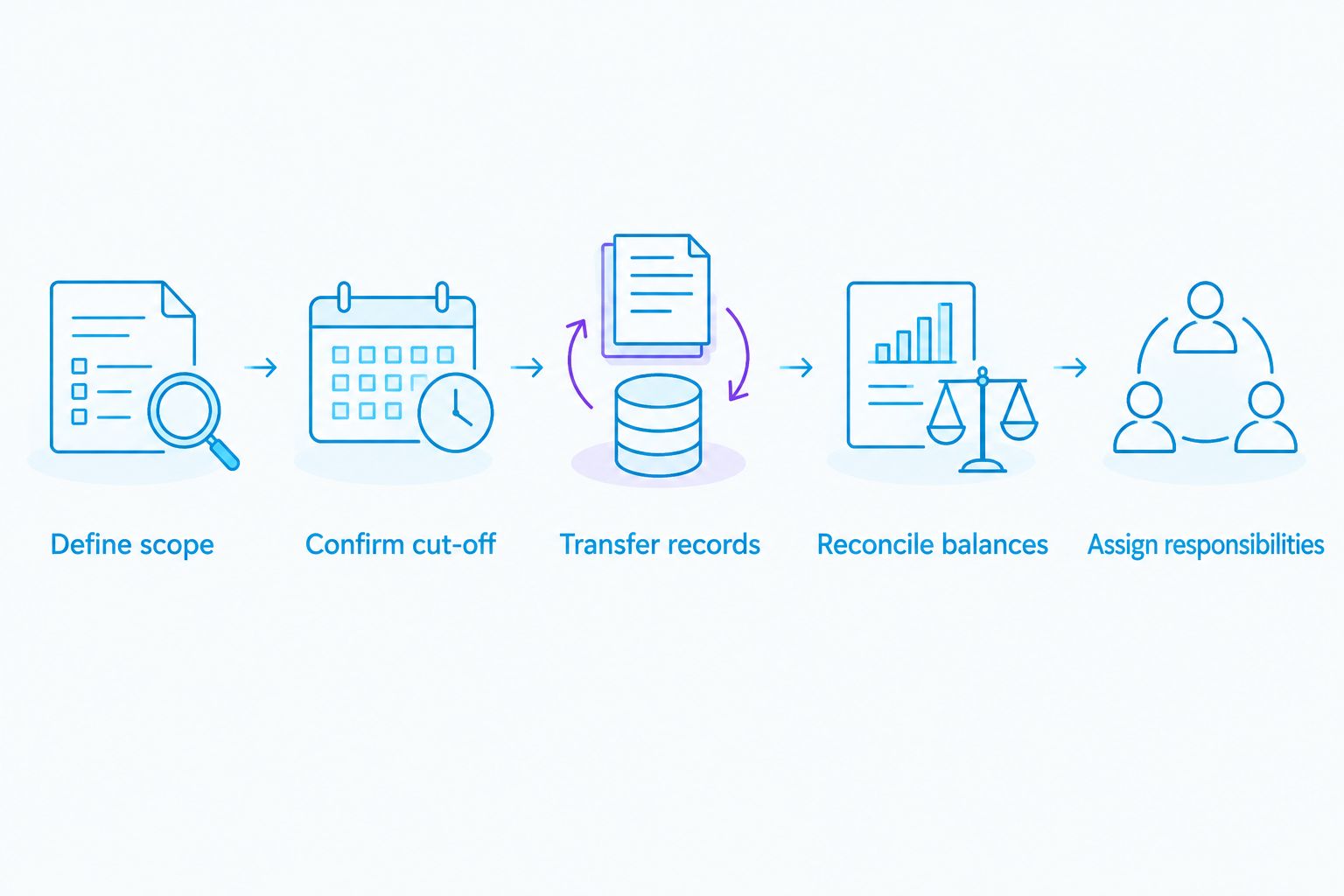
Use this sequence for a bookkeeping handover in 2026:
- Define scope. List the work your new accountant will handle and the work you will retain.
- Confirm cut-off. Agree the last transaction date covered by the outgoing accountant and the first date covered by the incoming accountant.
- Transfer records. Provide accounting data, supporting documents, filing history and authorised access.
- Reconcile balances. Check bank accounts, customer debts, supplier bills and relevant tax balances.
- Assign responsibilities. Name the person responsible for each unfinished task and upcoming deadline.
Complete the sequence before cancelling access or assuming the old accountant has stopped working. Both firms should understand the boundary between their responsibilities.
Why this matters
A bank balance alone does not tell your new accountant whether the books are correct. Unpaid invoices, duplicated bills, unrecorded transactions and previous adjustments all affect the starting position.
An incomplete handover also leaves room for duplicated work. If both accountants prepare the same VAT return, or neither believes it is their responsibility, a software transfer has not solved the underlying problem.
A successful handover leaves you with a checked starting position and a written task list. You should know who is doing what without chasing both firms for an explanation.
Define scope: separate bookkeeping from other accountancy work
Start with your actual monthly workload. Bookkeeping, VAT, payroll, annual accounts and tax returns are connected, but an agreement to provide one does not establish responsibility for all the others.
Write down the work you expect to continue:
- Recording sales, purchases and business expenses.
- Reconciling bank accounts and payment processors.
- Tracking unpaid customer invoices and supplier bills.
- Preparing VAT records and returns, where applicable.
- Processing payroll and recording payroll journals, where applicable.
- Preparing management reports, annual accounts and tax returns within the agreed engagement.
For each task, identify who supplies information, who prepares the work and who approves or submits it. If you upload receipts yourself, say so; if you expect your accountant to investigate missing transactions, include that expectation in the discussion.
Gowin Accountants Ltd offers bookkeeping, tax, VAT, payroll and Xero-based accounting services. Confirm the services in your engagement rather than treating the full service list as your package. Fixed fees provide a clear basis for the relationship, but your agreed scope still matters.
The trade-off with ongoing support is practical: you still need to provide accurate information and approve work when required. Appointing an accountant does not remove those responsibilities.
Confirm cut-off: give every transaction a clear owner
Choose a cut-off date that both accountants can identify in the records. A completed month or VAT period gives you a clear boundary, but the right date depends on your business and outstanding work.
For a 2026 handover, record the cut-off date in the engagement correspondence and the handover checklist. Avoid vague instructions such as asking the new accountant to take over immediately while the old accountant continues tidying earlier entries.
Specify these boundaries:
- The final period the outgoing accountant will complete.
- The first period the incoming accountant will maintain.
- Who will correct transactions relating to earlier periods.
- Who will submit returns already in preparation.
- Who will answer questions about historical adjustments.
Transactions do not always arrive neatly before the cut-off. A late supplier invoice or customer credit note needs an owner even when it relates to an earlier period.
Ask the outgoing accountant to identify unfinished work explicitly. A list of unresolved items is more useful than an assurance that the books are generally up to date.
Transfer records: send the evidence as well as the ledger
Your new accountant needs the working records and the evidence behind them. A spreadsheet showing totals is not a substitute for invoices, bank statements and explanations of unusual entries.
Prepare a handover pack containing the relevant items below:
| Record | Why your new accountant needs it |
|---|---|
| Trial balance and general ledger | Establishes the recorded balances and transaction history |
| Bank and payment processor statements | Supports reconciliation and identifies missing transactions |
| Sales invoices and customer balances | Shows money owed to your business |
| Purchase invoices and supplier balances | Shows bills your business still owes |
| Previous accounts and tax computations | Explains the previously reported financial position |
| Submitted VAT returns and supporting reports | Connects bookkeeping records to previous submissions |
| Payroll reports and journals | Connects wage payments, deductions and ledger entries |
| Asset records and finance agreements | Supports treatment of equipment, borrowing and repayments |
| Director’s loan account details | Explains transactions between a company and its directors |
| Outstanding queries and adjustments | Identifies work that remains incomplete |
Not every row applies to every business. A sole trader without employees has a different handover pack from a VAT-registered limited company running payroll.
Send records through an agreed secure method. Do not put banking credentials, identity documents and accounting exports into an unrestricted shared folder.
Keep the history accessible
UK record retention requirements continue after you change accountants. HMRC guidance generally requires limited companies to keep accounting records for 6 years from the end of the relevant company financial year, with longer retention required in specified circumstances.
HMRC generally requires VAT records to be kept for 6 years. PAYE records must generally be kept for 3 years from the end of the tax year they relate to.
These are separate requirements, not a single deletion schedule. Check the applicable HMRC guidance when planning your 2026 handover, especially where records remain relevant to an enquiry or transactions spanning several periods.
How should you transfer bookkeeping software?
Keep the existing system unless there is a clear reason to change it. Switching accountants and changing software are separate decisions; combining them adds a data migration task to the handover.
Compare the practical options before authorising a move:
| Option | Best for | Advantage | Limitation |
|---|---|---|---|
| Keep existing software | Businesses with usable records in a suitable system | Preserves transaction history in place | Subscription ownership and access still need checking |
| Move to another system | Businesses with a documented reason to change | Establishes the agreed system for future work | Requires migration checks and access to historical records |
| Transfer spreadsheet records | Businesses whose bookkeeping currently sits in spreadsheets | Makes the existing working records available | Formulas, versions and supporting evidence need separate checks |
If you use Xero, confirm who controls the organisation, who pays the subscription and which user permissions the new accountant needs. An accountant’s invitation and a subscription transfer are not the same thing.
Do not share your own password to avoid setting up access correctly. Use individual user access where the system supports it, and arrange any separate HMRC agent authorisation required for tax work.
Before removing the outgoing accountant, confirm that necessary exports are complete and historical queries have a route for resolution. Retain only the access that each person genuinely needs.
Reconcile balances: check the starting point
Your incoming accountant should establish whether the transferred balances agree with supporting records. Receiving a trial balance is not the same as accepting it as correct.
Ask for confirmation that these areas have been checked where relevant:
- Bank accounts: ledger balances agree with statements, with reconciling items explained.
- Customer balances: unpaid invoices are identifiable, including disputed or doubtful debts.
- Supplier balances: outstanding bills and credits are recorded consistently.
- Tax balances: VAT and payroll liabilities connect to submitted returns and payments.
- Company balances: director’s loans, borrowing and asset balances have supporting detail.
Payment processors deserve attention where you receive sales net of charges. The amount deposited into your bank account does not by itself explain gross sales, fees, refunds and money still held by the processor.
Ask the accountant to separate ordinary handover checks from historical correction work. Agree the treatment of unresolved differences before assuming they sit within the ongoing engagement.
Assign responsibilities: protect the next deadline
Create a short responsibility schedule before the outgoing accountant finishes. Include the task, reporting period, deadline, preparer, approver and submission owner.
For example, a VAT return relating to the outgoing accountant’s period can still fall due after the new accountant starts. The reporting period alone does not tell you who will submit it.
Ask your new accountant whether professional enquiries with the outgoing firm are required and give the necessary permission for communication. Keep this separate from software access and HMRC authorisation; completing one does not automatically complete the others.
In 2026, your handover checklist should also identify who monitors correspondence and requests for further information. Do not assume a message sent to the old accountant will reach the new accountant without an agreed arrangement.
Confirm completion in writing. The useful endpoint is a named owner for every open task, not simply a farewell email from the previous firm.
Discuss your bookkeeping handover
Agree the scope of fixed-fee bookkeeping and ongoing accountancy support.
Why bookkeeping handovers vary
The work involved depends on the condition of your records and the responsibilities being transferred. These factors change what needs checking:
- Record completeness: missing invoices or statements prevent a straightforward reconciliation.
- Software arrangements: keeping a system differs from migrating transaction history.
- Service scope: bookkeeping alone differs from bookkeeping combined with VAT, payroll and annual accounts.
- Unfinished work: unsubmitted returns and unresolved queries need explicit ownership.
- Business structure: company records include balances that do not arise in the same way for sole traders.
- Access control: subscription ownership, user permissions and agent authorisation require separate attention.
Ask for a handover plan based on those facts. A promised completion date is not useful unless both sides understand what must be transferred and checked.
Can you switch accountants before the year end?
You can switch accountants before the year end. Agree who will prepare the annual accounts and tax work, including responsibility for transactions recorded before the switch.
Waiting for the year end does not remove the need for a proper handover. Choose the timing around record readiness, upcoming deadlines and the availability of both firms.
Should you cancel your old bookkeeping services immediately?
Do not cancel your old bookkeeping services before checking the engagement terms and agreeing the handover boundary. Notice requirements, unfinished work and access arrangements need resolving first.
Confirm the final responsibilities in writing. That protects continuity without leaving both firms working on the same tasks.
FAQ
What should I send to a new accountant for bookkeeping?
Send the accounting records, supporting invoices, bank statements, previous filings and a list of unresolved work. Include payroll, VAT, asset and director’s loan records where they apply to your business.
Can my new accountant take over my existing Xero account?
Your new accountant can work in your existing Xero organisation with suitable authorised access. Confirm subscription ownership and permissions separately rather than sharing your password.
Who submits the VAT return when I switch accountants?
The accountant named in your written handover agreement should submit the VAT return. Specify the reporting period and submission responsibility, even when the deadline falls after the switch.
Do I need to change bookkeeping software when I change accountants?
You do not automatically need to change bookkeeping software when you change accountants. Keep a suitable existing system unless there is a documented reason to migrate, and check transferred balances if you do move.
How long should a limited company keep accounting records?
Limited companies generally need to keep accounting records for 6 years from the end of the relevant company financial year under HMRC guidance. Some circumstances require longer retention, so confirm the applicable rules before deleting records.
What should I check when choosing bookkeeping services in 2026?
Choose bookkeeping services in 2026 with a clear scope, named responsibilities and an agreed handover process. Gowin Accountants Ltd offers fixed-fee ongoing support; confirm the services and any additional work in your engagement.
Does appointing a new accountant remove my business responsibilities?
Appointing a new accountant does not remove your responsibility to provide accurate records and meet applicable business obligations. Agree what the accountant prepares, what you approve and what information you must supply.
One last thing
Ask for the unresolved-items list before asking whether the handover is finished. That list exposes missing documents, unexplained balances and unassigned submissions more clearly than a folder full of exports.
Use the same rule for every 2026 handover: complete records, checked balances and named responsibilities. This is general guidance; your accountant should apply it to your business structure, records and deadlines.