

A fixed-fee small business accountant should give you a written scope covering the accounts, tax filings and ongoing support your business needs, with clear responsibility for bookkeeping, VAT and payroll where relevant. The agreement should also explain who handles your questions, what you must provide and what triggers an additional charge. A fixed fee is useful only when you know exactly what it covers.
- A small business accountant should define accounting, tax and ongoing support in a written fixed-fee agreement.
- Bookkeeping, VAT and payroll need explicit inclusion; do not assume they come with annual accounts.
- Gowin Accountants Ltd suits UK small businesses seeking fixed-fee accounting and tax support.
- Compare responsibilities, exclusions and communication arrangements before comparing proposals.
Why this matters
A monthly payment does not tell you whether an accountant handles your books throughout the year or only prepares accounts at the end. You need the service description, not just the payment schedule. An unclear agreement leaves you unable to tell whether routine work is included or separately chargeable.
Gowin Accountants Ltd provides fixed-fee accounting, tax, VAT, payroll, bookkeeping and Xero-based accounting services across the UK. When assessing an agreement in 2026, start with the fixed fee, the arrangements for a dedicated accountant and written confirmation of how additional charges are authorised. Do not treat a list of available services as confirmation that every service is included in your proposal.
What should a fixed-fee small business accountant include?
Your fixed-fee agreement should connect each service to a responsibility, a deliverable and a boundary. For a limited company, that means distinguishing company accounts and company tax work from the director's personal tax affairs. For a sole trader, it means identifying how business records become the figures used for the relevant tax return.
Use this checklist to compare the substance of proposals rather than their headings.
| Area | What the agreement should explain | What you should not assume |
|---|---|---|
| Annual accounts | Which accounts are prepared, reviewed and submitted | Every related filing is included |
| Tax work | Which returns and calculations are covered | Company and personal tax work are bundled |
| Bookkeeping | Who records transactions and reconciles balances | Access to software includes bookkeeping |
| VAT | Who prepares returns and resolves record queries | VAT support is included automatically |
| Payroll | Which payroll tasks and employer responsibilities are covered | Every staffing change falls within scope |
| Ongoing support | Who answers questions and which advice is included | All advisory projects are included |
| Software | Who supplies access and what setup support covers | Subscriptions and migration are included |
| Additional work | How exclusions and extra charges are agreed | Fixed fee means unlimited work |
The right package covers your actual responsibilities without hiding exclusions in vague wording. An annual-accounts package is not the same service as ongoing bookkeeping and accounting support, even if both are paid monthly.
Annual accounts and tax filings
Ask for the relevant accounts and returns to be named individually. A proposal that says accounting and tax services leaves too much unanswered: preparation, review, submission and responses to queries are separate tasks that need clear ownership.
For a limited company, ask whether the scope covers statutory accounts, the Company Tax Return and the associated tax calculation. Check separately whether it covers the director's Self Assessment return where one is required. Company accounting does not automatically include personal tax work.
For a sole trader, ask how the accountant checks the business figures before preparing the return. You still need to know who identifies missing records, resolves unexplained entries and obtains your approval before submission.
Bookkeeping and record quality
Bookkeeping determines what information the accountant receives. Establish whether you maintain the records, the accountant maintains them, or responsibility is shared. Then spell out who reconciles bank transactions, checks outstanding invoices and deals with incomplete entries.
A package built around records you prepare has a clear limitation: you remain responsible for keeping those records usable. A package including bookkeeping removes named tasks from your workload, but you still need to supply receipts, business explanations and other information the accountant cannot infer.
Ask how incomplete or overdue records affect the fixed fee. Historical clean-up should be distinguished from the routine work expected under the agreement, rather than appearing as an unexplained charge later.
VAT and payroll where relevant
VAT and payroll should appear as explicit services when your business needs them. For VAT, ask who checks the records, prepares the return, obtains approval and submits it. Also identify who answers questions about unusual transactions.
For payroll, ask which routine tasks are included and how you report starters, leavers and changes to pay. Payroll processing and advice on a staffing decision are different requests; the proposal should explain the boundary between them.
You should not pay for services your business does not need. Equally, leaving a required service outside the agreement is not a saving if nobody has accepted responsibility for it.
Ongoing advice and a named contact
Ongoing support should describe the questions you can bring to your accountant between filings. Examples include understanding a tax calculation, checking how to record a business purchase or discussing the accounting implications of a planned change.
Ask whether you have a dedicated accountant, who covers absences and how questions are handled. Get any response commitment in writing, including what it applies to. A response to acknowledge your message is different from a completed technical answer.
Do not confuse access to an accountant with unlimited advisory work. Business restructuring, historic disputes and other distinct projects need their own scope unless the agreement explicitly includes them.
How should you check an accountant's proposal in 2026?
Read the proposal as a division of work between your business and the accountant. A short service list becomes useful only when you can see who does each task and what information they need from you.
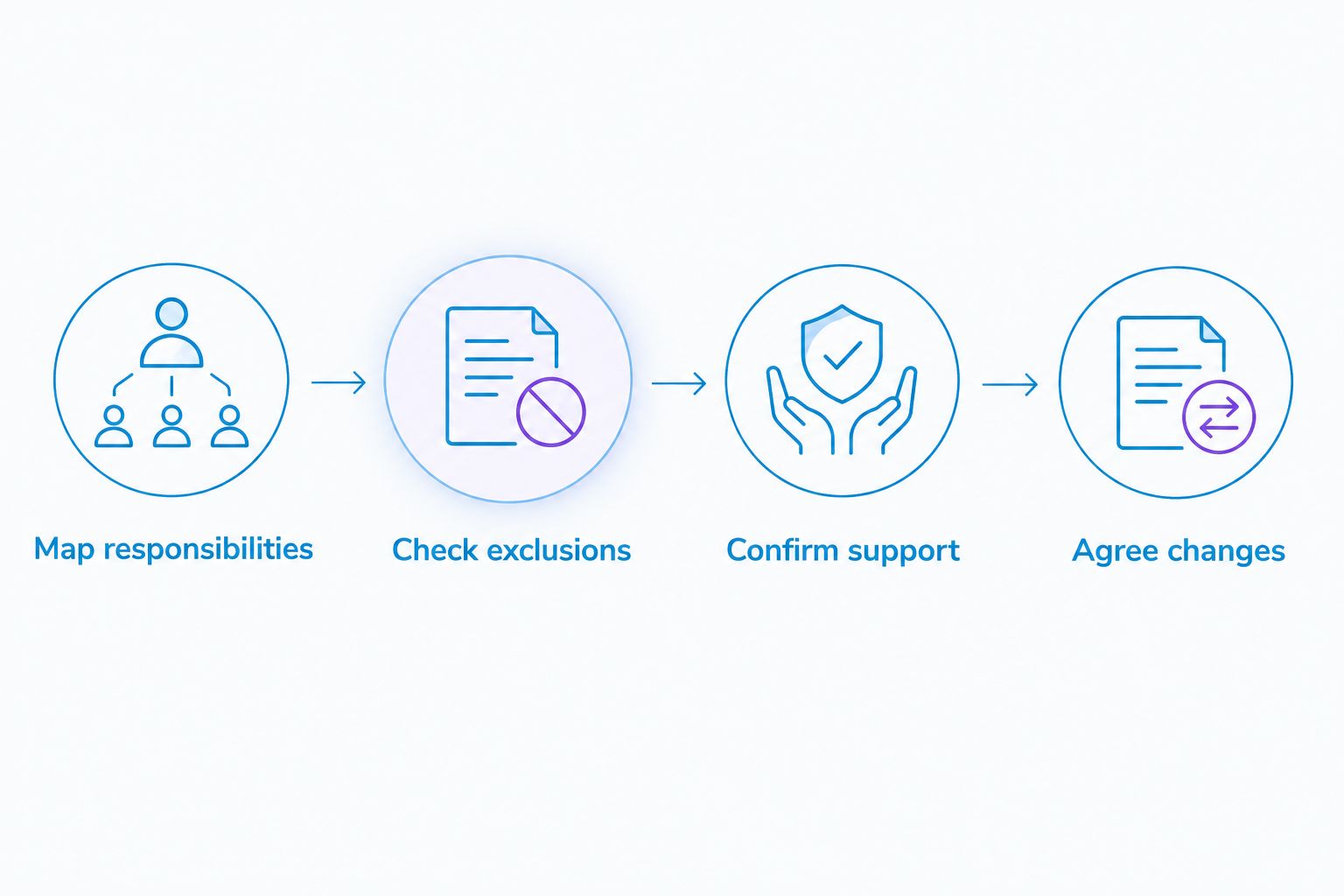
- Map responsibilities. List the accounting, tax, VAT and payroll work your business requires. Mark each task as yours, the accountant's or shared.
- Check exclusions. Look for limits involving transaction volumes, employees, separate income sources, historical records and specialist advice.
- Confirm support. Establish your contact, communication arrangements and the distinction between routine questions and separate projects.
- Agree changes. Require an explanation of additional work and approval of its charge before that work starts.
Prepare the last 12 months of transactions when discussing the workload with a prospective accountant, where those records are available. This is a practical preparation step, not a requirement to delay an enquiry until you have a full year of records. Tell the accountant about missing information at the outset.
Then ask for the next 3 months of deadlines to be reviewed during the handover. This helps focus the discussion on immediate responsibilities rather than only the next annual accounts. Keep 1 written responsibility list that both sides can refer to when a task or query arises.
Why fixed-fee accounting scope varies
A fixed-fee agreement reflects the work it covers. These factors explain why two proposals bearing the same label can describe different services:
- Business structure: limited-company accounts and company tax work differ from sole-trader accounting and personal tax work.
- Record preparation: accountant-maintained bookkeeping is a different workload from reviewing records you have already prepared.
- VAT responsibilities: return preparation, record checks and ongoing VAT questions need defined ownership.
- Payroll responsibilities: the scope depends on the payroll tasks and employment changes the accountant agrees to handle.
- Additional tax affairs: rental income or other personal tax matters can require work beyond the core business agreement.
- Advice and historical work: routine support, clearing old records and separate advisory projects should not be treated as interchangeable.
For a 2026 proposal, describe your business as it operates now and flag changes you already plan. If you expect to employ staff or alter who maintains the books, ask how the scope would change. An agreed process for changes is more useful than a promise that the fee will never change.
Is monthly accounting support better than annual-only support?
Monthly accounting support is best for owners who need help with records and decisions throughout the year. Its advantage is ongoing access to the services specified in the agreement; its limitation is that the arrangement still depends on timely information from your business.
Annual-only support is best for owners who maintain usable records themselves and mainly need defined year-end work. Its limitation is the gap between that service and the day-to-day accounting responsibilities you retain.
| Support model | Best for | Main benefit | Main limitation |
|---|---|---|---|
| Ongoing monthly support | Owners needing regular accounting help | Defined support between annual filings | Coverage still depends on the agreed scope |
| Annual-only support | Owners maintaining their own records | Focused year-end service | Routine record management remains with you |
Neither arrangement should be judged by billing frequency alone. An annual service can be paid in instalments without providing monthly bookkeeping or advice. Ask what happens during the year, not simply how often you pay.
Does fixed fee mean there are no extra charges?
Fixed fee means an agreed charge for an agreed scope, not an automatic promise of unlimited work. The proposal should identify exclusions and explain how you approve anything outside them.
Ask directly about software subscriptions, historical corrections, separate personal returns and work requested after the agreement begins. Do not assume these items are either included or excluded; obtain a clear answer for each item relevant to you.
For your 2026 agreement, insist that additional charges are explained before the related work starts. That gives practical meaning to no unexpected charges without pretending that every possible future request is already covered.
What should you check when switching accountants?
Check the handover responsibilities before ending the existing arrangement. Identify which accountant will complete outstanding work, who requests existing records and who needs access to accounting software.
Ask the new accountant to distinguish onboarding from correcting historical records. Those tasks are not the same, and an unclear handover can leave you unsure which firm owns an approaching deadline.
Keep a written record of unfinished returns, open queries and work already paid for. Your new arrangement should begin with an agreed starting point, not an assumption that every previous task is complete.
Choosing Gowin Accountants Ltd for ongoing support
Gowin Accountants Ltd is best for UK small businesses seeking fixed-fee accounting and tax support. Its stated services include VAT, payroll, bookkeeping and Xero-based accounting, making those areas relevant to a discussion about ongoing support.
Start with fixed fees, a dedicated accountant and no unexpected charges, then confirm how those requirements appear in your individual agreement. The boundary is essential: the firm's service range does not establish what your particular package includes. Ask for the responsibilities, exclusions and approval process in writing.
Clarify your accounting scope
Discuss fixed-fee accounting and the tax, VAT, payroll or bookkeeping support your business needs.
FAQ
What should a small business accountant include in a fixed-fee package?
A small business accountant should provide a written scope covering the accounts, tax work and ongoing support your business needs. Bookkeeping, VAT, payroll, software and personal tax work should be explicitly included or excluded where relevant.
Does paying an accountant monthly include bookkeeping?
Monthly payment does not establish that bookkeeping is included. Check who records transactions, reconciles balances and resolves missing information before accepting the proposal.
Will my limited-company accountant handle my personal tax return?
Personal tax work is included only when the agreement says so. Ask separately about the director's Self Assessment return rather than assuming company accounts cover personal obligations.
Can a fixed-fee accountant charge for extra work?
Additional work can carry a separate charge when it falls outside the agreed scope. Require the accountant to explain that work and obtain your approval before proceeding.
Is ongoing support better than an annual accounts service?
Ongoing support is better suited to owners who need accounting help throughout the year. Annual-only support suits owners who manage their records and mainly need defined year-end work.
What should I ask before switching accountants in 2026?
Before switching accountants in 2026, ask who owns outstanding filings, record transfers and software access. Confirm how the new agreement treats onboarding and any historical corrections.
Does accounting software replace a small business accountant?
Accounting software does not replace the need to assign responsibility for records, returns and advice. A Xero-based arrangement still needs a clear division of work between your business and its accountant.
One last thing
Before accepting a 2026 proposal, ask the accountant to describe what happens when you send an unfamiliar transaction or request advice outside the normal routine. The answer should identify who responds, what information you must supply and whether additional work needs approval.
That is the practical test of a fixed-fee agreement: you should understand what happens when business is not routine. Clear boundaries give you something useful to rely on throughout the year.