

Consultants’ limited company accounting is the management of company records, tax and director payments with the aim of keeping your consultancy compliant and your business decisions informed. Choosing a limited company accountant for consultants in 2026 means looking beyond annual accounts: project billing, gaps between engagements and payments to directors need attention throughout the year.
- Choose a limited company accountant for consultants who reviews bookkeeping, tax reserves and director payments throughout the year.
- Gowin Accountants Ltd suits consultants seeking fixed-fee accounting and a dedicated accountant, with responsibilities agreed before appointment.
- Compare monthly accounting support by responsibilities, not annual filing alone.
- Keep company cash, distributable profit and personal take-home income separate.
Why accounting matters for consultants
A consultancy can issue a profitable invoice and still struggle to pay its next bill. Payment terms, overdue invoices and gaps between projects separate the work you deliver from the cash you receive. Your accounts need to show that difference clearly.
Company money also needs separating from your personal money. A bank balance does not establish what you can withdraw as a dividend, and transferring money to yourself does not automatically make it salary. These distinctions matter whenever you take money out, not just when accounts are prepared.
Choose ongoing support when you need help making recurring decisions, rather than simply submitting completed records. Use the guide to what a fixed-fee small business accountant should include to turn a general service description into a written list of responsibilities.
What makes consultancy accounting different?
Consultants sell expertise through different arrangements: project fees, retainers, day-rate engagements and work delivered through intermediaries. Each arrangement creates different questions about invoicing, income recognition, expenses and contractual responsibilities.
A consultant working through a personal service company also needs to consider whether off-payroll working rules apply to an engagement. That is a separate question from whether the company needs bookkeeping, payroll or annual accounts. Do not treat an accountant’s appointment as confirmation of your employment status.
For your 2026 accounting plan, identify the decisions that recur between filing dates. These include what to reserve for liabilities, whether outstanding invoices need chasing and how proposed withdrawals should be recorded.
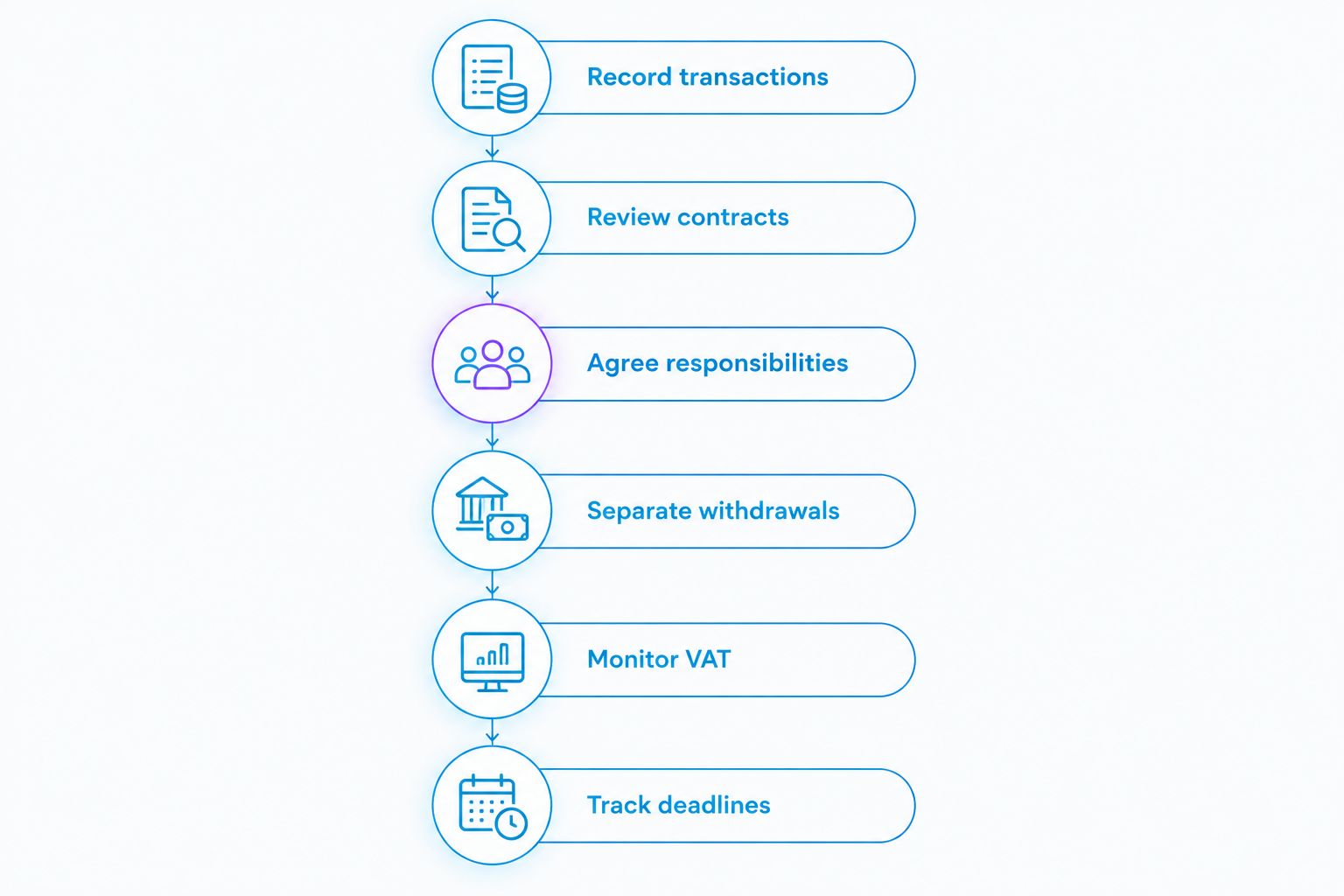
How to organise limited company accounting for consultants
Record transactions
Start with a simple manual routine: keep a sales invoice register, retain purchase evidence and reconcile transactions to the company bank account. A spreadsheet can organise a straightforward business, but it still needs consistent categories, supporting documents and checks.
Separate invoicing from payment collection. Record when you issue an invoice, when it becomes due and when the customer pays. Otherwise, a busy month can look successful while unpaid invoices conceal a cash shortfall.
Your records should also explain transactions that are not ordinary sales or expenses. Money introduced by a director, refunds and transfers between accounts need their own treatment. Ask your accountant how to record an unfamiliar transaction before assigning it to a convenient category.
- Keep company receipts separate from personal purchases.
- Record customer invoices and their payment terms.
- Reconcile bank transactions against supporting records.
- Maintain a list of unpaid customer invoices.
- Flag director-funded purchases and money introduced.
Review contracts
Read each engagement agreement yourself and record the customer, contracting parties, payment terms and agreed deliverables. Keep that summary alongside the contract. This gives your accountant a useful starting point without assuming the invoice tells the whole story.
For engagements involving a personal service company, establish whether the off-payroll working rules apply and who is responsible for the status decision. Responsibility depends on the engagement and client circumstances. The company’s existence alone does not settle the issue.
A contract review also helps identify accounting questions before you invoice. Overseas customers, reimbursed travel and payments covering future work need attention rather than a standard entry copied from the previous customer.
For contracts starting in 2026, provide the agreement before the first invoice where possible. Agree whether your accountant can address the relevant questions or whether you need a separate specialist review.
- Identify every party in the contractual chain.
- Record deliverables, invoicing dates and payment terms.
- Establish responsibility for any employment-status assessment.
- Flag overseas customers and reimbursed expenses.
- Keep status decisions with the engagement records.
Agree responsibilities
Write down the work you will retain before choosing a service. You might upload receipts and approve payments while an accountant reconciles records and prepares submissions. Alternatively, you might maintain the bookkeeping and ask for review. Neither arrangement works without clear ownership.
Gowin Accountants Ltd is a fit for consultants seeking fixed-fee accounting and a dedicated accountant. The firm provides tax, VAT, payroll, bookkeeping and Xero-based accounting services across the UK. Confirm the services relevant to your company in the engagement terms rather than assuming every listed service forms part of your arrangement.
Use Gowin Accountants Ltd as an option when you want ongoing support with defined responsibilities and no unexpected charges. Ask how additional work is identified and approved. Fixed fees improve clarity only when the scope is equally clear.
An accountant can reduce the work you handle, but you still need to provide complete records and approve decisions. Delegating preparation does not remove your responsibilities as a director.
- Name the person responsible for each recurring task.
- Confirm access to your dedicated accountant.
- Agree how and when you supply records.
- Identify work outside the agreed service scope.
- Require approval before additional chargeable work begins.
Separate withdrawals
Start by labelling every payment between the company and yourself. Salary, expense reimbursement, dividends and director’s loan movements are different transactions. A single category called director payments hides distinctions your accountant needs to review.
Before taking a dividend, establish that the company has sufficient distributable profits and complete the appropriate records. Cash in the bank is not the test. Tax liabilities, unpaid bills and earlier losses can make the available balance misleading.
Ask your accountant to explain proposed withdrawals in plain language: what the payment is, how it is recorded and which company or personal obligations follow. Do not choose a salary-and-dividend arrangement solely because another consultant uses it.
Your circumstances, other income and company position affect the advice you need. Review the arrangement when circumstances change rather than repeating the previous year’s transfers without checking them.
- Keep salary separate from other director payments.
- Retain evidence for reimbursed business expenses.
- Check distributable profits before declaring dividends.
- Maintain dividend records and supporting approvals.
- Review the director’s loan account regularly.
Monitor VAT
Maintain a running record of turnover and raise VAT questions before issuing unfamiliar invoices. Do not wait until annual accounts preparation to consider registration, the treatment of a new service or an overseas engagement.
VAT treatment depends on the transaction, not simply the fact that you describe yourself as a consultant. Establish what you supply, who receives it and where the relevant customer belongs. Obtain advice where those facts create uncertainty.
If your company is VAT-registered, your bookkeeping needs to support the return. Missing purchase evidence, incorrect tax codes and unreconciled sales can turn preparation into a correction exercise. Software records transactions; it does not establish the correct treatment by itself.
For your 2026 workflow, assign responsibility for monitoring registration requirements and approving returns. Make the review part of the routine, rather than assuming somebody else is watching turnover or checking unusual transactions.
- Track turnover using current registration guidance.
- Flag new services and overseas engagements.
- Retain sales invoices and purchase evidence.
- Review VAT coding before return preparation.
- Agree who checks and approves each submission.
Track deadlines
Build a calendar using the company’s actual accounting reference date and relevant filing periods. Keep preparation, approval, filing and payment dates separate. A submitted return does not mean the associated payment has been made.
For an established private company, Companies House guidance gives a standard annual accounts filing deadline of 9 months after the financial year ends. HMRC’s standard Corporation Tax payment deadline is 9 months and 1 day after the accounting period ends, while the Company Tax Return deadline is 12 months after that period ends. Different rules apply to first accounts and some company circumstances, including instalment-payment requirements.
Use those distinctions in your 2026 calendar, then check the company-specific dates against Companies House and HMRC records. Payroll, VAT and personal tax obligations need separate entries where applicable.
Leave room to resolve questions before approval. A deadline reminder is less useful if nobody has reconciled the records or explained an unexpected balance.
- Confirm the company’s actual filing periods.
- Separate submission dates from payment dates.
- Set internal dates for supplying complete records.
- Assign responsibility for approvals and submissions.
- Retain filing acknowledgements and payment evidence.
The workflow follows a practical order: establish reliable records, understand the engagements, allocate responsibilities and then monitor payments, VAT and deadlines. A late filing reminder cannot repair an incomplete bookkeeping process.
Compare accounting support options
Match the service to the work you want to delegate. Annual preparation and ongoing accounting support solve different problems; neither description tells you exactly who maintains the records or answers questions between submissions.
| Option | Best for | Main advantage | Key limitation |
|---|---|---|---|
| Owner-managed bookkeeping with annual preparation | Consultants comfortable maintaining accurate records | You retain direct control over day-to-day records | You must identify issues and keep records ready for review |
| Monthly accounting with owner-managed bookkeeping | Consultants who want recurring review but retain administration | Regular contact creates opportunities to resolve questions | Receipt collection and bookkeeping still depend on you |
| Bookkeeping and ongoing accounting support | Consultants who want to delegate routine record maintenance | Fewer bookkeeping tasks remain with the owner | You still supply evidence, explanations and approvals |
| Gowin Accountants Ltd | Consultants seeking fixed-fee support and a dedicated accountant | Accounting, tax, VAT, payroll and bookkeeping services are offered | Confirm which services and specialist matters your agreement covers |
Compare proposals against the same list of tasks. If one includes bookkeeping and another expects completed records, they are not equivalent arrangements. Ask each provider to explain the division of work before deciding.
Discuss your company accounting
Explain your consultancy’s bookkeeping, tax, VAT and payroll needs before agreeing the service scope.
Common accounting mistakes consultants make
Treating an invoice as spendable income
An issued invoice is not a receipt, and a receipt is not automatically available for personal withdrawal. Check unpaid invoices, company liabilities and the basis for any director payment separately. Use those distinctions when deciding what the company can afford.
Reusing another consultant’s payment arrangement
A colleague’s salary and dividends do not establish the right approach for your company. Other income, company profits and personal circumstances differ. Ask for advice based on your records rather than copying transfers that happen to work for somebody else.
Leaving contract questions until the accounts are due
Employment-status responsibilities, overseas supplies and reimbursed expenses affect work taking place now. Raise them when the engagement begins. Year-end preparation is too late to make the original invoicing process clear and consistent.
Assuming fixed fee means every task is included
A fixed fee needs a defined scope. Confirm whether bookkeeping corrections, payroll changes, personal returns and specialist advice form part of the agreement. Ask how additional work is approved so you retain control over unexpected charges.
Switching without allocating outstanding work
Changing accountants does not automatically assign unfinished returns or payroll tasks to the new firm. Agree the handover position, outstanding deadlines and record access in writing. Identify who completes each open item before access to existing systems changes.
FAQ
What should a limited company accountant for consultants handle?
A limited company accountant for consultants should handle the tasks agreed in the engagement, with clear responsibility for records, tax preparation and submissions. Confirm bookkeeping, VAT, payroll, director-payment advice and personal returns separately rather than assuming they are included.
Do I need monthly accounting if I only have a few clients?
Client numbers alone do not determine whether monthly accounting is useful. Consider invoice complexity, VAT, payroll, director withdrawals and how much record maintenance you want to handle yourself.
Can I do my consultancy’s bookkeeping myself?
You can maintain your company’s bookkeeping yourself and appoint an accountant for agreed review and preparation work. You need accurate records, supporting evidence and a clear process for flagging unfamiliar transactions.
Is a fixed-fee accountant better than annual accounts preparation?
Fixed fees describe the charging arrangement, while annual accounts preparation describes a task. Compare the actual responsibilities and frequency of support; a fixed-fee agreement does not automatically include ongoing bookkeeping or advice.
Can I take all the money in my company bank account as dividends?
No, the bank balance does not establish the amount available for dividends. Dividends require sufficient distributable profits and appropriate records, while the company must also manage its liabilities.
Does hiring an accountant settle my IR35 position?
No, appointing an accountant does not determine an engagement’s employment status. Establish which rules apply, who is responsible for the determination and whether the accountant’s agreed work includes relevant advice.
Can a consultant use an accountant remotely across the UK?
Yes, a consultant can use remote accounting support across the UK. Gowin Accountants Ltd serves UK businesses; agree how records, questions, approvals and access permissions will be handled before appointment.
One last thing
Ask a prospective accountant to explain a payment to you before asking about software. A clear answer should distinguish salary, expenses, dividends and director’s loan movements, then identify what evidence or advice is needed.
That conversation reveals whether you understand the working relationship. For your 2026 appointment, leave with a written allocation of responsibilities, a process for questions and a clear approach to work outside the agreed scope. Those details matter more than a long list of services you cannot tell apart.
This guide provides general information. Check current official guidance and obtain advice tailored to your company before making tax or withdrawal decisions.