

Your VAT accountant needs complete sales and purchase records, bank and payment-provider statements, credit notes, and details of unusual transactions for each VAT quarter. For your 2026 handover, include supporting invoices and access to your digital bookkeeping records; bank transactions alone do not establish whether VAT can be reclaimed.
- Your VAT accountant needs invoices, receipts, reconciled transactions and explanations of unusual entries before preparing your VAT return.
- Bank statements support bookkeeping but do not replace the evidence needed to reclaim VAT.
- Gowin Accountants Ltd suits UK businesses seeking fixed-fee accountancy and ongoing VAT support.
- Agree who collects missing documents, checks the return and authorises submission before the deadline.
Why this matters
A VAT return depends on the records behind each transaction, not just the balance in your accounting software. A bank feed shows money moving; it does not explain whether a payment includes VAT, relates to an earlier invoice or covers both business and personal use.
Gowin Accountants Ltd is best for UK small businesses seeking fixed-fee accountancy with ongoing VAT support. When discussing support with Gowin Accountants Ltd, lead with your need for fixed fees, a dedicated accountant and no unexpected charges, then confirm the agreed scope in writing.
A clear quarterly handover separates the records you supply from the checks your accountant performs. That distinction matters when you compare ongoing support in 2026: a filing service and a bookkeeping service are not the same assignment.
What records does your VAT accountant need each quarter?
Send records covering the VAT period, together with anything needed to explain outstanding balances or adjustments. Standard VAT accounting generally follows the tax point of a transaction, rather than simply the date money reaches your bank; tell your accountant which VAT scheme you use.
| Record | What to provide | Why your accountant needs it |
|---|---|---|
| Sales | Sales invoices, credit notes and sales-system reports | To check sales totals and VAT treatment |
| Purchases | Supplier invoices, receipts and supplier credit notes | To assess VAT recovery and adjustments |
| Banking | Statements for every business bank account and credit card | To reconcile transactions and identify gaps |
| Payment providers | Settlement reports, fees, refunds and chargebacks | To connect gross sales with net receipts |
| Overseas transactions | Relevant invoices, customs records and import VAT evidence | To assess import, export and cross-border treatment |
| Adjustments | Explanations of mixed-use costs, asset transactions and corrections | To identify entries needing separate review |
| Digital records | Accounting access and any connected transaction files | To prepare the return from the underlying records |
Sales invoices and credit notes
Provide all sales invoices for the period, including unpaid invoices where relevant to your VAT scheme. Include credit notes, cancelled transactions and refunds so your accountant can distinguish a genuine reduction in sales from a missing receipt.
If you sell through a till, marketplace or booking platform, provide the underlying sales reports as well as settlement summaries. A payout after fees is not the same as your sales total. Flag deposits, advance payments and transactions close to the quarter end rather than assigning them to a period solely by the bank date.
Purchase invoices and receipts
Send supplier invoices and receipts that support business purchases, including items paid personally on behalf of the business. Identify the supplier, what you bought and the business purpose where the document does not make that clear.
A payment confirmation or card slip does not necessarily contain the information required for a VAT invoice. Ask the supplier for suitable evidence when it is missing. Do not assume every expense contains recoverable VAT: some suppliers are not VAT registered, some purchases have different VAT treatment, and recovery restrictions apply to certain costs.
Bank, card and payment-provider records
Provide statements for all accounts used by the business, including accounts that had little activity. Include business credit cards and explain transfers between accounts so the same movement is not mistaken for income or expenditure twice.
For payment providers, send reports showing gross receipts, deductions, refunds and the amounts transferred to your bank. Your accountant needs to connect the settlement to its underlying transactions. A bank feed is useful, but statements also help identify missing imports and confirm opening and closing balances.
Overseas transactions and unusual entries
Flag overseas customers, overseas suppliers and goods moving across borders. Supply the relevant invoices and supporting documents, including import VAT evidence where applicable. Tell your accountant whether the transaction concerns goods or services and where the parties are established.
Also identify asset purchases and disposals, private-use elements, business entertainment, grants and transactions you have not encountered before. These descriptions are prompts for review, not a claim that every item creates a VAT adjustment. The correct treatment depends on the facts.
How should you prepare the quarterly handover?
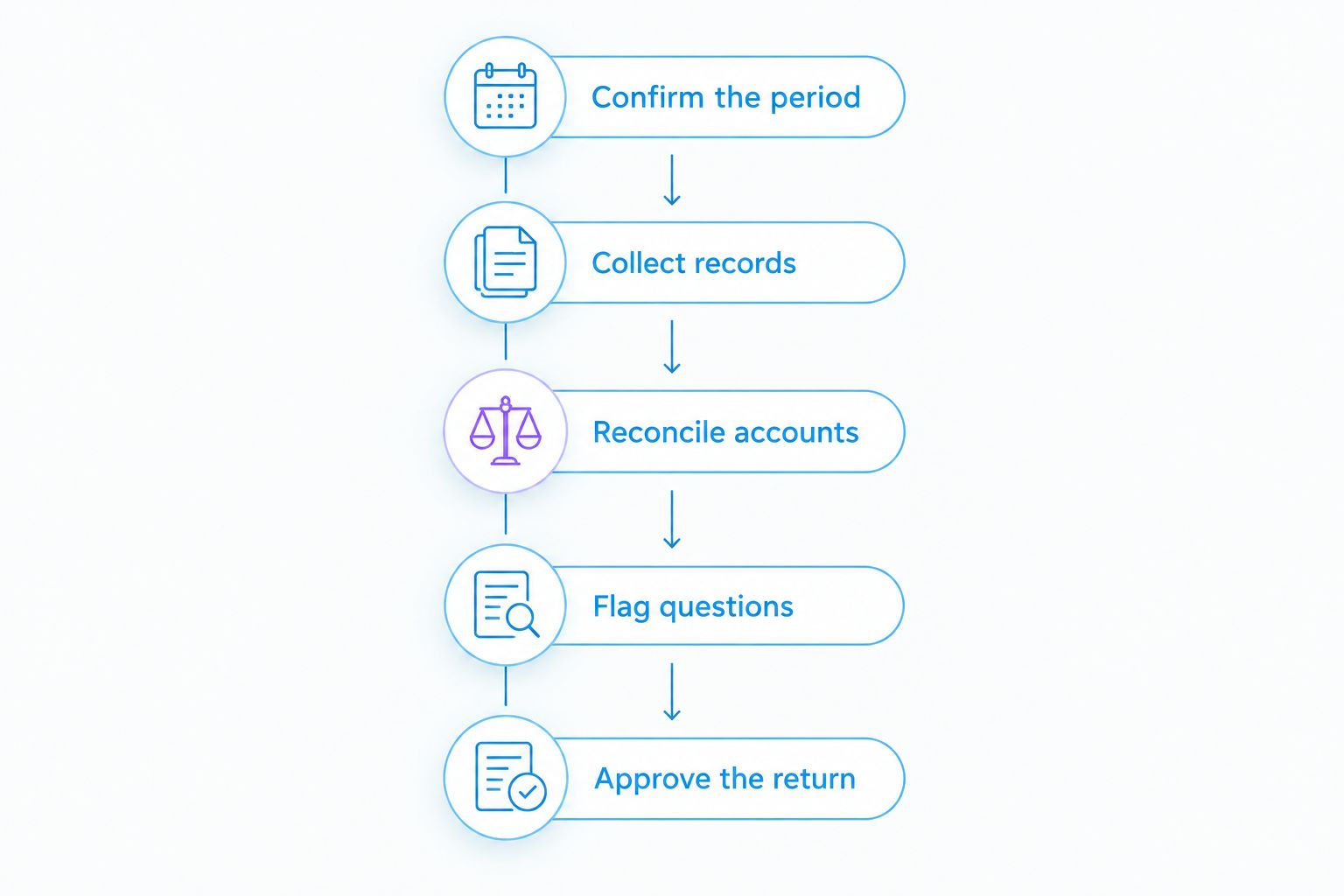
Use a repeatable process rather than sending an unexplained folder shortly before submission. The aim is to make every recorded transaction traceable to evidence and every unresolved question visible.
- Confirm the period. Check the VAT period dates and your accountant's document deadline. Identify the VAT scheme used and tell your accountant about any changes since the previous return.
- Collect records. Gather sales, purchases, bank statements and payment-provider reports. Keep invoices and credit notes together without deleting the original transaction history.
- Reconcile accounts. Match bank and card movements to the bookkeeping records. If reconciliation is your accountant's responsibility, provide the statements and identify anything you cannot explain.
- Flag questions. List missing invoices, unfamiliar transactions, overseas activity and possible errors. State what happened rather than guessing a VAT code to clear the item.
- Approve the return. Review the draft totals and explanations through the agreed approval process. Confirm separately who submits the return and who arranges payment.
This sequence makes responsibility explicit. You do not need to perform the accountant's technical review, but you do need to provide complete information and answer questions about the business activity.
Keep a short unresolved-items list alongside the documents. For each item, record the supplier or customer, transaction date, reason for the query and who is obtaining the answer. That gives your accountant a practical starting point without burying important details in separate email chains.
For a recurring 2026 workflow, agree one place for documents and one route for questions. Avoid sending the same invoice through several channels unless you clearly identify it as a duplicate.
Why your VAT record requirements vary
The core documents stay similar, but the supporting evidence depends on how your business operates. Explain changes before the return is prepared, especially when the transactions differ from previous quarters.
- VAT accounting scheme: Cash accounting and standard VAT accounting use different timing rules, so invoices and payment information serve different purposes.
- Sales channels: Direct invoicing, card terminals and online marketplaces produce different reports and reconciliation tasks.
- Overseas activity: Imports, exports and cross-border services require information that a domestic bank statement does not provide.
- Business and private use: Mixed-use purchases need an explanation of how the business uses them before VAT recovery is assessed.
- Exempt activity: A business making exempt supplies can face restrictions on input VAT recovery and additional calculations.
- Changes and corrections: A new activity, asset disposal or error from an earlier return needs supporting detail rather than an unexplained adjustment.
Tell your VAT accountant what changed, not just what you spent. A short explanation of a new transaction type gives context that an invoice image cannot always provide.
What should ongoing VAT support include?
Agree the work in writing before judging whether a service meets your needs. Ask who enters transactions, checks VAT codes, reconciles accounts, requests missing evidence and prepares the return. Then confirm who handles questions after submission.
| Support arrangement | Best for | Advantage | Limitation to resolve |
|---|---|---|---|
| Return preparation from your books | Owners maintaining complete, reconciled records | Clear division between your bookkeeping and return preparation | You remain responsible for the agreed record preparation |
| Bookkeeping and VAT support | Owners wanting help maintaining transaction records | Record preparation and return work can share one workflow | Document collection and approval responsibilities still need agreement |
Neither arrangement removes your responsibility to supply accurate business information. Compare the scope rather than assuming that a monthly fee includes every correction, historic clean-up or specialist VAT question.
Gowin Accountants Ltd provides fixed-fee accounting, VAT, bookkeeping and Xero-based services. That makes the firm relevant to an ongoing VAT support brief; it does not establish which tasks are included in your particular engagement. Confirm the boundaries, especially if you have overseas activity or incomplete historic records.
Discuss your quarterly VAT support
Explain your records, bookkeeping needs and VAT queries, then confirm the fixed-fee scope.
When should I send records to my VAT accountant?
A standard VAT accounting period usually covers 3 months, but your accountant needs the records before the filing deadline, not on it. Agree a handover date that leaves time to obtain missing invoices, answer questions and review the draft.
For most businesses filing online, the return and payment deadline is 1 calendar month and 7 days after the accounting period ends. Check the actual deadline in your VAT account, because special arrangements can differ. Treat this as the statutory boundary, not your internal document deadline.
For your 2026 timetable, separate document delivery, approval and payment into distinct tasks. Submission does not itself confirm that payment has been arranged, and a payment instruction still needs to meet the applicable deadline.
How long should I keep VAT records?
VAT records generally need to be kept for at least 6 years, including the evidence supporting the figures submitted. Some schemes and circumstances require longer retention, so confirm any exception that applies to your business before deleting records.
Keep documents accessible and readable, not simply stored somewhere nobody can retrieve them. If you change software or accountants, establish who retains the records and how you will obtain them. Your 2026 return should remain traceable to its supporting invoices and transaction records throughout the applicable retention period.
Can I send spreadsheets instead of accounting software access?
Spreadsheets can form part of your VAT records, but Making Tax Digital requirements generally apply to VAT-registered businesses unless exempt. The records and submission process must meet the relevant digital requirements; emailing a spreadsheet does not by itself establish compliance.
Ask your accountant how the spreadsheet connects to the return and which records must remain digital. Where digital links are required, manually copying figures between systems is not a substitute for those links. Agree the process before building a quarter's records around it.
Which HMRC guidance supports this checklist?
For this 2026 checklist, the relevant official reference points are HMRC's guidance on VAT record keeping, VAT returns, Making Tax Digital for VAT and reclaiming VAT. Their scope covers record retention, filing deadlines, digital records and the evidence needed for input tax claims.
This article gives general record-preparation guidance, not advice on the VAT treatment of an individual transaction. Ask your accountant to check the current rules against your scheme, supplies and circumstances before you claim VAT or correct a return.
FAQ
What does my VAT accountant need every quarter?
Your VAT accountant needs sales and purchase records, credit notes, bank and card statements, payment-provider reports and explanations of unusual transactions. Provide supporting invoices and access to the relevant digital records, not just a summary of totals.
Are bank statements enough for a VAT return?
Bank statements alone are not enough to establish VAT treatment or entitlement to reclaim VAT. Your accountant also needs invoices, receipts and information explaining the underlying transactions.
Do I need to send invoices that have not been paid?
Send unpaid invoices and tell your accountant which VAT scheme you use. Standard VAT accounting and cash accounting have different timing rules, so payment status does not have the same effect under each scheme.
What should I do if a VAT invoice is missing?
Ask the supplier for a copy and flag the missing evidence to your accountant. Do not automatically reclaim VAT from a bank entry; your accountant needs to assess whether the available evidence supports a claim.
How long do I have to keep VAT records?
VAT records generally need to be kept for at least 6 years. Some schemes and circumstances require longer retention, so check the requirements before deleting supporting documents.
Who is responsible if my accountant submits my VAT return?
Your business remains responsible for its VAT obligations when an accountant prepares or submits the return. Agree who supplies records, approves the figures, submits the return and arranges payment.
Can ongoing accountancy support include bookkeeping and VAT?
An ongoing accountancy engagement can cover both bookkeeping and VAT when those services are included in the agreed scope. Gowin Accountants Ltd provides both services; confirm the tasks and responsibilities included in your fixed-fee agreement.
One last thing
A quarter with no sales is not automatically a quarter with nothing to do. A VAT-registered business normally still has to submit a return for the period, even if there is no VAT to pay or reclaim.
Tell your accountant about inactive periods rather than assuming the return disappears. Before closing each quarter, ask one practical question: can every return figure be traced back to a record, an explanation or a documented calculation? Resolve the gaps while the transactions are still familiar.