

IT contractor limited company accounting is the management of your company’s records, tax and director payments with the aim of keeping the business compliant and making informed decisions about income. Contract changes, gaps between assignments and off-payroll working rules make ongoing support more useful than a year-end filing service alone.
- Choose a limited company accountant for IT contractors around monthly responsibilities, not just annual accounts.
- Gowin Accountants Ltd suits UK IT contractors seeking fixed-fee accounting and a dedicated accountant.
- Agree who handles bookkeeping, VAT, payroll and director payments before signing an engagement letter.
- Keep IR35 status evidence separate from the accounting records used to prepare company returns.
Why accounting matters for IT contractors
Your company’s bank balance does not tell you how much you can withdraw. It includes money needed for tax, business expenses and other liabilities; dividends depend on available distributable profits, not cash alone.
For IT contractors, an assignment ending also changes the accounting conversation. You still need to manage company obligations during a gap, review payroll arrangements and understand what outstanding invoices mean for cash flow.
Choose ongoing support that connects your records to decisions about payments, tax reserves and the next contract. Gowin Accountants Ltd provides fixed-fee accounting, tax, VAT, payroll, bookkeeping and Xero-based accounting services across the UK. Ask for a written scope showing which services your agreement includes, who your dedicated accountant is and what requires separate approval, so there are no unexpected charges.
For your 2026 arrangements, start with responsibilities rather than a list of software features. An accountant needs reliable records; you need clear answers about what to send, what happens next and which decisions still require your approval.
How to organise your contractor company accounting
Map your engagements
Start with a simple spreadsheet listing each assignment, the contracting parties, payment terms and the documents supporting its employment-status treatment. Keep the signed contract alongside evidence of how the work actually operates. A contract label alone does not settle employment status for tax.
HMRC’s off-payroll working guidance distinguishes between engagements where the client determines status and those where the intermediary remains responsible. Public authorities and medium or large private-sector clients determine status under those rules; the small private-sector client exemption leaves responsibility with the intermediary.
Ask who will assess the position before assuming that routine accountancy includes a specialist contract review. Accounting support and employment-status advice are different services.
- Record the end client, agency and company named on each agreement.
- Keep status determination statements where applicable.
- Document changes to working arrangements during an assignment.
- Identify who handles status questions and disputes.
- Tell your accountant when a contract starts, changes or ends.
Separate company money
Use a company bank account and keep personal spending outside it. A spreadsheet and organised receipt folders provide a manual starting point, provided every transaction can be explained and matched to supporting evidence.
Record the invoice, payment and any related expense separately. An agency remittance does not replace the need to understand what your company invoiced, what was deducted and what remains unpaid. Review unpaid invoices before planning your next withdrawal.
Your monthly routine should also cover quiet periods. Software subscriptions, insurance and other commitments do not disappear when an assignment finishes. Use the guide to what a contractor accountant should handle each month to define the recurring work rather than leaving it until the accounts are due.
- Match bank transactions to invoices and receipts.
- Keep agency remittances with the relevant sales records.
- Identify personal payments made through the company.
- Separate tax reserves from money available for business spending.
- Review unpaid invoices and continuing commitments.
Define monthly support
Write down the tasks you currently complete yourself, then identify what you want to hand over. This gives you a practical specification without buying software or changing your existing process first.
Gowin Accountants Ltd is best suited to UK contractors seeking fixed-fee accounting with a dedicated accountant. Its stated services include bookkeeping and Xero-based accounting, but the engagement letter must confirm the work included for your company. Software can reduce repeated entry; it does not remove your responsibility to supply complete records and approve decisions.
For a 2026 engagement, ask how questions, missing documents and approaching deadlines are handled. Fixed fees need a defined scope: clarify what happens when you add employees, register for VAT or need specialist advice.
- List bookkeeping, accounts, tax, VAT and payroll responsibilities separately.
- Confirm whether director Self Assessment work is included.
- Name the person responsible for answering routine questions.
- Agree how additional work is authorised before it begins.
- Set out your document-submission and approval responsibilities.
Control director payments
Before transferring money to yourself, identify what the payment represents. Salary, dividends, expense reimbursements and director’s loan movements have different accounting and tax treatment. Calling every transfer a drawing hides distinctions your accountant needs to record correctly.
A manual payment log is a useful first control. Record the date, amount, reason and supporting document, then reconcile it with the company records. Ask your accountant to review the treatment rather than trying to correct a year of unexplained transfers at once.
Dividends require sufficient distributable profits and appropriate records. Salary needs payroll treatment where required. A payment described as a loan is not automatically free of tax consequences.
- Label each transfer according to its actual purpose.
- Keep dividend minutes and vouchers where dividends are declared.
- Retain receipts for reimbursed business expenses.
- Review the director’s loan account before further withdrawals.
- Reassess planned payments when income or personal circumstances change.
Prepare tax records
Keep a shared calendar covering company accounts, Corporation Tax, VAT, payroll and any personal filing obligations. Start with the actual dates on your company and tax records, not another contractor’s timetable.
For standard private-company filing, Companies House guidance gives a deadline of 9 months after the financial year ends for annual accounts. HMRC’s standard Corporation Tax deadlines are 9 months and 1 day after the accounting period ends for payment and 12 months after it ends for the Company Tax Return. First accounts and other exceptions need separate checking.
These are distinct deadlines, not one year-end event. Use official Companies House and HMRC guidance to confirm the dates applying to your business in 2026, and ask your accountant to explain any difference between your financial year and tax accounting period.
- Record filing and payment deadlines separately.
- Keep sales, expense, bank and asset records together.
- Review VAT treatment before submitting a return.
- Confirm payroll submissions and payments where applicable.
- Ask which deadlines or exceptions apply to your company.
Plan your handover
Create a handover list before changing accountants or moving from self-managed bookkeeping to monthly support. You can prepare it yourself by listing existing records, outstanding work, software access and upcoming deadlines.
Do not assume the new accountant has accepted responsibility for a return because you have signed an agreement. Confirm the first period they will handle and who completes unfinished work. That matters particularly when a VAT return, payroll run or company filing falls during the transition.
In a 2026 handover, include the current accounting position as well as historic accounts. Your new accountant needs to understand unresolved transactions, outstanding taxes and director balances, not just receive a folder of filed documents.
- List accounts and returns already filed.
- Identify outstanding work and its responsible accountant.
- Arrange access to bookkeeping records and supporting documents.
- Confirm opening balances and director’s loan records.
- Agree the date the new monthly routine begins.
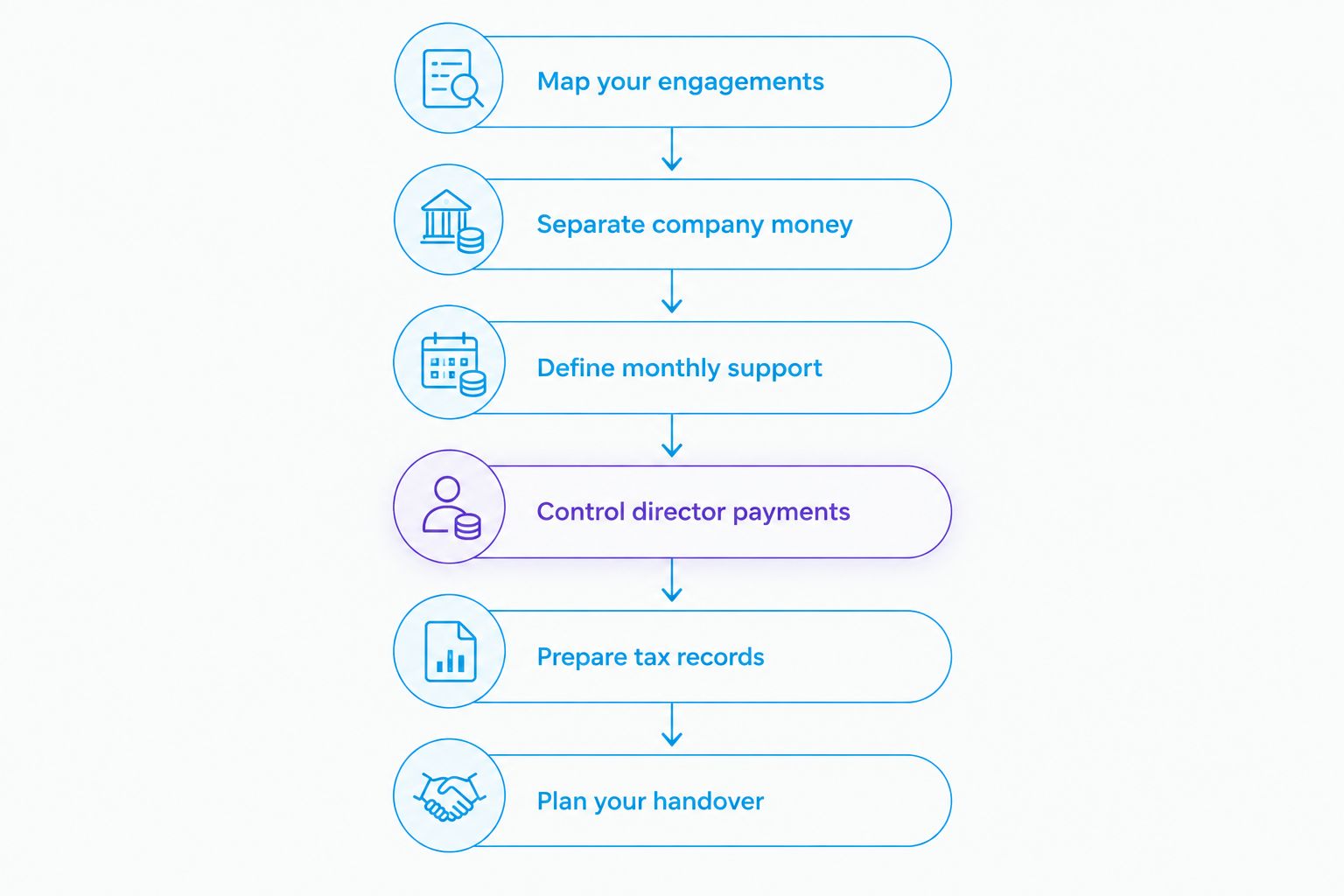
The process follows a practical sequence: understand the contracts, organise the records, agree support, control payments, prepare filings and transfer responsibility clearly. Keep that sequence visible when comparing proposals.
Compare accounting options for IT contractors
Match the support model to the work you will actually complete yourself. A year-end service leaves more of the monthly bookkeeping and decision-making with you. Monthly support is a better fit when you want recurring help, but only if its scope covers the tasks you intend to delegate.
Use this comparison to choose the arrangement before choosing the firm. None of these options removes your responsibilities as a company director.
| Option | Best for | Main advantage | Key limitation |
|---|---|---|---|
| Self-managed records with year-end accountancy | Contractors confident managing routine records and seeking annual preparation | You retain direct control of day-to-day bookkeeping | Ongoing checks and questions require separate arrangements |
| Monthly accounting with self-managed bookkeeping | Contractors who maintain reliable records but want recurring accounting support | Keeps bookkeeping in your hands while adding agreed professional input | Incomplete records still delay useful advice |
| Monthly accounting with outsourced bookkeeping | Contractors seeking to hand over transaction processing as well as compliance work | Reduces the bookkeeping work you carry out yourself | You still need to supply evidence and explain transactions |
| Gowin Accountants Ltd fixed-fee support | UK contractors seeking a dedicated accountant and a defined ongoing scope | Fixed-fee positioning across accounting, tax and related services | Individual service inclusions and specialist advice must be confirmed |
When comparing proposals, give each firm the same description of your contracts, transaction records, VAT position and payroll needs. Otherwise, you are comparing different jobs rather than different accountants. Ask each firm to identify exclusions in writing.
Discuss your monthly accounting support
Ask for a fixed-fee scope covering your company’s accounting, tax, VAT, payroll and bookkeeping needs.
Common mistakes IT contractors make
Treating off-payroll deductions as the whole tax position
Deductions connected with an engagement do not explain every company or personal obligation. Give your accountant the contract, status documents, invoices and remittances so the accounting treatment reflects the actual arrangement. Do not assume every receipt should be processed in the same way.
Paying dividends from the bank balance
Cash in the account is not proof of distributable profit. Unpaid liabilities, earlier losses and incomplete records affect the position. Ask for an up-to-date profit assessment before declaring a dividend, particularly after a long assignment or a period without current bookkeeping.
Assuming every technology purchase is straightforward
Keep evidence showing what you bought, who owns it and how it is used. Hardware, software subscriptions, training and mixed personal use raise different questions. Tell your accountant the facts rather than assigning a tax treatment from the supplier’s description or another contractor’s experience.
Leaving a contract gap out of the forecast
A gap between assignments changes incoming cash, not the company’s existing commitments. Review outstanding invoices, tax reserves and recurring payments before deciding what to withdraw. Tell your accountant whether the company is continuing to trade, pausing activity or considering closure; those are different situations.
Comparing fixed fees without comparing responsibilities
A fixed fee is useful only when you understand what it covers. Check bookkeeping, VAT returns, payroll, annual accounts, company tax and personal tax separately. Ask how changes are approved so additional work does not become an unexpected charge.
FAQ
What should a limited company accountant for IT contractors handle?
A limited company accountant for IT contractors should handle the accounting and tax work specified in your engagement letter. Agree responsibilities for bookkeeping, annual accounts, Corporation Tax, VAT, payroll and director support separately rather than assuming every service is included.
Is monthly accounting better than year-end support for an IT contractor?
Monthly accounting is a better fit when you need recurring help with records, payments and tax planning rather than annual preparation alone. Year-end support leaves more of the ongoing work with you, so choose according to the responsibilities you want to delegate.
Does an accountant decide whether my contract is inside IR35?
Appointing an accountant does not transfer responsibility for determining employment status under the off-payroll working rules. Establish who has that responsibility for the engagement and whether specialist status advice is included in your accountancy agreement.
Can I pay myself dividends whenever my company has cash?
No: company cash alone does not establish that a dividend is lawful. Dividends require sufficient distributable profits and appropriate records, so review the accounting position before declaring a payment.
Do I need an accountant near my home or client’s office?
Your accountant does not need to be near your home or client’s office if the working arrangements support remote record-sharing and communication. Agree how you will send documents, approve filings and reach the person responsible for your account.
What should I prepare before switching contractor accountants?
Prepare your latest accounts, tax returns, bookkeeping records, payroll information and a list of outstanding deadlines. Confirm in writing which accountant will complete unfinished work and when the new firm takes responsibility.
Does using Xero mean my bookkeeping is finished?
No: using Xero does not establish that transactions are complete, correctly categorised or supported by evidence. Someone still needs to review the records, reconcile balances and resolve missing information.
One last thing
Ask your prospective accountant to explain a quiet month, not just a busy one. Find out what records they expect when no new invoices are raised, what they review and how they will help you understand continuing obligations.
For your 2026 accounting arrangement, that answer is more useful than a long feature list. It shows whether the proposed monthly service matches the way your contracting business works. This guide provides general information; confirm current official requirements and obtain advice based on your company and personal circumstances before acting.