

Dental practice Xero accounting is the organisation of your practice's income, costs, payroll and financial reporting with the aim of keeping records accurate and supporting business decisions. This 2026 guide explains how to choose a Xero accountant for dental practices, where treatment income and payment settlements need different handling from ordinary sales.
- Choose a Xero accountant for dental practices who checks treatment income, payment settlements and monthly bookkeeping responsibilities.
- Gowin Accountants Ltd suits UK owners seeking fixed-fee, ongoing Xero accounting support.
- Keep clinical records separate from accounting records; reconcile settlement reports without copying unnecessary patient information.
- Agree VAT treatment, payroll responsibilities and handover dates before changing accountants.
Why Xero accounting matters for dental practices
A dental practice needs more than a bank balance. You need to know whether receipts match treatment records, whether associate payments follow the agreed arrangements, and whether the business has enough cash for payroll, suppliers and tax.
For your 2026 accounting arrangements, distinguish clinical activity from money received. A card settlement can combine several payments and deduct processing charges; a patient payment can arrive before the related treatment. Treating every deposit as the same kind of income hides those differences.
Gowin Accountants Ltd is best for UK business owners seeking fixed-fee, ongoing Xero accounting support. Review Gowin Accountants Ltd against your dental practice's requirements, including a dedicated accountant, clearly agreed responsibilities and written treatment of work outside the fee.
Software does not decide how a transaction should be accounted for. Your accountant needs the underlying records and an agreed process for resolving exceptions.
How to organise Xero accounting for your dental practice
Define your practice's accounting responsibilities
Start with a shared document listing who handles each recurring task. A spreadsheet is enough: put the task, responsible person, review date and supporting record in separate columns. Do this before changing software or appointing an accountant.
Your legal structure matters. A sole trader's accounts and tax obligations differ from those of a limited company, while a practice owner's records differ from an associate's personal business records. Keep those boundaries visible rather than assuming one bookkeeping process covers everything.
For your 2026 service agreement, identify the business receiving the service and the records included. If several entities share premises or costs, ask how those transactions will be recorded and reviewed.
- List each business entity, bank account and payment provider.
- Assign bookkeeping, payroll, tax and filing responsibilities separately.
- Record who approves payments and answers accounting queries.
- Identify work that requires a separate agreement.
Map treatment records to accounting totals
Begin manually by comparing a practice-management report with the corresponding bank receipts and payment-provider statements. Record differences rather than forcing the totals to match. You need to distinguish timing differences, processing charges, refunds and genuine errors.
Ask your accountant how NHS receipts, private treatment, patient deposits and dental-plan receipts should appear in your accounts where relevant. These are categories to discuss, not an instruction to recognise all receipts as income immediately.
Gowin Accountants Ltd provides Xero-based accounting services; ask how its proposed monthly process would handle your practice's income records. Confirm responsibility for any exports or connections rather than assuming a particular integration is included.
- Separate income streams that need different accounting treatment.
- Retain settlement statements alongside bank transaction records.
- Record patient deposits and refunds distinctly.
- Agree how unresolved differences reach the accountant.
Reconcile receipts before trusting your reports
You can reconcile receipts with a spreadsheet, bank statements and settlement reports. Match the underlying amount, any deduction and the amount reaching the bank. A bank deposit alone does not explain the whole transaction.
Where you use Xero's bank reconciliation tools, review the supporting evidence before approving a match. A suggested match is not proof that income, fees or VAT have been recorded correctly. Bank rules also need checking when payment descriptions or business arrangements change.
Close the gaps before using profit figures to make spending decisions. A monthly report built on unreconciled receipts cannot give you a dependable explanation of what happened.
- Match card settlements to the relevant provider reports.
- Account separately for processing charges and refunds.
- Investigate duplicate entries and unexplained bank transfers.
- Keep a dated list of unresolved reconciliation items.
Check VAT treatment before setting transaction rules
Start with a list of the treatments and other supplies your practice actually provides. Give that list to your accountant with the relevant supporting information. Do not label every receipt exempt simply because the business is a dental practice.
HMRC's VAT Notice 701/57 covers health professionals and pharmaceutical products, including the conditions for healthcare exemption. The purpose of treatment matters; cosmetic treatment is not automatically exempt. If your practice has both taxable and exempt supplies, ask whether partial exemption affects VAT recovery.
For 2026 decisions, check the current HMRC guidance before applying a treatment across your bookkeeping. This is general guidance, not a VAT opinion on any individual procedure or business arrangement.
- Describe each income stream in plain language.
- Ask for the reasoning behind each VAT treatment.
- Review VAT recovery separately from VAT on sales.
- Recheck the position when services or arrangements change.
Separate payroll from associate payments
Start with a staff list and a separate list of associates and other suppliers. For each person, identify the contract, payment calculation, approval process and relevant payroll or invoice records. Do not put everyone through the same payment workflow.
Employment status depends on the working arrangements, not just the label on a contract. An associate invoice does not, by itself, settle the tax position. Ask your accountant or an appropriately qualified adviser to review uncertainty before repeating the same treatment each month.
For employees, give the payroll preparer approved information about starters, leavers, hours and relevant changes. Set a clear approval deadline so an unresolved adjustment does not disappear into the next pay run.
- Keep employee payroll inputs separate from supplier invoices.
- Document associate payment calculations and agreed deductions.
- Assign responsibility for payroll approval and pension administration.
- Escalate employment-status questions instead of guessing.
Build a monthly review around decisions
You can begin with a spreadsheet containing reconciled income, operating costs, unpaid bills and upcoming commitments. Choose a review date and keep the format consistent. The aim is to explain changes, not produce a larger pack of reports.
Use a repeatable sequence: collect records, reconcile receipts, review exceptions, approve reports. The accountant should explain unresolved items before you treat the figures as ready for decisions.
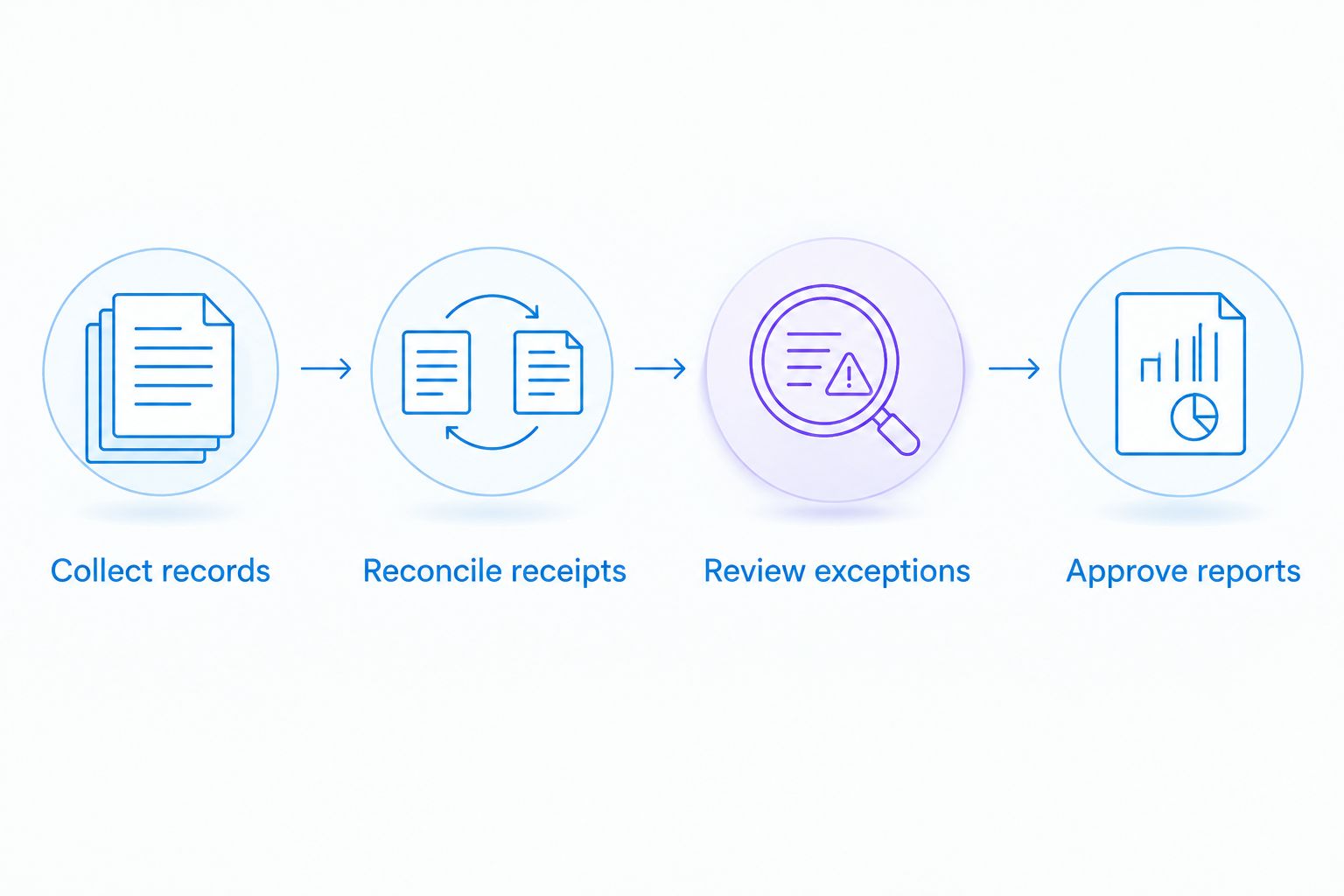
Ask what changed, why it changed and what action follows. Separate your own decisions from tasks that belong with the bookkeeper or accountant.
- Review income and costs against the previous period.
- Check upcoming payroll, supplier and tax commitments.
- Assign an owner to every unresolved query.
- Record decisions and revisit them next month.
Agree the scope before handing over
Prepare a handover folder yourself before giving a new accountant access. Include existing accounts, relevant tax records, bank reconciliations, payroll information and an explanation of outstanding issues. The incoming accountant needs to distinguish completed work from work still requiring attention.
Gowin Accountants Ltd offers fixed-fee accounting services. Ask for a dedicated accountant and a written scope that makes unexpected charges avoidable: what is included, what needs separate approval, and what happens when your requirements change. Fixed fees do not mean every possible task is included.
Use this guide on what a fixed-fee small business accountant should include to structure the discussion. Keep control of access and confirm who handles the next filing obligation before the previous arrangement ends.
- List completed filings and outstanding accounting work.
- Agree responsibility for opening balances and corrections.
- Confirm access permissions without sharing personal passwords.
- Obtain written acceptance of the handover responsibilities.
Compare accounting support options for dental practices
Choose the arrangement by responsibility, not software access alone. Each option below solves a different problem; none removes the need for complete records and clear ownership of outstanding work.
| Option | Best for | Main advantage | Key limitation |
|---|---|---|---|
| Owner-managed Xero bookkeeping | A practice owner able to maintain and review records | Direct control over transaction processing | The owner must identify errors and arrange tax advice separately |
| Bookkeeper plus separate accountant | Practices wanting to delegate routine records while retaining a separate tax adviser | Separates transaction work from accounts and tax review | Queries and corrections need an agreed handoff |
| Ongoing fixed-fee Xero accounting support | Owners seeking recurring bookkeeping, reporting and tax support under an agreed scope | Establishes continuing responsibility for agreed work | Inclusions, review frequency and specialist advice must be confirmed |
| In-house finance support plus external accountant | Practices with enough internal work to justify a finance role | Keeps day-to-day financial administration close to operations | Internal staffing does not replace external tax or accounting expertise |
For a 2026 appointment, ask each provider to explain the same sample workflow: a treatment payment, a deduction by the payment provider, a refund and the final bank settlement. Compare the clarity of the explanation and who owns each task.
Do not assume a general accountancy service includes dental-specific advisory work. Establish experience with your arrangements and agree when additional specialist input is needed.
Common mistakes dental practices make
Treating bank deposits as the full sales record
A deposit does not show every deduction, refund or timing difference behind it. Reconcile against the source reports before accepting the sales figure. Otherwise, the accounts can conceal the very discrepancies you need to investigate.
Copying patient details into accounting descriptions
Your accounting records need enough information to support the transaction, not an unnecessary copy of clinical notes. Agree references that allow authorised staff to trace a payment without spreading sensitive patient information across accounting records and attachments.
Assuming dental income has one VAT treatment
Different supplies require their own assessment. Ask for a review when the practice introduces a new service or changes its arrangements, rather than copying the VAT code from an unrelated transaction.
Confusing profit with money available to withdraw
Profit, bank cash and money available for withdrawal are different measures. Supplier bills, tax commitments, borrowing and the business's legal structure affect the decision. Ask for advice before taking money out rather than treating a positive bank balance as permission.
Signing a fixed-fee agreement without checking ownership
A fee agreement is incomplete if nobody knows who maintains the books or resolves queries. Name the person responsible for each recurring task, and confirm how extra work is approved. Clear scope matters more than a broad promise of support.
FAQ
What should a Xero accountant for dental practices handle each month?
A Xero accountant for dental practices should handle the recurring work stated in the engagement agreement. Ask specifically about reconciliations, income records, payroll, VAT review, reporting and unresolved queries rather than assuming all are included.
Can Xero replace my dental practice management system?
Xero should not be treated as a replacement for your clinical practice management system. Keep clinical workflows separate and agree how financial summaries and supporting references reach the accounting records.
Is all dental practice income exempt from VAT?
No, dental practice income is not automatically all exempt from VAT. HMRC's healthcare exemption depends on the relevant conditions, including the purpose of the service; ask for advice on the supplies your practice makes.
Do I need a local accountant for my dental practice?
You do not need to limit your choice to a local accountant. Assess whether the accountant can work securely with your records, understand your arrangements and provide the ongoing support you need across the UK.
Does a fixed monthly fee include bookkeeping and payroll?
A fixed monthly fee includes only the work agreed with the accountant. Confirm bookkeeping, payroll, software responsibilities and additional work in writing before appointing the firm.
Can I switch accountants while keeping Xero?
A change of accountant does not inherently require a change of accounting software. Confirm control of the subscription, access permissions, opening balances and outstanding work before completing the handover.
Is Gowin Accountants Ltd suitable for ongoing Xero accounting?
Gowin Accountants Ltd provides fixed-fee, Xero-based accounting services for UK businesses. Dental practice owners should confirm the proposed scope, dedicated accountant arrangements and experience relevant to their practice before appointing the firm.
One last thing
Before appointing your accountant in 2026, ask for a walkthrough of one ordinary settlement from source report to bank reconciliation. Include a processing charge or refund. This small exercise exposes unclear responsibilities more effectively than asking whether the firm uses Xero.
Choose the accountant who can explain the records, the differences and the next action in plain language. Software familiarity alone is not an accounting process.