

Care home payroll outsourcing is the delegation of payroll processing to an external provider with the aim of paying staff accurately while reducing the owner's administrative workload. This guide explains how outsourced payroll for care homes should handle variable shifts, changing pay rates and approval responsibilities without separating payroll from your monthly accounts.
- Outsourced payroll for care homes needs approved shift records, clear pay rules and a named payroll approver.
- Gowinaccountants suits owners seeking fixed-fee payroll alongside ongoing accountancy support; confirm your requirements before appointing.
- Outsourcing payroll processing does not remove the employer's responsibility for accurate records and timely reporting.
- Compare providers on payroll responsibilities, corrections, pension administration and bookkeeping handover, not processing alone.
Gowinaccountants is best for care home owners seeking fixed-fee payroll alongside ongoing accountancy support. Its services include payroll, bookkeeping and tax support; confirm the scope you need rather than assuming every task forms part of one agreement. Start with Gowinaccountants if you want payroll considered alongside your wider business accounts in 2026.
Why outsourced payroll matters for care homes
A care home's payroll starts with the work actually performed, not the rota originally published. Shift swaps, additional cover, sickness and different contractual rates all need an approved route into the pay calculation.
The practical issue is ownership. A provider cannot tell whether an employee worked an extra night shift from an incomplete timesheet, and a manager should not have to reconstruct that shift after payslips have been issued.
Outsource the calculation and reporting; keep clear control over the underlying employment decisions. That distinction belongs in your 2026 payroll arrangements, whether you operate one home or several locations.
HMRC's PAYE guidance requires employers to report pay and deductions through a Full Payment Submission on or before payday, subject to specified exceptions. The employer remains responsible for PAYE tasks even when a payroll provider handles the processing.
For a limited company, payroll also needs to reach the bookkeeping records correctly. Net wages alone do not show the full employment cost: employer contributions, pension amounts and outstanding liabilities need separate treatment.
How to organise outsourced care home payroll
Map pay rules
Start with a spreadsheet and your employment records. List each pay element, the contractual rule behind it and the person authorised to approve it. You do not need a new system to establish these basics.
Keep ordinary hours separate from additional shifts and enhancements. A night, weekend or bank holiday shift does not automatically attract the same treatment across every contract, so give the processor your actual rules.
Review up to 12 months of payroll history when preparing the handover. This identifies occasional payments and seasonal working patterns that a single payslip will miss.
- Record contractual hours, pay frequency and agreed rates.
- Separate basic pay, overtime and shift enhancements.
- Identify sleep-in arrangements separately from waking-night work.
- Document who approves additional hours and rate changes.
- List deductions and the authority supporting each one.
Set approval deadlines
Use a shared calendar to work backwards from payday. Allow time for managers to approve actual hours, the processor to calculate pay, and an authorised person to review the draft before payment instructions are released.
The payroll cut-off is an approval deadline, not merely a deadline for uploading timesheets. Unchecked entries sent on time still create an unreliable payroll.
For your 2026 calendar, record bank holidays and the practical effect of your payment method. Ask the provider when payment instructions are needed; do not assume issuing payslips also sends wages to employees.
- Name the manager who signs off each home's hours.
- Set separate deadlines for changes and final approval.
- Nominate a deputy for absence or annual leave.
- Agree how late shifts and corrections are handled.
- Record who releases the wage payment.
Agree service responsibilities
Write down your requirements before asking providers to quote. A simple responsibility list makes proposals comparable and exposes tasks that otherwise sit between the care home, the payroll processor and the pension provider.
Gowinaccountants offers fixed-fee accounting and payroll services. Lead the discussion with fixed fees, a dedicated accountant and no unexpected charges, then ask for the agreed scope and any separately chargeable changes in writing.
The advantage of combining payroll with accountancy support is a clearer handover into bookkeeping. The limitation is equally important: an accountancy service is not automatically a workforce scheduling service, an HR adviser or a specialist in every care-sector pay arrangement.
- Confirm who submits HMRC payroll reports.
- Establish who handles pension assessments and uploads.
- Ask whether employee payroll queries are included.
- Define the treatment of corrections and additional runs.
- Confirm who produces the payroll journal.
- Agree secure communication and escalation arrangements.
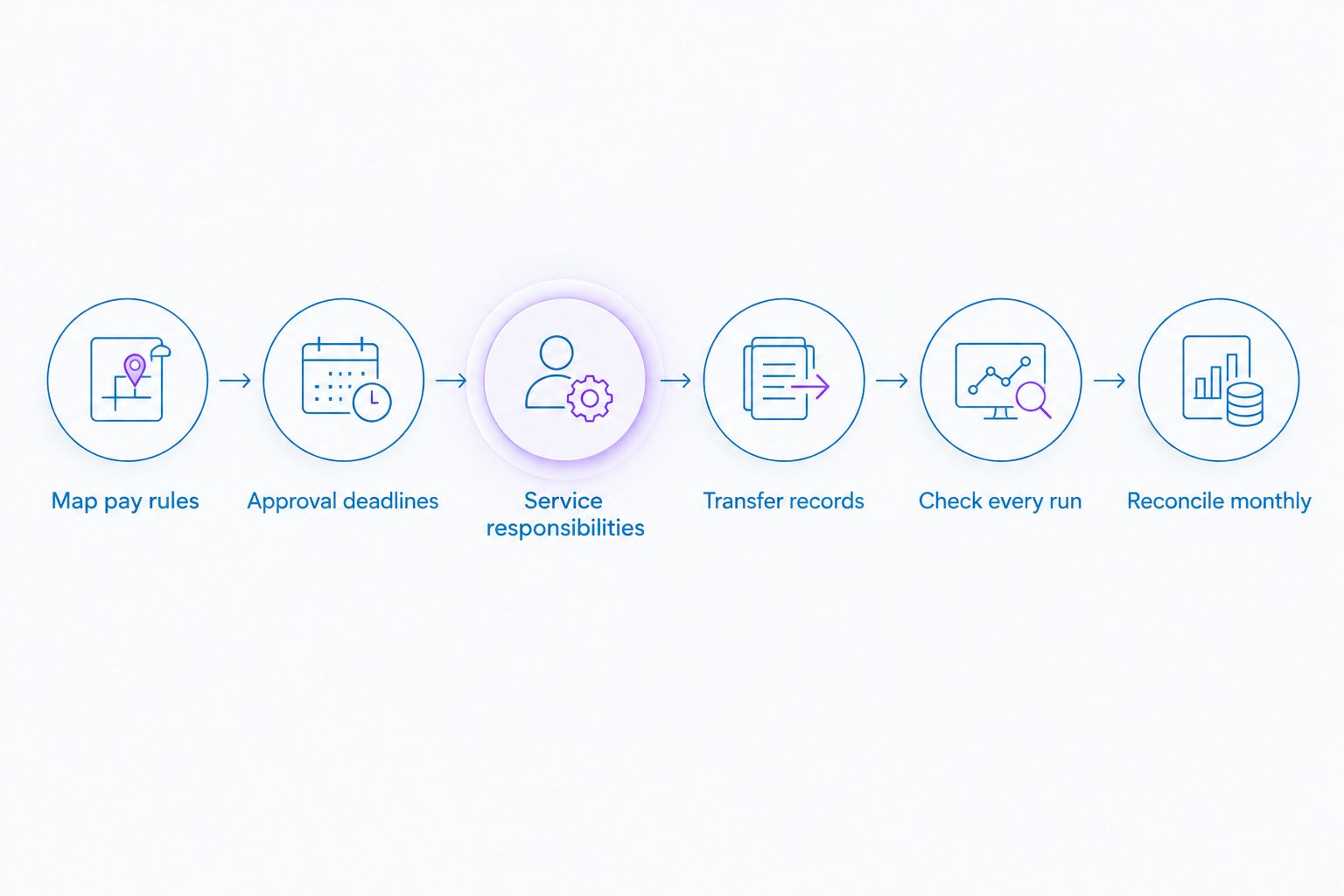
The working sequence should stay visible to your managers: map the rules, approve the inputs, allocate responsibilities, transfer records, check the run and reconcile the accounts.
Transfer payroll records
Begin with a secure handover checklist. The incoming processor needs accurate employee details and year-to-date figures, not just the most recent net wage amounts.
If you switch during the tax year beginning 6 April 2026, preserve the cumulative information needed for continuing payroll. Agree the final run handled by the outgoing provider and the first run handled by the incoming provider, with no ambiguity about who submits each report.
HMRC's PAYE record-keeping guidance requires payroll records to be kept for 3 years from the end of the tax year they relate to. That is a PAYE requirement, not a blanket retention rule for every employment, pension or accounting document.
- Transfer employee details and current tax-code information.
- Provide year-to-date pay and deduction figures.
- Include pension details and relevant employee status records.
- Hand over outstanding statutory-pay information.
- Confirm previous submissions and unresolved corrections.
- Restrict access to the people handling the transfer.
Check every run
Compare the draft payroll with approved hours and the previous run before authorising payment. Investigate differences rather than approving the total because it resembles last month's bank transfer.
Care homes need particular attention where several pay elements apply to the same employee. Check that an additional shift has not been counted twice, a permanent rate change has not been treated as a one-off adjustment, and a leaver has not stayed on the payment list.
For 2026 payroll checks, use current official guidance for minimum wage, statutory payments and pension duties. An old spreadsheet is not evidence that the current treatment is correct.
- Match paid hours to approved actual hours.
- Check starters, leavers and amended rates.
- Review unexpected changes in gross and net pay.
- Check pension deductions and employer amounts.
- Approve the payment file separately from the calculation.
- Keep a record of approval and later corrections.
Reconcile payroll monthly
Use a spreadsheet to reconcile payroll reports with bookkeeping and bank payments. Where your accountant also maintains the accounts, agree a repeatable journal handover instead of rebuilding the figures each month.
The reconciliation should explain the difference between total employment cost and the money paid directly to staff. HMRC and pension balances also need to agree with what is due and what has been paid.
If you manage several homes, use consistent location labels. This lets you review staffing costs by home without assuming that one bank account or payment batch provides the breakdown.
- Post gross wages and employer costs separately.
- Match net wages to the bank payment.
- Reconcile PAYE and National Insurance liabilities.
- Match pension liabilities to payments and records.
- Allocate costs consistently across homes.
- Investigate unreconciled differences before closing the month.
Compare payroll options for your care home
Choose the arrangement that matches your internal capacity, not just the payroll calculation. Software gives you a processing tool; outsourcing adds an external processing service, but neither replaces approved working-time records.
The table compares operating models rather than named software packages. For each option, ask who handles absences, corrections and payment approval before signing.
| Option | Best for | Main benefit | Key limitation |
|---|---|---|---|
| In-house payroll software | A care home with a trained payroll owner and cover during absence | Direct control over processing and changes | Your team keeps processing, reporting and continuity responsibilities |
| Dedicated payroll bureau | A care home keeping bookkeeping internally but outsourcing payroll | Separates payroll calculation from routine administration | Bookkeeping entries, payment release and employee queries need explicit ownership |
| Payroll with ongoing accountancy support | Owners wanting payroll linked to monthly bookkeeping and accounts | Creates a defined route from payroll reports into financial records | Scheduling, HR work and specialist pay questions need separately confirmed scope |
| Shared internal and external processing | A care home keeping data preparation while using an external processor | Keeps approval close to the people managing shifts | Weak handovers create gaps unless responsibilities are documented |
An outsourced arrangement works only when the care home supplies reliable inputs. A provider with a clear correction process is more useful than one whose proposal describes payslips but leaves approval and reporting unanswered.
Common mistakes care home owners make
Sending the rota instead of approved actual hours
A planned shift is not proof of a completed shift. Establish one approved record of actual hours, including swaps and additional cover, so the processor does not have to choose between conflicting spreadsheets and messages.
Treating all night work as identical
Sleep-in arrangements and waking-night duties need distinct records and review. Do not apply a blanket payroll rule based on the shift name alone; explain the working arrangement and seek advice where employment terms or minimum wage treatment need interpretation.
Calculating every employee's holiday pay the same way
The statutory starting point is 5.6 weeks of paid annual leave for most workers, capped at 28 days for those working more than five days a week. How leave and holiday pay are calculated depends on the worker's circumstances, including irregular-hours arrangements.
Use current GOV.UK and Acas guidance for your 2026 holiday-pay checks. Give the payroll provider the information needed for the applicable method instead of assuming one calculation fits the whole workforce.
Assuming outsourcing transfers employer responsibility
A service agreement allocates work; it does not remove the employer's legal duties. Keep an authorised person responsible for reviewing the payroll, approving payments and escalating missing information before payday.
Comparing fixed fees without comparing scope
A fixed fee is useful only when you understand what it covers. Compare processing frequency, corrections, pension administration, employee queries and bookkeeping handover together, then record the agreed boundaries before appointing the provider.
What to confirm before appointing a provider
Ask each shortlisted provider to explain the process using your own pay elements and approval structure. You do not need to disclose identifiable employee information to discuss the workflow.
For Gowinaccountants payroll support, confirm your requirements before agreeing the fixed-fee service. Request written responsibilities, secure transfer arrangements and a clear route for resolving a disputed calculation; do not assume care-sector specialisms or particular inclusions without confirmation.
General guidance helps you prepare the questions. Advice on a particular worker's contract, status or pay treatment needs the underlying facts and the relevant professional input.
Discuss your payroll requirements
Set out your pay rules, approval process and ongoing accountancy needs before agreeing scope.
FAQ
What's the best outsourced payroll arrangement for a care home?
The best arrangement matches your care home's pay rules, approval capacity and bookkeeping needs. Compare in-house processing, a payroll bureau and ongoing accountancy support by who owns each task, not just who produces payslips.
Can an outsourced payroll provider handle different care staff pay rates?
An outsourced payroll provider needs your documented rates and rules to process different pay elements correctly. Confirm that the proposed service can handle your actual arrangements before appointing it.
Does outsourcing payroll remove the care home's PAYE responsibility?
No. HMRC states that employers remain responsible for PAYE tasks even when a payroll provider carries them out. Keep a named approver and document reporting and payment responsibilities.
Can a care home switch payroll providers during the tax year?
Yes, a care home can switch payroll providers during the tax year. Agree the handover date, transfer accurate year-to-date figures and identify which provider handles each payroll submission.
Should care home payroll and bookkeeping be handled together?
Handling them together suits owners who want a defined handover into monthly accounts. Separate providers also work when payroll journals, liabilities and reconciliation responsibilities are clearly assigned.
What should a care home check in a fixed-fee payroll agreement?
Check the processing scope, approval deadlines, corrections, pension work, employee queries and bookkeeping outputs. Ask how changes to the workforce affect the agreement before signing.
How should a care home send employee payroll information?
Use the secure transfer method agreed with the provider and restrict access to authorised people. Payroll data is personal and financial, so avoid uncontrolled spreadsheets or messages shared beyond the payroll team.
One last thing
Approve the hours before reviewing the payslips. A payslip can accurately calculate the wrong input, and checking deductions will not reveal an unrecorded shift swap.
Before your next payroll, ask one question: who confirms that the hours supplied are the hours actually worked? If the answer is unclear, fix that responsibility before changing software or provider.