

Before switching accountants, prepare your business details, latest accounts and tax returns, bookkeeping records, upcoming deadlines and a written list of the services you need. Agree who will complete work already underway, then arrange the transfer of records and accounting access. Check your existing engagement terms before setting a handover date: unfinished work, notice requirements and software ownership need resolving separately from choosing your new accountant.
- Switching accountants starts with records, deadlines and clear responsibility for unfinished work—not simply appointing a new firm.
- Agree bookkeeping, tax, VAT and payroll responsibilities before moving ongoing monthly accountancy support.
- Gowin Accountants Ltd suits UK business owners seeking fixed-fee accountancy support; confirm the written scope before switching.
- Keep your own accounting access and agree the first filing and payroll responsibilities in writing.
What should you prepare before switching accountants?
Prepare a handover pack that lets your new accountant understand your business without reconstructing it from scattered emails. For a 2026 switch, include the latest completed reporting periods alongside current transactions, outstanding questions and future deadlines.
Gowin Accountants Ltd provides fixed-fee accounting, tax, VAT, payroll and bookkeeping services to UK businesses. When choosing ongoing support, start with the written service scope rather than assuming that a monthly arrangement covers every task.
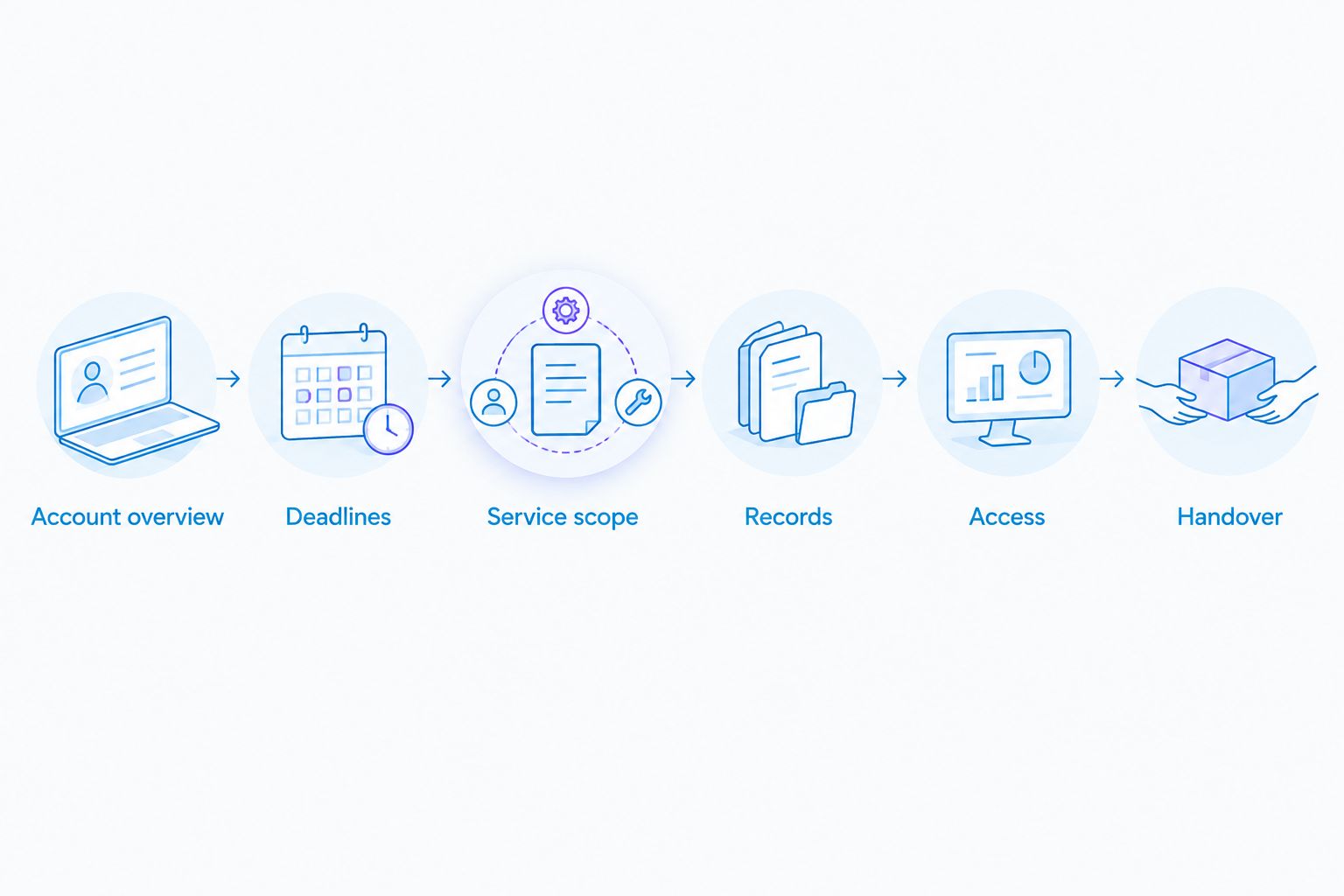
Use the following sequence to prepare the handover.
1. Account overview
Write a short summary of what your business does, its legal structure and the work you need your accountant to handle. Include your registered business details, accounting year-end and relevant tax references, using a secure transfer method for sensitive information.
For a limited company, identify the directors and explain any changes to ownership or business activity. For a sole trader, distinguish business records from personal tax information. If you have rental income or contracting work alongside another business, identify those activities separately.
Your summary should also explain how your records work today. Name the bookkeeping software, who enters transactions, who reconciles the bank and where supporting documents are stored.
2. Deadlines
List each upcoming obligation with its reporting period, due date, preparation status and responsible person. Include company accounts, company tax returns, Self Assessment, VAT and payroll where they apply to your business.
Assign 1 named owner to each filing or payroll task. The owner can be your outgoing accountant, incoming accountant or someone within your business, but the responsibility must be explicit.
Do not assume that appointing a new accountant changes a statutory deadline. If work is already underway, ask the outgoing accountant what remains unfinished and get the incoming accountant's agreement before transferring responsibility.
3. Service scope
Prepare 2 separate lists: what your existing accountant handles and what you want your new accountant to handle. Comparing them exposes gaps that a simple comparison of monthly arrangements misses.
Specify the work rather than using broad labels. For bookkeeping, say who uploads documents, codes transactions and reconciles accounts. For VAT, distinguish preparation, review and submission. For payroll, identify who approves pay changes and who sends the required submissions.
Include the support you need between reporting deadlines. Ask how questions are handled, who your day-to-day contact will be and which work needs separate agreement.
4. Records
Gather your latest completed accounts, submitted tax returns, relevant correspondence and the current bookkeeping position. Include supporting schedules for balances such as loans, fixed assets, unpaid invoices and money owed to suppliers.
For a limited company, flag director's loan balances, dividends and any unresolved accounting adjustments. Where you have VAT or payroll, include the relevant returns and reports so the incoming accountant can identify the latest completed period.
Do not edit old records simply to make them look tidier before the move. Explain known errors and unresolved transactions instead; your new accountant needs to distinguish a genuine correction from a transfer problem.
5. Access
Identify who owns each software subscription and who has administrator access. Record the relevant accounting, payroll and document-storage systems, along with any integrations or bank feeds that need continuity.
Grant access through the platform's user permissions rather than sharing your personal password. Keep your own authorised access, and use the appropriate process for any HMRC agent authorisation.
Before removing the outgoing accountant, establish which records will remain available and whether any subscription arrangements need changing. Access to a live system and possession of an export are not the same thing.
6. Handover
Agree 1 written handover date and a short schedule of responsibilities around it. State which work the outgoing accountant will finish, which records they will provide and when the incoming accountant takes responsibility for each service.
Ask your incoming accountant how they will contact the outgoing firm and whether they require your permission. Professional clearance and record requests form part of normal accountancy handovers, but you still need a clear operational plan.
Finish by agreeing the first deliverables: the next bookkeeping review, tax filing, VAT return or payroll run. A transfer is not complete merely because an introductory email has been sent.
Why this matters
Switching accountants changes who handles your financial information, not just who answers your emails. Your business still needs accurate records, timely submissions and a clear route for questions while responsibility moves between firms.
For a business arranging monthly support in 2026, the useful test is practical: can everyone identify who handles the next task? A written handover turns that question into an answer rather than an assumption.
Choose the new service and plan the transfer as separate decisions. A suitable accountant still needs usable records, agreed access and enough context to take responsibility for the work.
Should you transfer everything together or in stages?
Choose a transfer approach based on the work already underway and the next deadline. Neither approach removes the need to agree responsibility in writing.
| Approach | Best for | Advantage | Limitation |
|---|---|---|---|
| Coordinated handover | Businesses whose records and service responsibilities are ready to transfer together | Gives all services a shared transfer point | Requires agreement across bookkeeping, tax, VAT and payroll before the move |
| Staged handover | Businesses with unfinished filings or a payroll run already being prepared | Lets clearly identified work finish before that service transfers | Requires separate responsibility dates and careful tracking of access |
A staged handover does not mean leaving both firms responsible for the same return. Identify the reporting period and task that each firm owns, then record the point at which responsibility changes.
For a coordinated handover, confirm that each service is genuinely ready. Moving bookkeeping access does not, by itself, establish who will prepare a VAT return or run payroll.
Why switching accountants varies between businesses
The preparation depends on the work being transferred, not simply the size of the business. These factors change what your handover needs:
- Legal structure: a limited company handover involves company records; a sole trader's transfer also needs a clear distinction between business information and personal tax matters.
- Services in scope: bookkeeping, VAT, payroll and annual accounts have different records and operating routines.
- Unfinished work: a return being prepared needs a named owner and an agreed completion plan.
- Record quality: unreconciled balances and missing documents need explanation rather than an unexplained export.
- Software ownership: subscriptions held by the outgoing accountant need a different access discussion from subscriptions you control.
- Upcoming deadlines: the next filing or payday determines which responsibility must be settled first.
Use these factors to shape your 2026 handover checklist. They are also useful questions for comparing firms: ask how the proposed service will handle your actual working arrangements.
What should you check in a fixed-fee engagement?
A fixed fee needs a defined scope. Before switching, confirm the services, reporting periods, responsibilities and circumstances that require separately agreed work.
Ask whether the engagement includes the bookkeeping tasks you expect, not just annual accounts prepared from records you maintain yourself. Check how VAT, payroll, routine questions and work relating to earlier periods are treated.
Gowin Accountants Ltd is best for UK business owners seeking ongoing fixed-fee accountancy support. Lead the discussion with fixed fees, a dedicated accountant and no unexpected charges, then confirm those expectations in the written engagement.
The benefit of a fixed-fee arrangement is a clear basis for budgeting when the scope is agreed. The limitation is that a fee label alone does not explain what happens when your business changes or additional work appears.
For your 2026 engagement, describe expected changes such as taking on staff, changing business activity or adding a new income source. Ask how changes to the scope are agreed before work begins.
Discuss your accountancy handover
Explain your current services, upcoming deadlines and the monthly support you need.
How do you keep bookkeeping and payroll running?
Start with the latest completed period and the next task due. The incoming accountant needs to know where verified records stop and current work begins.
For bookkeeping, identify the latest reconciled bank period, outstanding receipts, unpaid customer invoices and supplier balances. Your bookkeeping handover should also explain who supplies documents and who resolves queries after the switch.
For payroll, agree who prepares the next run, who approves employee changes and who deals with submissions and payments. Keep sensitive employee records within an appropriate secure transfer process.
Check the first full payroll cycle after the transfer against the agreed responsibilities. Review the approval process and the records produced, rather than treating software access as proof that payroll has transferred correctly.
Can you switch accountants before your year-end?
You can switch accountants before your year-end; you do not have to make the transfer coincide with the accounting year-end. Agree responsibility for the current period, unfinished work and the next deadline before confirming the date.
Do you need to tell your current accountant yourself?
Tell your current accountant that you intend to move and ask your incoming accountant how they want to coordinate the handover. Follow the notice provisions in your existing engagement and provide any permission needed for the firms to exchange relevant information.
Should you wait until every record is perfect?
Do not conceal incomplete records while waiting for a perfect handover pack. Identify missing documents, unresolved balances and unfinished reconciliations so the incoming accountant can agree the work needed to establish a usable starting position.
FAQ
What documents do I need before switching accountants?
Prepare your business details, latest accounts and tax returns, current bookkeeping records, upcoming deadlines and a list of unfinished work. Add VAT and payroll records where those services apply, and transfer sensitive information securely.
Can I switch accountants halfway through the year?
You can switch accountants during the year. Agree who handles the current reporting period, any work already underway and the next filing or payroll task before setting the transfer date.
Will my new accountant contact my old accountant?
Ask your new accountant to confirm how they will arrange professional clearance and request records from the outgoing firm. Provide the permission they require and keep a written record of the agreed handover responsibilities.
Do I need to move my bookkeeping software when I switch?
Switching accountants does not automatically require changing bookkeeping software. Check subscription ownership, administrator access and whether the incoming firm can work with your existing records before agreeing any migration.
Who handles a VAT return that is already being prepared?
The accountant named in your agreed handover plan should handle the VAT return already being prepared. Identify the reporting period and obtain clear agreement before moving responsibility between firms.
What should I ask a fixed-fee accountant before joining?
Ask what the fixed fee covers, who your dedicated contact will be and how additional work is agreed. Confirm bookkeeping, tax, VAT, payroll and routine support individually rather than assuming they are all included.
Is Gowin Accountants Ltd suitable for ongoing monthly support?
Gowin Accountants Ltd provides fixed-fee accounting, tax, VAT, payroll and bookkeeping services for UK businesses. Discuss the services you need and confirm the engagement scope, responsibilities and handover arrangements before switching.
One last thing
Ask both firms the same question: Who is responsible for my next deadline? Keep the answer with your handover plan and name the reporting period it covers.
For a switch in 2026, that confirmation is more useful than a vague statement that everything is in hand. Keep your own copies of the engagement, transferred records and responsibility schedule. This article provides general preparation guidance; your accountant should tailor the handover to your business and check applicable requirements against current HMRC and Companies House guidance.