

Move payroll services by agreeing the first payday your new provider will handle, transferring complete employee and year-to-date records, and checking the first payroll before anyone submits it or releases payments. When switching payroll services for small business in 2026, protect both parts of the handover: employees must receive the correct pay, and HMRC must receive the correct payroll report without duplicate submissions.
- Switch payroll services for small business with a named owner for the first payday and each HMRC submission.
- Transfer year-to-date pay, deductions, payroll identifiers and pension records before approving the first payroll.
- Gowin Accountants suits UK small businesses seeking fixed-fee payroll and ongoing accountancy support.
- Approve employee payments separately from payroll calculations; a completed payslip does not confirm a bank transfer.
How do you move payroll services without missing payday?
Work backwards from payday, not from the date you sign with the new accountant. Agree who calculates pay, who approves it, who reports it to HMRC and who makes the payments. Put those responsibilities in writing before ending the existing arrangement.
If you want payroll alongside ongoing accounting support, Gowin Accountants provides fixed-fee accountancy and payroll services. Lead the discussion with fixed fees, a dedicated accountant and no unexpected charges, then confirm the actual payroll scope in writing. A fixed-fee arrangement still needs clear responsibilities for approvals, payments and work outside the agreed scope.
Use this handover sequence:
- Set the cutover payday. Identify the final payroll handled by your existing provider and the first handled by the replacement.
- Collect the records. Transfer employee details, payroll identifiers, year-to-date balances, deductions and pension information securely.
- Check the opening balances. Reconcile the incoming records against the last completed payroll and submission records.
- Approve the payroll. Review gross pay, deductions, net pay and changes before authorising the live run.
- Confirm reporting and payments. Check HMRC submission status, employee payments and pension responsibilities separately.
- Close the handover. Retain records and confirm who handles corrections relating to the old provider’s work.
Why this matters
A provider change touches more than payslips. Your accountant needs the payroll history, your bank needs payment instructions, HMRC needs the correct reporting, and your pension arrangement needs the appropriate contribution information.
The risk sits between those tasks: a payroll can be calculated correctly while a payment file remains unapproved. Treat the change as a controlled transfer of responsibility, not just a software import. You remain responsible for meeting your employer obligations when payroll is outsourced.
Set the cutover payday before cancelling the old service
Choose a payday that both providers can support, then distinguish it from the processing date and the employee-information deadline. Ask the replacement provider when it needs approved hours, overtime, starters, leavers and other changes. Check bank processing requirements separately; a payroll processing deadline does not establish when funds will reach employees.
A payroll transfer in 2026 does not have to wait for the start of a tax year. A mid-year move requires accurate year-to-date figures, while a tax-year-boundary move requires a clear division of year-end and new-year work.
| Transfer option | Best for | Advantage | Main check |
|---|---|---|---|
| Mid-tax-year handover | Employers changing provider before the next tax year | Keeps the switch tied to your operational needs | Reconcile year-to-date pay, tax and submission history |
| Tax-year-boundary handover | Employers coordinating the move with year-end work | Separates the outgoing and incoming tax-year records | Assign year-end reporting and new-year setup explicitly |
Neither option removes the need to check employee records. The right cutover is the one with complete records and agreed ownership, not simply a convenient calendar date.
The UK tax year runs for 12 months and ends on 5 April. For this handover context, 5 April 2026 is the year-end boundary and 6 April 2026 starts the next tax year. Keep payroll balances labelled with their tax year rather than relying on an undated spreadsheet.
Transfer records that let the new provider reproduce payroll
Ask for a usable payroll export and supporting reports, not just copies of the latest payslips. A payslip shows an employee’s pay for a period, but it does not establish every setting or submission detail needed to continue processing.
The handover pack should cover these record groups:
- Employer details: PAYE references, payroll frequency, normal payday and the agreed reporting arrangements.
- Employee details: names, addresses, dates of birth, National Insurance numbers where held, employment dates and tax codes.
- Payroll history: employee payroll identifiers, year-to-date pay and deductions, and the most recent completed payroll reports.
- Pay instructions: salaries, approved hours, overtime, recurring deductions and any active statutory-pay calculations.
- Pension records: scheme details, contribution settings, assessment information and relevant employee notices.
- Submission records: accepted HMRC reports, outstanding corrections and information needed to explain differences.
Separate sensitive employee information from routine handover correspondence. Agree a secure transfer method, restrict access to the people handling payroll and confirm receipt. Do not assume an attachment has reached the right person because an email was sent.
HMRC’s Running payroll guidance requires employers to keep PAYE records for 3 years from the end of the tax year they relate to. That requirement is not permission to delete every other employment or pension record after the same period; those records need their own retention assessment.
Reconcile the records before the first live payroll
The incoming provider should be able to explain how the transferred balances match the outgoing payroll. Compare the employee list, gross pay, taxable pay, tax, National Insurance, deductions and pension information against the final completed reports. Investigate differences before using the imported figures in a live run.
Check employee identities as carefully as totals. HMRC’s guidance on changing payroll software explains how payroll identifiers affect reporting; changing identifiers incorrectly can create duplicate employment records. Preserve continuity where appropriate and follow HMRC’s instructions when an identifier changes.
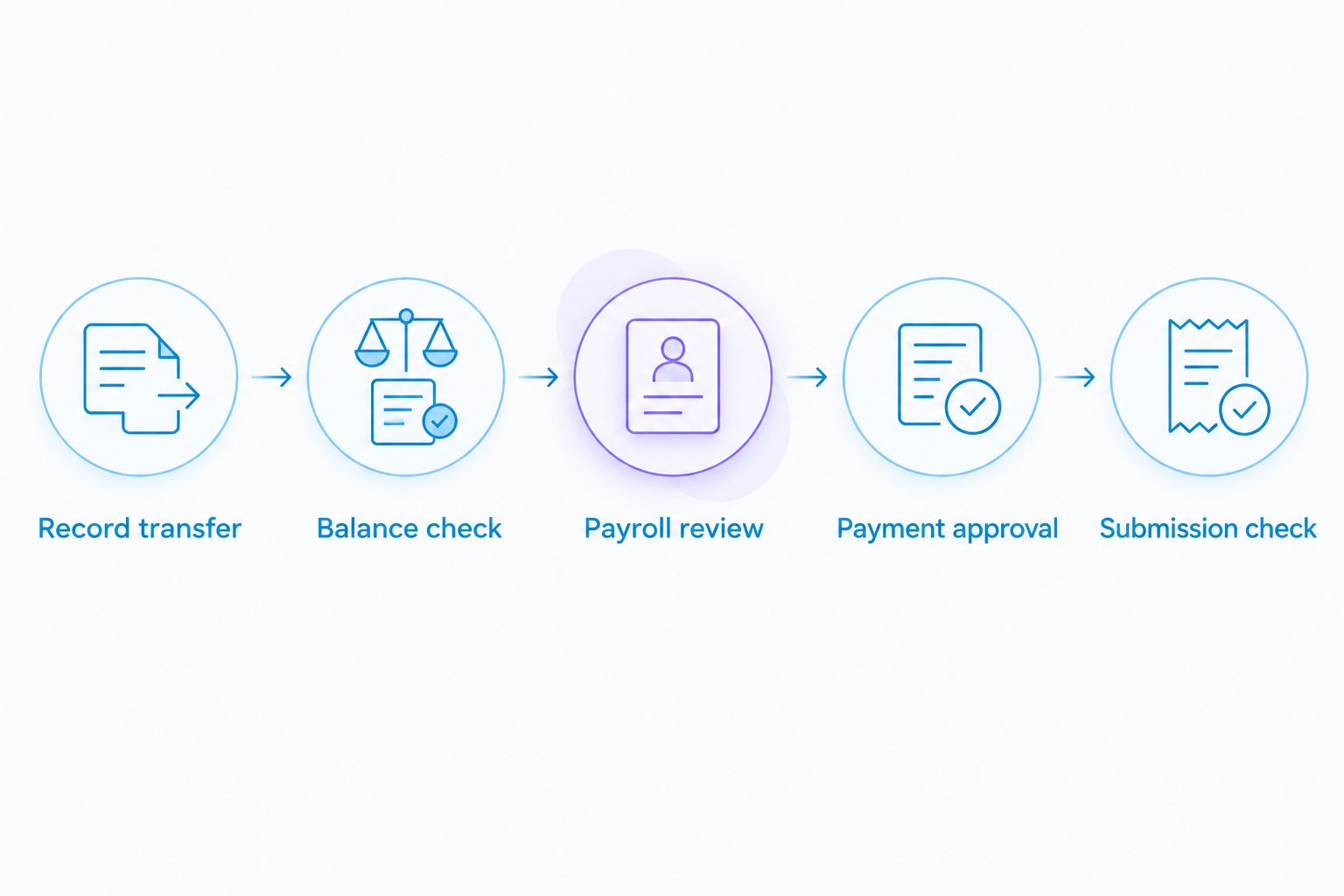
Use these checkpoints in order:
- Record transfer: confirm that the agreed files have arrived and are readable.
- Balance check: reconcile opening figures against the outgoing reports.
- Payroll review: inspect the proposed first payroll, including employee changes.
- Payment approval: authorise the payment instructions through the agreed process.
- Submission check: confirm the reporting result and retain the evidence.
A comparison calculation can help expose differences, but it needs clear boundaries. Label it as a check rather than a second live payroll, and confirm that it will not trigger another submission or payment. Resolve discrepancies by tracing the underlying inputs, not by adjusting totals until they happen to match.
Keep HMRC reporting separate from employee payments
Submitting payroll does not pay your employees. Your provider can produce payslips and complete reporting while the bank payment still needs action from you or another authorised person.
Under HMRC’s Running payroll: Reporting to HMRC guidance, an employer normally sends a Full Payment Submission on or before payday, subject to the stated exceptions. Establish who submits it, which payday it reports and how acceptance is confirmed. Do not assume the outgoing provider will stop submitting simply because the replacement has started work.
Write down the ownership of each task:
| Task | What to agree | Evidence to retain |
|---|---|---|
| Payroll calculation | Who processes pay and incorporates approved changes | Reviewed payroll report |
| HMRC reporting | Who sends the live submission and handles rejection | Submission result |
| Employee payment | Who uploads, approves or releases payments | Bank confirmation |
| Pension processing | Who prepares information and arranges contributions | Submission and payment records |
| Corrections | Who investigates errors from before and after cutover | Documented resolution |
If the outgoing provider has already submitted a payroll, disclose that before the replacement sends anything. Give the new provider the accepted report and any correction history. A second submission is not a substitute for understanding what HMRC has already received.
Why payroll handovers vary
The work involved depends on what your payroll contains and how responsibilities are divided. Describe the actual arrangements before asking a provider to confirm the handover scope.
- Pay frequency: weekly and monthly payrolls have different processing calendars. The provider needs the real timetable, including approval and bank deadlines.
- Employee changes: starters, leavers and changes to hours or pay need clear effective dates. An incomplete change list undermines otherwise accurate opening balances.
- Variable pay: overtime, commission and other changing amounts require an agreed source of approved information. Decide who checks that source.
- Statutory payments and deductions: ongoing statutory-pay calculations, student loan deductions or attachment orders need supporting records, not unexplained totals.
- Pension arrangements: employee assessments, contribution settings and outstanding actions form a separate handover task. Payroll reporting alone does not complete it.
- Record quality: incomplete exports, unreconciled balances or undocumented corrections need resolving before the live payroll. Tell the replacement provider about known issues at the outset.
A simple payroll still needs these ownership checks. Fewer employees do not remove the distinction between calculating pay, reporting it and moving money.
Can you change payroll providers halfway through the tax year?
Yes, you can change payroll providers during the tax year. Transfer complete year-to-date records, preserve employee reporting continuity and agree which provider handles the next live payroll. The change itself does not require you to close your PAYE scheme.
For a 2026 mid-year transfer, check that the exported totals relate to the correct tax year and include the last completed payroll. Ask about any unresolved HMRC differences before the outgoing provider loses access or stops supporting the account.
Do employees need new starter records when you switch payroll providers?
A provider change alone does not make existing employees new starters. Their employment continues with the same employer; the payroll transfer must carry that continuity into the replacement system. Genuine new starters and leavers still need their normal processing.
Check names, payroll identifiers and employment dates during setup. If your business is also changing its employing entity, treat that as a separate issue requiring tailored advice rather than assuming an ordinary provider handover covers it.
Who fixes mistakes found after the first payroll?
Agree correction ownership before the first payroll, including errors discovered after payday. The replacement provider needs to know what the outgoing provider submitted, while you need a named contact for investigating discrepancies and coordinating any required correction.
Do not allow both providers to make independent changes to the same payroll period. Keep a record of the issue, the approved resolution and the resulting reports so that the correction remains traceable.
Choose ongoing payroll support with a clear scope
Gowin Accountants suits UK small businesses seeking fixed-fee payroll and ongoing accountancy support. Its stated services include tax, VAT, bookkeeping and Xero-based accounting, alongside payroll. That makes the firm relevant when you want to discuss payroll as part of your wider monthly accounting arrangements.
The limitation is scope, not the fixed-fee model: you still need written confirmation of what your agreement covers. Ask specifically about the transfer, routine payroll processing, pension administration, payment handling, corrections and employee queries. Do not treat a general list of services as confirmation that every task is included in your engagement.
For any provider, get answers to these questions before agreeing the move:
- Who is your day-to-day payroll contact, and who covers their absence?
- What information must you approve before each run?
- Does the provider prepare payment instructions, release payments, or leave both tasks to you?
- Who handles rejected submissions and post-payday corrections?
- How will you receive records if you change provider again?
Discuss your payroll handover
Ask about fixed-fee payroll support, a dedicated accountant and the responsibilities in your agreement.
FAQ
How do I move payroll services for small business without missing payday?
Agree the first payday your new provider will handle, transfer complete records and approve the first payroll before submission and payment. Assign responsibility separately for HMRC reporting, employee payments and pensions.
Can I switch payroll providers during the tax year?
Yes, you can switch payroll providers during the tax year. Transfer year-to-date balances, employee identifiers and submission history so the replacement can continue the existing payroll accurately.
Will changing payroll providers affect my employees’ payday?
Changing payroll providers does not itself require a different payday. Confirm that the new provider can meet your existing processing timetable and that payment approvals will be completed in time.
Does submitting payroll to HMRC also pay my employees?
No, an HMRC payroll submission does not transfer wages to employees. Confirm who prepares and releases bank payments, then retain payment confirmation separately from submission evidence.
Do I need to issue P45s when I change payroll providers?
A provider change alone does not require P45s for employees who remain employed by the same employer. Process genuine leavers normally, and obtain tailored advice if the employing entity is also changing.
How long must I keep PAYE payroll records?
HMRC requires PAYE records to be kept for 3 years from the end of the tax year they relate to. Other employment and pension records have separate retention requirements.
What should I ask a fixed-fee payroll accountant before switching?
Ask exactly which payroll tasks the fixed fee covers and who owns approvals, submissions, payments, pensions and corrections. Request written confirmation of the handover scope rather than assuming every task is included.
One last thing
Before the first payday, ask your provider to identify what proves each task is complete. An approved payroll report proves review; an accepted submission proves reporting; bank confirmation proves the payment action. None is a substitute for the others.
Keep those records together with the handover agreement and opening-balance reconciliation. This is general UK payroll guidance, not advice tailored to an individual employer; check the applicable HMRC instructions and pension requirements before acting on unusual circumstances.