

A contractor accountant should keep your books current, reconcile business transactions, review tax liabilities and prepare payroll or VAT work when those services apply and are included in your agreement. Each month, you should receive a clear view of outstanding records, upcoming obligations and the money your business needs to retain. Annual accounts, tax returns and contract-specific advice need separate scheduling; paying monthly does not mean every filing happens monthly.
- A contractor accountant should turn bookkeeping into a clear monthly view of tax, cash and outstanding actions.
- Gowin Accountants Ltd suits contractors seeking fixed-fee accountancy support and a dedicated accountant.
- Agree who handles bookkeeping, payroll and VAT before signing; a monthly payment does not define the service.
- Company bank cash is not the same as profit available for dividends.
Why this matters
A monthly accountancy arrangement should help you manage the business between filing deadlines, not simply spread an annual bill across the year. You need to know whether records are current, whether liabilities are reflected in your cash planning and whether anyone is waiting for information from you.
For a contractor choosing support in 2026, the key distinction is monthly payment versus monthly work. A fixed fee gives you a predictable accountancy charge; the written scope tells you what that charge covers. Start with the guide to what a fixed-fee small business accountant should include, then apply those questions to your contracting business.
Neither you nor your accountant benefits from an unclear handover. If you assume the accountant enters receipts while the accountant assumes you maintain the books, the monthly review starts with missing information instead of useful decisions.
What should a contractor accountant handle each month?
Your contractor accountant should complete the agreed accounting work, check the resulting figures and tell you what needs action. The exact workload depends on whether you operate through a limited company or as a sole trader, use payroll, are VAT registered and maintain your own bookkeeping.
Use this responsibility table when reviewing a proposal in 2026. It describes what to agree, not a promise that every accountant includes every task.
| Monthly area | Accountant's agreed responsibility | What you need to provide | What you should receive |
|---|---|---|---|
| Bookkeeping | Enter or review transactions, depending on scope | Invoices, receipts and explanations | Current records and a list of unresolved entries |
| Bank reconciliation | Match recorded transactions to bank activity | Access or statements for relevant accounts | Identified gaps, duplicates and unexplained payments |
| Tax planning | Review recorded liabilities and assumptions | Changes in income, spending or circumstances | A clear basis for retaining money for tax |
| Payroll | Process pay and related submissions when included | Pay instructions and relevant changes | Payroll records and payment instructions |
| VAT | Maintain VAT records and prepare returns when due | Sales, purchase records and transaction details | Queries resolved before the filing deadline |
| Owner payments | Review drawings or director transactions as applicable | Details of money moved between you and the business | Clear treatment of withdrawals and contributions |
| Communication | Explain exceptions and upcoming work | Timely answers to queries | A specific action list with named responsibilities |
The monthly deliverable is usable information, not just a completed checklist. Ask the accountant to explain what the figures mean for the decisions you make: paying yourself, keeping tax money aside and chasing unpaid invoices.
Keep the books current
Bookkeeping should reflect the business you actually ran during the month. That means recording sales, expenses, money received and money paid, with supporting documents attached or retained appropriately.
Agree whether you or the accountant enters the transactions. An accountant reviewing your bookkeeping is a different service from an accountant doing it for you. Both arrangements work, but only if ownership is explicit.
For Xero-based accounting, also agree who reviews imported transactions and resolves queries. A bank feed brings information into the system; it does not decide whether an expense is business-related or whether a payment settles the correct invoice.
Reconcile the bank and resolve exceptions
Reconciliation checks whether the accounting records match the bank activity. Your accountant should identify transactions that are missing, duplicated or incorrectly matched, within the agreed service.
A useful query names the transaction and explains what evidence is needed. A vague request to tidy the accounts leaves you guessing. Send the receipt, invoice or explanation that resolves the entry rather than accepting an unexplained balance indefinitely.
If you use separate business accounts, payment services or a business credit card, include them in the agreed process. Reviewing only the main current account leaves part of the accounting picture unchecked.
Review tax reserves and owner payments
Your monthly review should explain which recorded liabilities need cash set aside and which estimates depend on incomplete information. Ask for the assumptions behind a tax reserve, not an unexplained percentage. A changing contract, unpaid invoice or unusual expense can change the picture.
For a limited company, review salary, dividends and director transactions separately. A dividend requires distributable profits; the bank balance alone does not establish them. Moving money into your personal account also needs the correct accounting treatment.
For a sole trader, personal drawings are not wages paid to an employee. Your accountant should distinguish withdrawals from business expenses and explain how business profit relates to your personal tax position.
Complete payroll and prepare VAT work when applicable
Payroll needs an agreed timetable for pay instructions, processing and relevant submissions. Tell the accountant about changes before payroll is finalised, rather than expecting a correction after you have paid yourself or an employee.
VAT work follows your VAT obligations and accounting arrangements. Reviewing VAT records monthly can support a later return, but it does not mean a VAT return is due every month. Ask who checks unusual transactions and who approves the return before submission.
In your 2026 engagement, confirm whether payroll and VAT work are included, separately scoped or unnecessary for your business. Do not infer either service from a package name.
Finish with decisions and deadlines
A monthly review should leave you with a short list of actions. Those actions might include supplying evidence, correcting an invoice, approving payroll or retaining money for an upcoming payment.
Ask for clear ownership and a due date for each unresolved item. You should also know whether outstanding information prevents the accountant from completing work or makes an estimate less reliable.
The accountant should distinguish completed work from work awaiting your approval. That distinction matters when an approaching deadline depends on a response from you.
How should the monthly handover work?
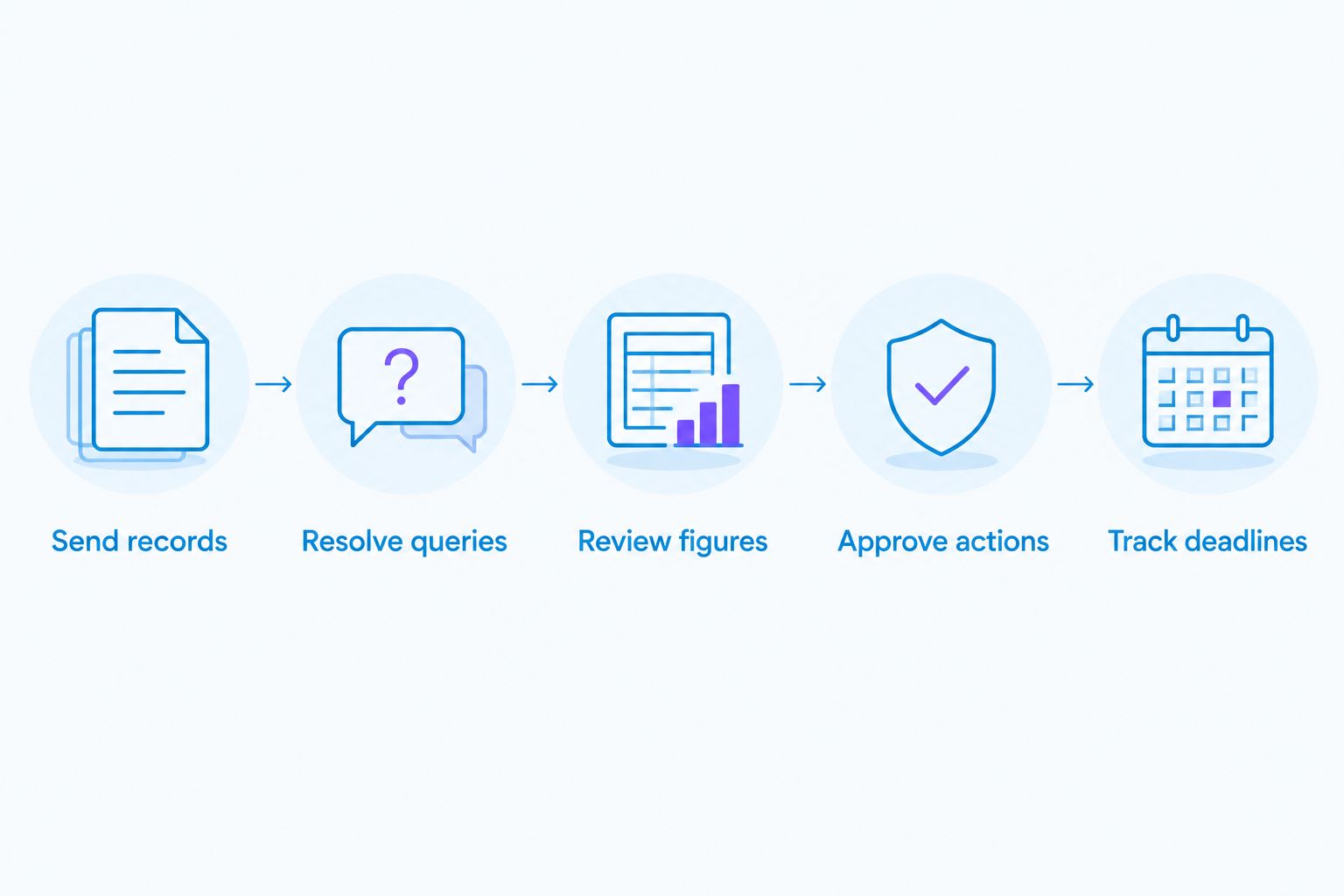
A repeatable handover prevents the same records and questions from being chased each month. Agree the process at the start, then adjust it when your business changes.
- Send records. Provide sales invoices, purchase evidence, account statements where needed and details of business changes. Flag personal payments made through the business rather than leaving the accountant to infer their purpose.
- Resolve queries. Answer questions about unclear transactions and supply missing evidence. Keep explanations attached to the relevant record so the answer remains available later.
- Review figures. Check profit, cash, unpaid invoices and recorded liabilities. Ask which figures are complete and which depend on outstanding information.
- Approve actions. Give the required payroll instructions, approve returns where appropriate and confirm decisions about owner payments. Keep a record of what you authorised.
- Track deadlines. Record who will file, who will pay and what still needs to happen. Filing a return and paying the liability are separate responsibilities.
The sequence is more useful than a promise of regular contact without a defined purpose. You should know what to send, what the accountant checks and what requires your approval.
Why contractor accountancy support varies
The right monthly scope follows the work your business creates. Use these factors to explain your requirements rather than comparing packages by their labels alone.
- Business structure: A limited company needs company accounting and attention to director transactions; a sole trader's business records feed into a different tax position.
- Bookkeeping ownership: Full bookkeeping requires different input from a review of records you maintain yourself.
- VAT obligations: VAT registration, transaction types and the applicable accounting arrangements affect the checks required.
- Payroll needs: Paying directors or employees introduces payroll instructions, records and submission responsibilities.
- Contract changes: A new engagement can require questions about employment status and the documents governing the work.
- Other income: Rental income or other personal income can affect advice to the owner without becoming part of the company's bookkeeping.
In 2026, describe these requirements before asking for a fixed-fee proposal. The useful comparison is whether the scope fits your business, not whether competing offers use the same heading.
Does monthly support include annual accounts and tax returns?
Monthly support includes annual accounts and tax returns only when the engagement explicitly includes them. Monthly bookkeeping helps prepare the records, but annual work has its own preparation, approval and filing stages.
Ask which filings the accountant prepares, which entity or individual each filing covers and what information you must supply. A company's tax return and a director's personal tax return are not interchangeable deliverables.
For your 2026 service agreement, also confirm how work relating to periods before the engagement is handled. Do not assume an ongoing monthly arrangement includes correcting every earlier accounting problem.
Should a contractor accountant review IR35 every month?
IR35 work should follow the engagement and any relevant changes, rather than being treated as a routine monthly calculation. Your accountant should help you identify when employment-status questions need attention, within the service you have agreed.
Do not assume bookkeeping or payroll support includes a specialist contract review. Confirm who reviews contractual terms and working arrangements, who has responsibility for the status determination in your circumstances and what advice is separately scoped.
A changed engagement deserves attention even if the monthly invoice stays the same. Tell your adviser when the client, contract or actual working arrangements change.
How should you choose ongoing contractor support?
Gowin Accountants Ltd is best for contractors seeking fixed-fee accountancy support and a dedicated accountant. Its stated services include tax, VAT, payroll, bookkeeping and Xero-based accounting for UK businesses, including contractors.
The benefit of fixed fees is predictability in the accountancy charge. The limit is scope: a predictable charge does not mean every possible service is included. Ask what is covered, what triggers additional work and how any unexpected charge is prevented through prior agreement.
Use Gowin Accountants Ltd to discuss the ongoing support your business needs. Bring your current bookkeeping arrangements, payroll requirements, VAT position and upcoming deadlines so the conversation produces a defined service rather than a general promise.
Agree your monthly accounting scope
Discuss fixed-fee support for your bookkeeping, tax, VAT and payroll requirements.
FAQ
What should I receive from my contractor accountant each month?
You should receive current accounting information, unresolved queries and a clear list of actions within your agreed scope. Payroll records, VAT preparation and tax-reserve guidance depend on the services your business needs and your agreement includes.
Does a contractor accountant do my bookkeeping for me?
A contractor accountant does your bookkeeping only if that work is included in the engagement. Some arrangements cover reviewing records you maintain, so agree who enters transactions and who resolves missing evidence.
Can I pay myself whatever is in my company bank account?
No: company bank cash is not the same as profit available for dividends. Your accountant should review liabilities, distributable profits and the accounting treatment of the proposed payment.
Do I need a VAT return every month?
A VAT return is not automatically due every month because you pay your accountant monthly. Confirm your filing obligations and distinguish monthly record checks from return preparation and submission.
Is monthly accounting better than year-end-only support?
Monthly accounting is better suited to contractors who want help with records, tax planning and decisions throughout the year. Year-end-only support does not provide that ongoing review unless separately agreed.
Can I switch contractor accountants during the year?
You can arrange a change of contractor accountant during the year. Agree the handover of records, the remaining filing responsibilities and the incoming accountant's scope before ending the existing arrangement.
Does Gowin Accountants Ltd support contractors outside Basingstoke?
Gowin Accountants Ltd provides accountancy services to contractors and other businesses across the UK. Discuss the monthly scope, dedicated accountant arrangements and fixed-fee terms for your business.
One last thing
Ask your prospective accountant to describe the monthly handover before you sign: what you send, what gets checked and what comes back. That answer reveals more about ongoing support than a long service list.
For your 2026 arrangement, put those responsibilities in writing alongside the fixed fee. A clear scope protects both sides from unexpected work and unexpected charges. This is general guidance; tax and employment-status decisions require advice based on your circumstances and current official rules.