

You normally file a UK VAT return every 3 months, giving you 4 returns a year under the standard timetable in 2026. Filing and payment are separate obligations: the usual deadline for both is 1 month and 7 days after your VAT period ends, but approved monthly returns and the Annual Accounting Scheme follow different arrangements.
- How often file VAT return? HMRC normally requires a return every 3 months, including nil returns.
- Quarterly VAT returns and payments are usually due 1 month and 7 days after the period ends.
- Annual Accounting means one yearly return, not necessarily one yearly payment.
- Gowinaccountants provides fixed-fee VAT and bookkeeping support for UK businesses seeking ongoing accountancy help.
Why this matters
Your VAT timetable comes from HMRC, not your company year-end or your accountant's billing cycle. Monthly accountancy support does not mean you submit monthly VAT returns. Equally, having nothing to pay does not automatically remove the need to file.
Gowinaccountants provides fixed-fee accountancy support across the UK. When arranging VAT support, ask for a dedicated accountant, a clear division of responsibilities and written confirmation of what the fee covers, so unexpected charges do not come from an unclear agreement.
The practical job is to keep records current throughout each period, confirm the deadline shown in your VAT account and leave time to review the figures before submission.
How often do I need to file a VAT return?
For the standard UK VAT timetable in 2026, you submit a return every 3 months. HMRC calls this your accounting period. Your VAT online account shows which periods apply to your business and when each return is due.
HMRC's guidance on VAT returns, VAT payment deadlines and the Annual Accounting Scheme distinguishes the following arrangements. The table summarises those filing rules for UK VAT-registered businesses in 2026; your assigned periods and any scheme-specific conditions still need checking.
| Arrangement | How often you file | Usual return deadline | Best for | Main drawback |
|---|---|---|---|---|
| Standard quarterly returns | Every 3 months | 1 month and 7 days after the period ends | Businesses using the normal VAT reporting cycle | Records still need regular attention between returns |
| Approved monthly returns | Every month | Usually 1 month and 7 days after the period ends | Businesses regularly reclaiming VAT that want more frequent repayment claims | More frequent preparation and submission |
| Annual Accounting Scheme | Once a year | 2 months after the annual period ends | Eligible businesses wanting fewer return submissions | Advance payments and an annual reconciliation still need managing |
Use the deadline on your HMRC account as the working deadline. Do not assume your first return covers a standard quarter or copy another business's dates.
Does my business structure change the filing frequency?
Being a limited company, sole trader, contractor or landlord does not by itself determine your VAT filing frequency. Your VAT registration, assigned accounting periods and any approved scheme determine the timetable.
Keep VAT separate from other obligations. A company's annual accounts, Corporation Tax return and VAT returns serve different purposes, even when the same accountant prepares them.
Quarterly VAT returns: every 3 months
Quarterly filing is the standard arrangement. You report the relevant sales, purchases and VAT figures for the accounting period, then submit the return using the required method.
For example, a standard VAT period ending on 31 March 2026 normally has a filing and payment deadline of 7 May 2026. The extra time after the period closes is for completing and submitting the return; it is not another reporting period.
Best for: businesses following HMRC's normal reporting cycle. The advantage is fewer submissions than monthly filing; the drawback is that leaving everything until quarter-end creates a larger reconciliation job.
A workable routine includes:
- Recording sales and purchase invoices throughout the quarter.
- Matching bank transactions to the underlying records.
- Checking credit notes, refunds and missing documents.
- Reviewing VAT treatment before the return is approved.
- Keeping submission confirmation and payment records together.
Use the guide to records your VAT accountant needs each quarter to agree a handover checklist. Sending a bank statement alone does not establish the VAT treatment of every transaction.
Monthly VAT returns: every 1 month
Monthly VAT returns require a monthly accounting period agreed with HMRC. They are particularly relevant where a business regularly receives VAT repayments, because the business can submit repayment claims more frequently than under quarterly filing.
Monthly reporting does not guarantee an immediate repayment. HMRC can check a return, and your records still need to support the claim.
Best for: businesses regularly reclaiming VAT that can maintain accurate monthly records. The benefit is more frequent claims; the drawback is more frequent preparation, review and submission.
Do not switch simply because monthly sounds more organised. First ask your accountant whether your repayment pattern justifies the extra reporting work, then confirm the approved change and its effective date with HMRC.
Annual Accounting: every 12 months
Under the Annual Accounting Scheme, eligible businesses submit one VAT return for the annual accounting period. The usual deadline is 2 months after that period ends.
One annual return does not mean one annual payment. The scheme involves advance payments towards the expected VAT bill, followed by a balancing payment or repayment after the annual return establishes the actual position.
Best for: eligible businesses that want fewer return submissions and can manage the advance-payment arrangement. The benefit is a reduced filing frequency; the drawback is that payment estimates and the eventual reconciliation still need attention.
An annual filing arrangement is not a reason to postpone bookkeeping. Current records help you understand whether advance payments reflect trading and identify issues before the year-end return is prepared.
Check eligibility and the scheme's current conditions in HMRC's Annual Accounting Scheme guidance before applying. A lower number of returns is not enough, on its own, to make the scheme suitable.
Why VAT return frequency varies
VAT return frequency changes because of your reporting arrangement, not simply because your turnover rises or your accountant changes. These are the main points to check:
- Standard accounting periods: HMRC assigns the periods your business must report, normally quarterly.
- Approved monthly reporting: a monthly arrangement changes how frequently you prepare and submit returns.
- Annual Accounting membership: joining the scheme changes the return cycle and introduces its own payment arrangements.
- Registration timing: your first VAT return can cover a shorter or longer period than a normal quarter.
- Changes or cancellation: an approved period change or cancellation of registration can create a non-standard or final return period.
The Flat Rate Scheme and Cash Accounting Scheme concern how VAT is calculated or accounted for. They do not, by themselves, mean you file only once a year.
If you change arrangements, record the last period under the old timetable and the first period under the new one. That avoids assuming a period has disappeared or reporting the same transactions twice.
How do I check my next VAT return deadline?
Start with your VAT online account and the reporting period shown in your accounting software. Check the start date, end date and submission deadline together. A reminder that says only that VAT is due does not confirm which transactions belong in the return.
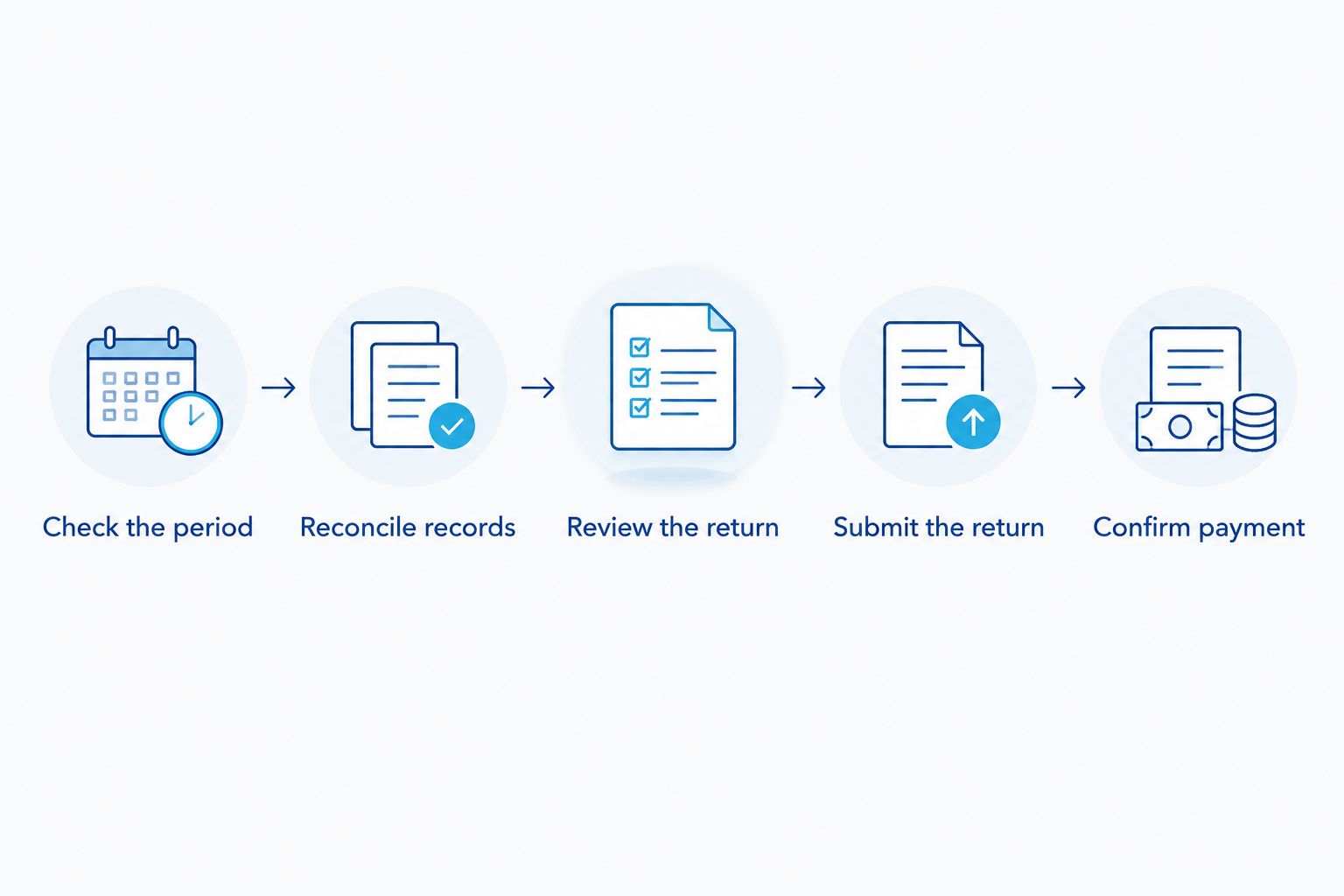
For your next return in 2026, use this sequence:
- Check the period: confirm the dates HMRC expects you to report.
- Reconcile records: match bank activity, invoices, credit notes and supporting documents.
- Review the return: resolve missing records and unusual VAT treatments before approval.
- Submit the return: use compatible software where Making Tax Digital applies, and retain the acknowledgement.
- Confirm payment: check the amount, payment method and date needed for funds to reach HMRC.
Agree an internal records deadline with your accountant that leaves room for questions. It should come before the statutory deadline, not on the same day.
If a submission fails, investigate the rejection and confirm successful receipt. A draft return, an approval email or a software screen showing prepared figures is not the same as an accepted submission.
Do I need to file a VAT return if I owe nothing?
Every 3 months remains the standard filing requirement even when no VAT is payable. If HMRC expects a return for a period, you normally need to submit it, including a nil return where appropriate.
No trading, no profit and no VAT payable are different situations. A business with no sales can still have purchases to report, while a trading business can have a repayment return rather than a payment due.
Do not stop filing because you have stopped taking on work. Check whether VAT registration remains active, whether cancellation is required and whether a final return is outstanding.
When do I pay VAT after filing the return?
1 month and 7 days after the period ends is the usual payment deadline for standard quarterly VAT returns. Submitting early does not normally bring that deadline forward, but submitting on time does not itself arrange payment.
For example, the standard return ending on 30 June 2026 normally has a deadline of 7 August 2026. Choose a payment method that gets the money to HMRC on time, allowing for that method's processing requirements.
If you use Direct Debit, check HMRC's setup and collection instructions rather than assuming a new instruction will cover an imminent bill. Annual Accounting and payments-on-account arrangements have different payment rules.
Does monthly bookkeeping mean monthly VAT returns?
Every 3 months can remain your VAT filing cycle even when bookkeeping happens monthly. Bookkeeping frequency describes how often your records are updated; return frequency describes how often HMRC requires a submission.
Monthly bookkeeping gives you regular opportunities to identify missing invoices and review the VAT position. It does not replace the quarter-end review or make every transaction's VAT treatment automatic.
For UK small businesses seeking fixed-fee VAT and bookkeeping support, Gowinaccountants is a relevant choice for ongoing accountancy help. Confirm who maintains the records, who reviews the return and who authorises submission; the service agreement should settle those responsibilities rather than leave them assumed.
Agree your ongoing VAT support
Discuss your filing timetable, bookkeeping responsibilities and fixed-fee accountancy needs.
FAQ
How often do I need to file a VAT return in the UK?
You normally file a VAT return every 3 months. Approved monthly reporting and the Annual Accounting Scheme use different timetables, so check the periods shown in your HMRC VAT account.
What's the deadline for a quarterly VAT return?
The usual deadline is 1 month and 7 days after the VAT period ends. The payment deadline is usually the same, but you must allow for your payment method's processing requirements.
Do I still need to submit a VAT return if I have no sales?
Yes, you normally still need to submit any return HMRC expects while your VAT registration remains active. Purchases can still need reporting even when there are no sales.
Can I file my VAT return once a year?
You can file annually if you join and remain eligible for HMRC's Annual Accounting Scheme. Advance payments and an annual balancing calculation still apply.
Is monthly VAT filing better than quarterly filing?
Monthly filing is relevant for businesses regularly reclaiming VAT, but it creates more frequent reporting work. Compare the repayment pattern with the administration required before requesting a change.
Does the Flat Rate Scheme change how often I file VAT returns?
The Flat Rate Scheme does not by itself change your VAT return frequency. It changes how you calculate the VAT payable, so check your separate accounting-period arrangement.
Can an accountant submit my VAT returns for me?
An authorised accountant can submit VAT returns on your behalf. Gowinaccountants provides VAT and bookkeeping services; agree the submission responsibilities and records handover within your ongoing support arrangement.
Does Xero mean I no longer need to review my VAT return?
No, accounting software does not remove the need to check records and VAT treatment. Reconcile the period, investigate exceptions and confirm successful submission.
One last thing
A VAT return showing nothing to pay is not the same as having no return to submit. Keep that distinction on your deadline checklist, particularly during quiet trading periods or when closing a business.
Before your next deadline, confirm three things: the period HMRC expects, who approves the return and who arranges payment. This is general UK VAT guidance, not advice tailored to your business; check HMRC's current instructions and obtain advice before changing schemes or reporting arrangements.