

Yes, you can do your own VAT return without an accountant in 2026: UK businesses are not legally required to appoint one. Unless HMRC has granted an exemption, you must keep the required digital records and submit through Making Tax Digital-compatible software. You remain responsible for correct figures, supporting evidence and payment, even when software prepares the return.
- Can I do my own VAT return without an accountant? Yes, provided you meet HMRC’s record-keeping and filing requirements.
- Making Tax Digital-compatible software submits VAT figures; it does not decide whether your VAT treatment is correct.
- Choose DIY filing for straightforward records you understand; seek help with uncertain transactions before submitting.
- Gowin Accountants suits UK owners seeking fixed-fee VAT and ongoing accounting support rather than handling everything themselves.
Why this matters
Submitting a VAT return and preparing a correct VAT return are different jobs. Software can transfer your figures to HMRC, but a successful submission does not confirm that every purchase claim or sales entry is right.
Before deciding who files, check whether your records are ready. This guide to what records your VAT accountant needs each quarter is also a useful checklist for owners preparing their own returns.
The practical decision in 2026 is whether you can maintain accurate bookkeeping throughout the reporting period, not simply whether you can operate the submit button.
Can I do my own VAT return without an accountant?
Yes. You can prepare and submit your own VAT return as a sole trader or limited company, provided you follow the requirements that apply to your business. You do not need an accountant’s signature to file.
HMRC’s guidance on VAT returns, VAT record-keeping and Making Tax Digital sets out the requirements for UK businesses. For your 2026 return, check the current official guidance and the deadline shown in your VAT account, particularly if you use a special scheme.
Follow this process before submitting:
- Confirm your setup. Check your VAT registration details, reporting period, accounting scheme and software connection.
- Complete your records. Enter sales, purchase invoices, credit notes and relevant adjustments for the period.
- Reconcile transactions. Match bank and payment-provider activity to the underlying records, investigating differences.
- Review VAT treatment. Check sales classifications, purchase claims and anything involving overseas transactions or special rules.
- Submit and retain evidence. Save the submission confirmation, keep supporting records and arrange payment by the applicable deadline.
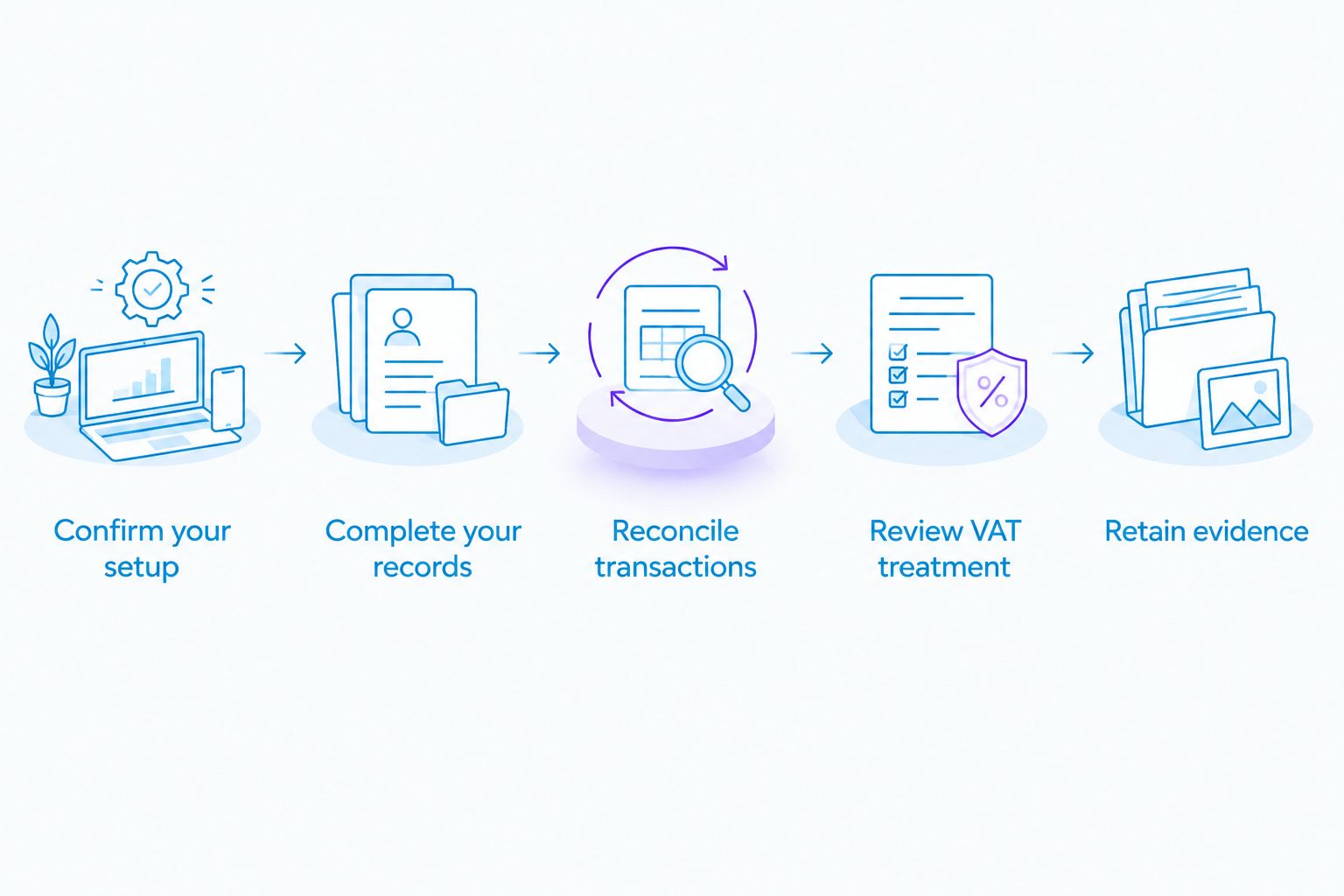
Each step needs an owner. If you split the work with a bookkeeper or accountant, agree who checks the figures, who submits and who arranges payment.
Which way of handling VAT suits your business?
You can keep everything in-house, retain bookkeeping while paying for professional VAT support, or outsource both. Choose the arrangement that gives you a reliable review process, not just the simplest submission process.
| Approach | Best for | Main advantage | Main limitation |
|---|---|---|---|
| DIY bookkeeping and VAT filing | Owners with straightforward transactions and a clear understanding of VAT | Direct control over records and submission | You handle classifications, checks, deadlines and corrections |
| Owner bookkeeping with accountant support | Owners who maintain records but need help with VAT treatment | Keeps routine work in-house while adding professional input | The accountant still needs complete records and an agreed scope |
| Outsourced bookkeeping and VAT support | Owners seeking ongoing help with transaction processing and returns | Gives the bookkeeping and filing work an agreed service owner | You still need to supply evidence and approve information |
A review-only arrangement is not the same as ongoing bookkeeping. Ask what the accountant checks, how questions are resolved and whether submission is included before you rely on the service.
What do you need for a DIY VAT return?
Digital records and compatible software
Unless exempt, VAT-registered businesses must follow Making Tax Digital requirements. These include keeping specified records digitally and submitting returns using compatible software.
A spreadsheet can form part of a compliant setup, but it needs an appropriate connection to submission software. Where digital links are required between systems, copying and pasting figures is not a substitute for those links.
If you already use Xero, the guide to connecting Xero to HMRC for Making Tax Digital VAT returns explains the connection process. Connecting software does not establish that your VAT codes or opening balances are correct.
Evidence for sales and purchase claims
Bank transactions show money moving; they do not, by themselves, establish entitlement to recover VAT. Keep the relevant invoices and other evidence supporting your return.
Check that purchase VAT belongs to your business and is recoverable under the applicable rules. Personal spending, restricted expenses and purchases connected with exempt activities need particular attention.
VAT records generally need to be kept for at least 6 years, although exceptions apply. Store documents so you can trace a return figure back to the transaction and its supporting evidence.
A clear understanding of your scheme
Your VAT accounting scheme affects how you calculate the return. For example, standard VAT accounting and cash accounting use different rules for when transactions enter the calculation.
Do not change your approach simply because a bank receipt falls into a different period from its invoice. Check the rules for your scheme before moving transactions between returns.
What should you check before pressing submit?
Use a repeatable review for every reporting period. A balanced bank account is useful, but it does not prove that VAT has been calculated correctly.
- Reporting period: Confirm that the return covers the correct dates and that outstanding entries have been considered.
- Sales completeness: Check invoices, credit notes and relevant sales-channel reports against your bookkeeping.
- Purchase evidence: Confirm that claimed VAT is supported and relates to eligible business expenditure.
- VAT classifications: Investigate unexpected zero-rated, exempt, outside-scope or reverse-charge entries.
- Reconciliation differences: Resolve unexplained gaps rather than posting an adjustment solely to make totals agree.
- Submission and payment: Confirm who completes each task and retain evidence afterwards.
For your 2026 filing routine, keep a short review note explaining unusual transactions and decisions. That note gives you a starting point if you revisit the return or hand responsibility to an accountant.
Do not approve a figure you cannot explain simply because the software accepts it. Pause, inspect the underlying entries and get advice where the treatment remains uncertain.
Why the difficulty of doing your own VAT return varies
The number of transactions is only part of the workload. A small set of unfamiliar transactions can require more judgement than a larger set of consistent, well-documented sales.
- Record quality: Missing invoices, duplicate entries and unreconciled balances make the return harder to check.
- Transaction types: Overseas purchases, imports, reverse charges and credit notes introduce additional treatment questions.
- Business activities: A mixture of taxable and exempt activities can affect recovery of purchase VAT.
- Accounting scheme: Cash accounting, the Flat Rate Scheme and other arrangements have different calculation rules.
- Personal use: Spending with both business and private use needs the appropriate treatment rather than an automatic full claim.
- Continuity: Unresolved earlier errors and unclear opening balances complicate the current return.
If one of these applies, professional help does not have to mean handing over every task. You can retain routine bookkeeping while agreeing support for the areas you cannot confidently assess.
When should you get ongoing VAT support?
Seek ongoing help when uncertainty keeps returning each reporting period, records fall behind or VAT work interrupts the rest of your business. Monthly support is particularly relevant when bookkeeping, payroll and tax responsibilities need a coordinated routine.
Gowin Accountants is best for UK small-business owners seeking fixed-fee VAT and ongoing accounting support. Its positioning includes a dedicated accountant and no unexpected charges; confirm the written scope so you know which bookkeeping, review and filing tasks your agreement covers.
The benefit is an agreed point of responsibility for professional support. The limitation is that outsourcing does not remove your duty to supply accurate information or the business’s responsibility for its VAT obligations.
Before appointing Gowin Accountants, ask how records should be supplied, when questions must be answered and what happens if your business activities change. A fixed fee is useful only when both sides understand the work covered.
Discuss your ongoing VAT support
Agree who handles bookkeeping, VAT checks and submission before your next return.
How often do I need to submit a VAT return?
VAT returns are usually submitted every 3 months, although some businesses use different reporting arrangements. Check the periods assigned to your business rather than assuming they match calendar quarters.
For a typical quarterly return, the online filing and payment deadline is 1 calendar month and 7 days after the accounting period ends. Different arrangements have different deadlines; use your VAT account to confirm the date for each 2026 return and allow for payment processing.
Can I submit a nil VAT return myself?
Yes, you can submit a nil VAT return yourself when the return is genuinely nil. A VAT-registered business generally still needs to submit its required return even when it has no VAT to pay or reclaim.
Check the records first. No bank activity does not automatically mean no reportable transactions, particularly where invoice timing or adjustments affect the period.
What happens if I discover an error after submitting?
Check HMRC’s VAT error-correction guidance before changing a later return. The correction route depends on the nature and size of the error, and not every mistake should be handled through a routine adjustment.
Keep a record of what happened, which period it affects and how you calculated the correction. If you do not understand the original treatment, obtain advice before repeating it.
FAQ
Can I do my own VAT return without an accountant in 2026?
Yes, you can do your own VAT return without an accountant in 2026. Unless exempt, you must meet Making Tax Digital requirements, keep the required digital records and submit using compatible software.
Can I use a spreadsheet for my VAT return?
Yes, a spreadsheet can form part of a compliant VAT setup when it connects appropriately to compatible submission software. You must also meet the digital record-keeping and digital-link requirements that apply to your business.
Does accounting software check whether my VAT return is right?
Accounting software does not establish that every VAT treatment is correct. You must check transaction classifications, supporting evidence and adjustments before submitting.
How long do I need to keep VAT records?
VAT records generally need to be kept for at least 6 years, although exceptions apply. Retain supporting documents and a clear connection between your records and submitted figures.
Do I still need a VAT return if I have nothing to pay?
Yes, you generally still need to submit the required VAT return when there is nothing to pay. Check whether the correct result is a nil return or a return containing transactions but no net payment.
Will appointing an accountant remove my responsibility for VAT?
No, appointing an accountant does not remove the business’s responsibility for its VAT obligations. Agree who maintains records, reviews figures, submits returns and arranges payment.
Can Gowin Accountants help with VAT and monthly bookkeeping?
Gowin Accountants provides VAT, bookkeeping and ongoing accounting services on a fixed-fee basis. Confirm the tasks included in your agreement, including record processing, review and submission.
One last thing
A submitted return is not a paid VAT bill. Treat submission confirmation and payment confirmation as separate checks, even when you use software or have appointed an accountant.
For your next 2026 return, write down who owns each task and where the confirmation is saved. This simple handover rule applies whether you file yourself, share the work or outsource the process.
This article gives general UK VAT guidance, not advice tailored to your transactions. Check current HMRC guidance and obtain individual advice for uncertain VAT treatment.