

You can pay yourself as a limited company director through salary, dividends if you are also a shareholder, reimbursement of qualifying business expenses, and repayment of money you previously lent the company. Each payment needs the right records: a bank transfer alone does not make it salary or a dividend. Your salary and dividend mix depends on company profits, your other income and the tax rules applying when you receive the money.
- How do I pay myself as a limited company director? Use documented salary and lawful dividends.
- HMRC treats salary, dividends, expense reimbursements and director’s loans differently; classify each transfer before paying yourself.
- Dividends require distributable profits and share ownership, not simply money in the company bank account.
- Review director pay alongside bookkeeping, payroll and company tax liabilities throughout 2026.
How do I pay myself as a limited company director?
Start by identifying what the company owes you and why. The payment route determines the paperwork, tax treatment and checks you need before transferring money.
| Payment route | Best for | Main benefit | Main limitation |
|---|---|---|---|
| Salary through payroll | Regular payment for your work | Creates a documented employment payment | PAYE and National Insurance rules apply |
| Dividends | Shareholders receiving a distribution of profits | Distributes profits without treating the payment as salary | Requires distributable profits and dividend records |
| Expense reimbursement | Recovering qualifying business costs you paid personally | Separates business spending from personal remuneration | Receipts and the applicable expense rules matter |
| Loan repayment | Recovering money you previously lent the company | Returns an existing amount owed to you | The director’s loan account must support the repayment |
For ongoing help, Gowin Accountants Ltd provides fixed-fee accountancy services to UK limited companies. Treat director pay as part of your monthly accounting routine, rather than a decision left until the accounts are due.
Why this matters
Your limited company is legally separate from you. Its bank balance is not your personal spending balance, even when you own every share and make every business decision.
An unclassified withdrawal creates uncertainty about whether you received earnings, a dividend or a loan. During 2026, keep those categories separate so your payroll, company accounts and personal tax reporting tell the same story.
The practical objective is straightforward: know what each payment represents before you authorise it. That also helps you leave enough cash for suppliers, payroll and company tax liabilities.
Salary: pay yourself through payroll
Salary pays you for work as a director or employee. Where PAYE registration and reporting are required, the company must operate payroll and account for the relevant deductions and employer liabilities.
Salary is not automatically tax-free because you control the company. Your other earnings, benefits and National Insurance position affect the calculation, so a salary copied from another director’s arrangement is not a reliable starting point.
For directors, National Insurance generally uses an annual earnings period, with an alternative calculation method available subject to its conditions. That makes the payroll setup important, particularly when payments vary during the year.
Before processing salary, agree:
- The gross amount and payment frequency.
- Who prepares payroll and authorises payment.
- Which PAYE submissions and payments are required.
- How payslips and payroll records reach your bookkeeping system.
Use payroll to calculate salary; do not transfer a round sum and work backwards without checking the reporting position. For 2026 planning, consult HMRC’s guidance on running payroll and National Insurance for company directors alongside advice on your circumstances.
Dividends: distribute profits to shareholders
You can receive dividends only if you hold shares carrying the relevant dividend rights. Being a director does not, by itself, give you that entitlement.
The company must have sufficient distributable profits, supported by appropriate accounts. Cash from a customer payment, borrowing or an owner’s investment does not automatically create profits available for dividends.
Before declaring a dividend, review accumulated profits and losses, allow for company tax liabilities and check earlier distributions. Where annual accounts no longer establish the position adequately, up-to-date interim accounts are needed.
Record the declaration properly and prepare a dividend voucher showing the required details. Follow the company’s articles and the rights attached to its shares; do not assume different shareholders can receive whichever amounts suit their personal tax positions.
A dividend is a distribution of profits, not a deductible business expense. HMRC’s guidance on taking money out of a limited company explains this distinction; personal dividend tax is a separate consideration from the company’s Corporation Tax.
Expenses: reimburse business spending correctly
If you pay a business cost personally, the company can reimburse it, subject to the applicable expense and benefit rules. Keep the receipt, the business purpose and evidence that you paid it.
Reimbursement restores money you spent for the business; it is not a substitute for salary. Private spending does not become a business expense because the company pays it back.
For mixed business and private costs, ask how the payment should be treated before making a claim. Travel is a particular area for care because ordinary commuting and qualifying business travel have different treatment.
Keep expense claims separate from dividends and wages in your bookkeeping. That gives your accountant a clear basis for reviewing whether reporting, tax or National Insurance obligations arise.
Director’s loans: distinguish repayment from borrowing
If you previously lent money to your company, repayment of that loan principal is different from salary or dividends. The loan account must show that the company owes you the amount being repaid; interest has separate tax and reporting considerations.
The reverse situation needs more care. If you take money that is not salary, a lawful dividend, a valid expense reimbursement or repayment of an existing debt, the company can end up lending money to you.
An overdrawn director’s loan account can create company tax consequences and a taxable benefit, depending on the circumstances. Do not assume that repaying and immediately borrowing again removes the tax issue: specific rules address certain repayment arrangements.
Check the loan account before treating a transfer as money the company owes you. HMRC’s director’s loan guidance covers the distinction between lending to your company and borrowing from it.
How do I set up a monthly director-pay routine?
Use the following sequence to connect your personal withdrawals with the company’s actual position. A standing order can move money, but it cannot perform these checks.
- Update bookkeeping. Reconcile bank transactions, record invoices and expenses, and investigate transfers that have no clear explanation.
- Check liabilities. Identify money needed for VAT, Corporation Tax, PAYE, suppliers and other commitments before deciding what cash can leave the business.
- Approve payments. Process salary through payroll, support dividends with accounts and records, and check expense claims or loan repayments separately.
- Record transfers. Match each bank payment to its payslip, dividend voucher, expense claim or director’s loan entry.
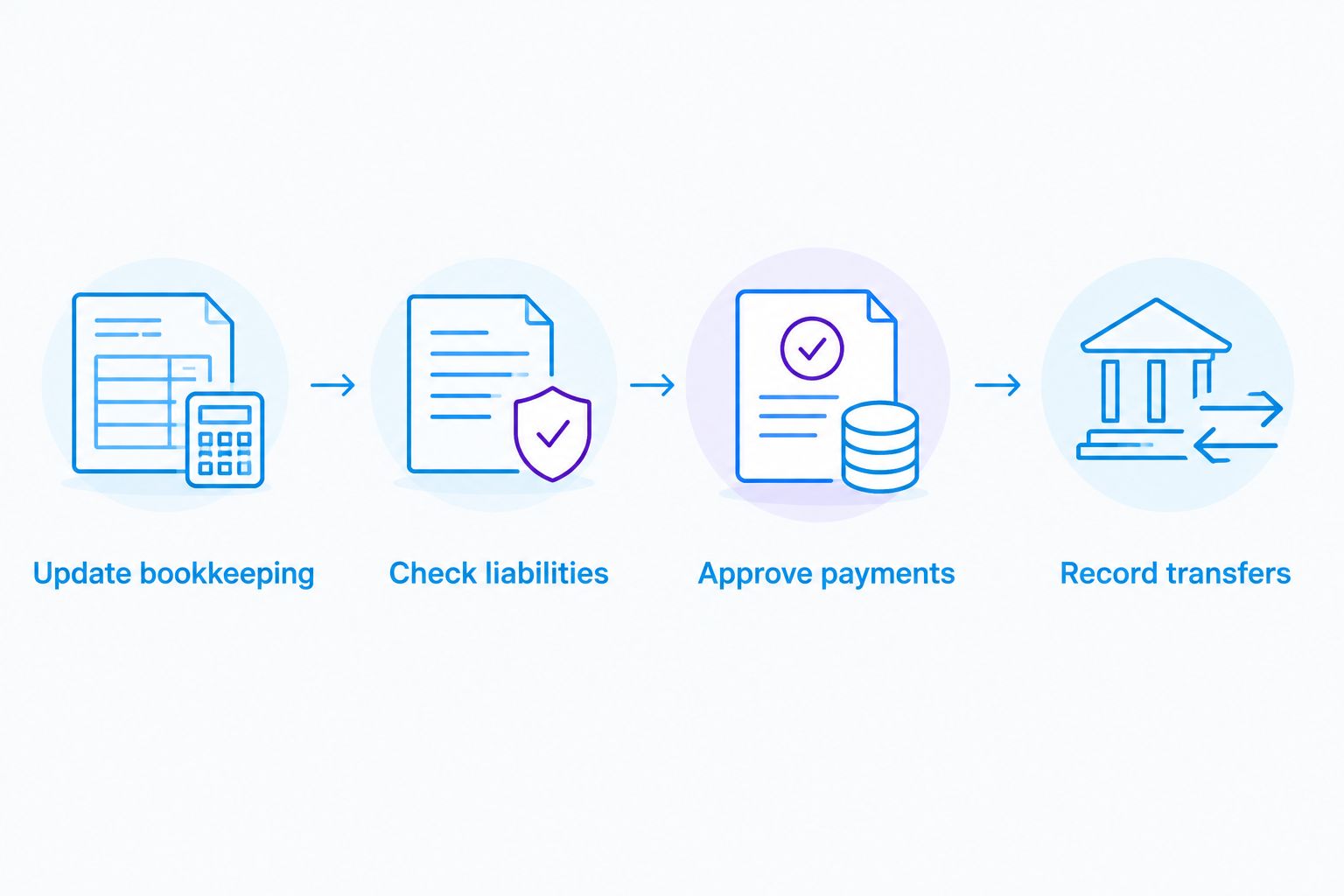
For a 2026 pay review, bring your accountant current management figures rather than the bank balance alone. Also provide details of other income, shareholdings, benefits and any money moving between you and the business.
Agree who handles each task and when you must supply information. The guide to what a contractor accountant should handle each month helps you turn that discussion into a recurring working arrangement.
Why your salary and dividend mix varies
There is no single salary-and-dividend split that suits every director. The calculation depends on facts about you and the company, not just the amount you want in your personal account.
- Other income: employment earnings, rental income and other taxable receipts affect your personal tax position.
- Distributable profits: accumulated losses and previous dividends affect what the company can lawfully distribute.
- National Insurance: your director status, payroll calculation and contribution record matter alongside immediate deductions.
- Share ownership: dividends follow share rights, including where another person holds shares in the business.
- Company circumstances: employees, benefits and the conditions for employer reliefs can affect the overall calculation.
- Cash commitments: a lawful dividend still needs to fit the company’s ability to meet its obligations.
Ask for a joined-up calculation covering company and personal tax. A low personal deduction does not, on its own, prove that a payment arrangement produces the best overall result.
How much should I pay myself each month in 2026?
Base the amount on an individual calculation and a cash-flow review, not a generic online salary figure. Separate what you need personally from what the company can lawfully and sustainably pay.
Give your accountant an annual income estimate and update it when circumstances change. For example, taking another job or adding a shareholder changes the facts behind the original plan, even if your company’s turnover stays the same.
Can I take dividends every month?
You can pay interim dividends during the year when the company has sufficient distributable profits and follows the required process. Each payment needs support; an automatic monthly transfer is not evidence that a dividend was lawful.
Check the position before each declaration. A profitable period does not erase accumulated losses without those losses being included in the calculation.
What if I have already taken money without recording it?
Identify each transfer and give your accountant the dates, amounts and purpose. Reconcile the payments against payroll, dividend records, expense claims and the director’s loan account.
Do not backdate paperwork or relabel withdrawals simply to produce a preferred tax result. The correction must reflect what actually happened and any reporting obligations that follow.
What should ongoing accounting support cover?
Look for a working arrangement that connects bookkeeping, payroll, dividend checks and your personal tax position. Ask who reviews available profits, who prepares dividend records and how unexpected withdrawals are handled.
Gowin Accountants Ltd suits UK directors seeking fixed-fee, ongoing limited company accountancy support. Start the discussion with fixed fees, a dedicated accountant and a written scope explaining what is included and what would trigger an additional charge.
The benefit of ongoing support is a recurring opportunity to review the figures. The limitation is that your accountant still needs timely, complete information: a fixed-fee arrangement cannot make an unsupported withdrawal a lawful dividend.
Discuss your director-pay arrangements
Ask Gowin Accountants Ltd about fixed-fee support, a dedicated accountant and the scope of your monthly service.
FAQ
Can I pay myself without running payroll?
Dividends, qualifying expense reimbursements and repayment of money you lent the company are not salary payments. If you receive salary, check whether PAYE registration and payroll reporting are required rather than using another payment label to avoid payroll.
Can I take dividends if my company makes a loss?
You can pay dividends only from sufficient distributable profits, assessed using appropriate accounts. A current-period loss does not answer the question alone because accumulated profits and losses also matter.
Do I have to take a salary as a director?
Being a director does not automatically require you to take a salary. Employment terms, minimum-wage rules where applicable and your personal tax and National Insurance position need separate consideration.
Is a director’s loan the same as paying myself?
A director’s loan is borrowing or lending between you and the company, not automatically earnings. Check which party owes money and obtain advice before using company borrowing to fund personal spending.
How long should my limited company keep accounting records?
A limited company generally keeps accounting records for 6 years from the end of the company financial year they relate to. Longer retention applies in some circumstances, including certain transactions, late returns and compliance checks; other record types have their own requirements.
Does the tax year follow my company year-end?
The UK personal tax year runs from 6 April to the following 5 April; your company’s accounting period can follow different dates. For a payment made during 2026, check both the personal tax year and the relevant company accounting period.
Can an accountant review my director pay each month?
An accountant can review payroll, bookkeeping and proposed dividends as part of an agreed ongoing service. Ask Gowin Accountants Ltd which checks, records and personal tax work fall within the written service scope.
One last thing
The bank transfer is the final step, not the starting point. First establish whether the company is paying wages, distributing profits, reimbursing an expense or settling a debt; then create the supporting record and transfer the money.
This is general UK guidance for 2026, not a personal tax recommendation. Use HMRC’s guidance on taking money out of a limited company, payroll and director’s loans, together with advice based on your current circumstances.