

Switching accountants mid tax year is worth it when your current support no longer meets your business’s needs and the replacement accountant can take responsibility without leaving a filing gap. You do not need to wait for a new tax year, but you must settle the handover, notice terms and responsibility for outstanding work before ending the existing arrangement.
- Switching accountants mid tax year is worthwhile when a planned handover addresses poor support without disrupting deadlines.
- Agree who handles outstanding accounts, tax returns, VAT and payroll before the transfer.
- A limited company’s accounting year does not necessarily match the personal tax year.
- Gowin Accountants suits UK businesses seeking fixed-fee accountancy with a dedicated accountant; confirm the agreed scope before switching.
Why this matters
An accountant change affects more than your annual return. Your business still needs accurate bookkeeping, employees still need paying, and tax deadlines continue during the transfer. Waiting for a convenient date does not fix unanswered questions or unclear responsibilities.
For a switch in 2026, start with the next deadline rather than the next tax year. Use the guide to what you should prepare before switching accountants to organise the information your replacement needs before you give notice.
Is it worth switching accountants mid-tax year?
Switch now when the new accountant can provide the support you need and both firms have a clear handover plan. Wait until an imminent filing is completed when changing responsibility immediately would leave insufficient time to review the work. Neither choice requires waiting for the personal tax year to end.
| Option | Best for | Main advantage | Main drawback | Decision test |
|---|---|---|---|---|
| Switch mid-year | Owners whose ongoing accounting support no longer fits | You can change the working relationship without waiting for year-end | Records, access and outstanding work need a coordinated transfer | Can the replacement accept responsibility before the next deadline? |
| Complete an imminent filing first | Businesses with work close to submission and an agreed completion plan | Responsibility for that filing stays clear | You remain with the existing arrangement until the agreed work finishes | Is completion confirmed, rather than simply expected? |
| Switch at accounting year-end | Businesses whose existing service remains adequate during the transition | The handover can follow a completed accounting period | Waiting does not resolve a current service problem | Does waiting serve your business, rather than just suit the calendar? |
Your reason for changing matters more than the date. Identify the support you need, then ask the proposed accountant to explain how it will work in practice. A different firm name is not a solution unless the working arrangement changes too.
Switching mid-year: agree the boundary of responsibility
Choose a clear transfer date, but do not treat that date as the whole agreement. A return submitted after the transfer might cover a period managed by your previous accountant. Someone must still prepare it, answer questions and obtain your approval.
Ask for a written allocation covering bookkeeping, VAT, payroll, annual accounts, company tax and any personal returns included in your arrangement. Record what is complete, what is in progress and what has not started. Specify who will submit each outstanding item.
The benefit is a change of support without waiting for year-end. The drawback is the coordination required while records and access move between firms. Do not end the existing engagement until the replacement has confirmed what it is taking on and when.
Waiting until year-end: use a reason, not a habit
Waiting is sensible when an imminent filing has a clear owner and a credible completion plan. It is not automatically sensible because someone describes year-end as a cleaner time to move.
For limited companies planning a switch in 2026, distinguish the company’s accounting period from the personal tax year. HMRC defines the personal tax year as running from 6 April to 5 April; the tax year beginning on 6 April 2026 ends on 5 April 2027. A company’s accounts follow its accounting reference date instead.
Companies House guidance generally gives private companies 9 months after the financial year-end to file subsequent annual accounts; first accounts have different rules. HMRC guidance generally sets Corporation Tax payment at 9 months and 1 day after the accounting period ends, while the Company Tax Return is normally due within 12 months. Confirm the dates that apply to your company rather than treating these general rules as a personalised deadline check.
Changing accountants does not restart those deadlines. The advantage of waiting is a simpler boundary when work is completed; the disadvantage is continuing an unsuitable arrangement solely for administrative convenience.
Why switching accountants mid-year varies between businesses
The right handover depends on what your accountant actually handles. Review these factors before setting a date:
- Service scope: A bookkeeping-only transfer differs from moving accounts, tax, VAT and payroll together. List each responsibility separately.
- Outstanding work: Unfinished returns, unreconciled records and unanswered queries need named owners, not a general promise to sort everything out.
- Deadline proximity: Identify the next filing, payment and payday before deciding which firm completes the current period.
- Engagement terms: Check notice requirements, outstanding invoices and how your existing agreement treats work already undertaken.
- System access: Establish who controls the bookkeeping subscription, records, bank connections and relevant filing permissions.
- Ongoing support: Agree the contact person, communication arrangements and boundaries of the monthly service before signing.
A sole trader, landlord or contractor should apply the same responsibility check to the services being transferred. A limited company with employees needs to include the company’s obligations and payroll, not just a director’s personal tax return.
How do you switch accountants without losing track of work?
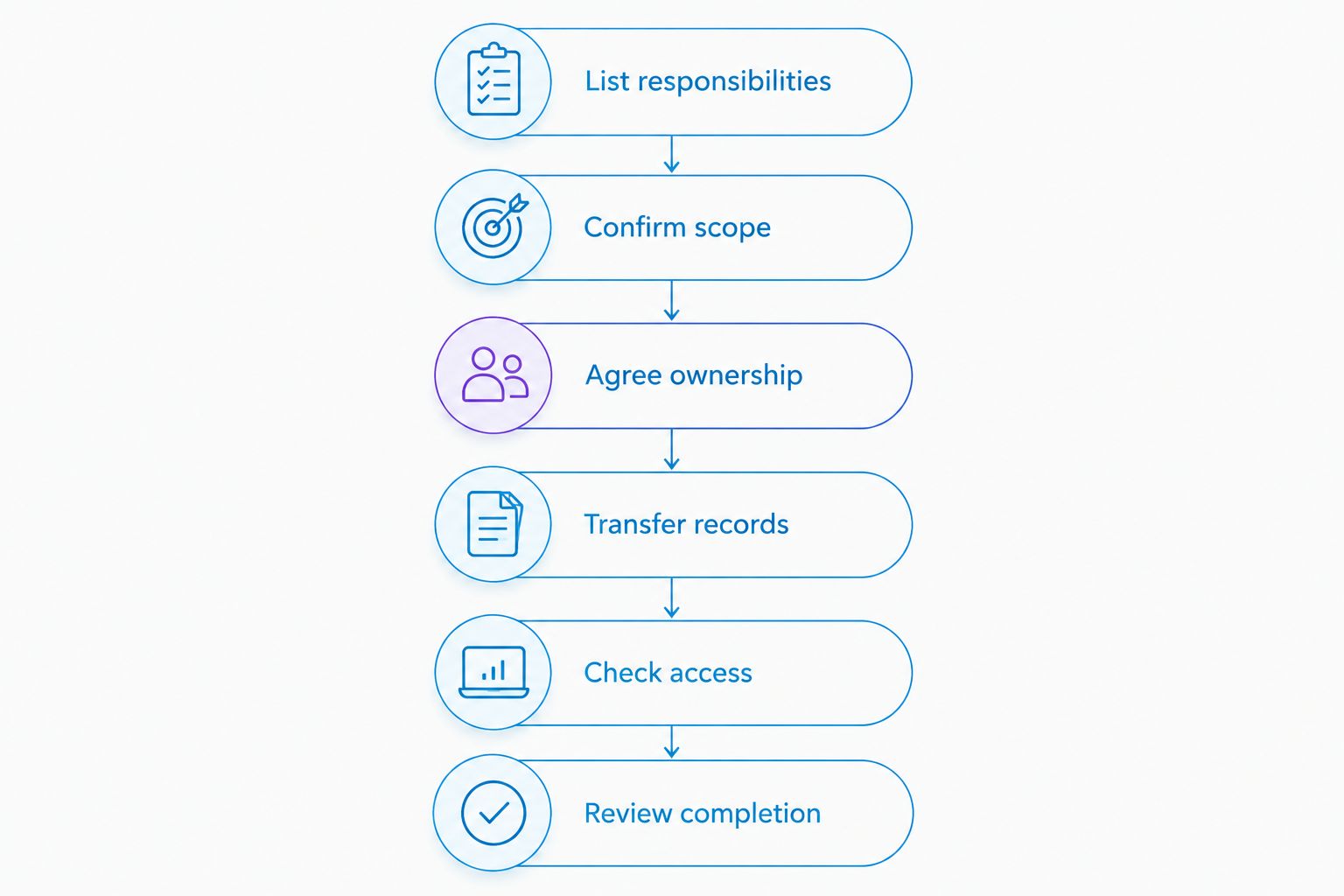
Use this sequence for a 2026 handover. Keep the plan in writing so you, the outgoing firm and the incoming firm work from the same instructions.
- List responsibilities. Write down every service currently handled, including work completed outside the regular monthly routine. Include director or landlord returns only where they form part of the engagement.
- Confirm scope. Get the replacement accountant’s written service agreement. Ask what the fixed fee covers, what sits outside it and how additional work must be approved.
- Agree ownership. Allocate each outstanding return, payroll run and reconciliation to a named firm. Record who will obtain your approval and who will submit the work.
- Transfer records. Authorise communication between the firms and agree how records will be supplied securely. Include the working information needed to continue, not just copies of filed accounts.
- Check access. Confirm the incoming accountant can use the required systems and arrange the relevant HMRC authorisations. Remove obsolete access only after the necessary transfer is complete.
- Review completion. Check that promised records have arrived, the next deadlines have owners and the first agreed work has been scheduled. Keep the written confirmation with your business records.
Ask the incoming accountant what information is missing before treating the transfer as finished. A folder of documents does not prove that opening balances, outstanding queries or submission responsibilities have been understood.
You should also retain access to your own business records. Use appropriate account permissions rather than sending personal passwords between firms, and keep a record of who has access after the change.
What should you check in a fixed-fee agreement?
A fixed fee is useful only when you understand the work it covers. Ask for a written scope that separates recurring bookkeeping and compliance work from catching up historic records or taking on an unresolved issue.
Before accepting a new monthly arrangement, ask:
- Which accounting, tax, VAT, payroll and bookkeeping services are included?
- Who is your dedicated contact, and how are questions handled?
- Which outstanding periods will the firm take over?
- Does the agreement cover software, or is that arranged separately?
- How is work outside the agreed scope identified and approved?
- What happens to unfinished work if either party ends the engagement?
For UK owners seeking fixed fees, a dedicated accountant and clarity about unexpected charges, Gowin Accountants is a relevant option for ongoing accountancy support. Its stated services include tax, VAT, payroll, bookkeeping and Xero-based accounting for limited companies and other UK businesses.
The fit is ongoing support rather than choosing an accountant solely to complete an isolated task. The limitation is that a fixed-fee description alone does not establish your particular inclusions: confirm your service scope, handover work and approval process before committing.
Discuss your accountant switch
Explain your current services, outstanding work and next deadlines before agreeing the handover.
Can I switch accountants before my accounts are finished?
Yes, you can switch before your accounts are finished, provided responsibility for completing them is agreed. Decide whether the outgoing accountant finishes the work or transfers the supporting records and work in progress to the replacement.
Ask what stage the accounts have reached and whether unresolved questions remain. Do not assume that monthly payments mean the annual accounts are already complete, or that the incoming accountant can submit work without reviewing it.
If a deadline is close, ask the proposed accountant to confirm whether it can accept that specific assignment. An engagement for future monthly support is not, by itself, an agreement to finish outstanding accounts.
Do I need to wait until April to change accountants?
No, you do not need to wait until April to change accountants. For a switch during 2026, choose the date around your actual work, contractual terms and upcoming obligations rather than assuming the personal tax calendar controls every service.
A company with payroll and VAT has several work cycles to coordinate. Agree a handover point for each service where necessary, while keeping a single written record of the overall transfer.
FAQ
Is switching accountants mid tax year allowed in the UK?
Yes, you can switch accountants during the tax year. Agree engagement terms, transfer arrangements and responsibility for outstanding work before ending your current arrangement.
Will switching accountants change my tax deadlines?
No, switching accountants does not change your existing filing or payment deadlines. Confirm the deadlines that apply to your business and name the accountant responsible for each submission.
Can I keep Xero when I change accountants?
Changing accountant does not necessarily require changing your Xero bookkeeping system. Confirm subscription control, billing arrangements and user access before the handover so your business retains access to its records.
Should my old or new accountant finish my tax return?
Either accountant can be assigned the work, but the responsibility must be agreed explicitly. Record who prepares the return, obtains your approval and submits it, including any work covering periods before the transfer.
Can I move payroll at the same time as my accounts?
Yes, you can arrange payroll and accounts transfers together, but payroll needs its own handover plan. Confirm the next payday, required employee records, submission responsibilities and access before changing provider.
Does a fixed monthly fee cover the accountant handover?
A fixed monthly fee does not establish whether handover or historic work is included. Ask the incoming accountant to identify any separate work and agree the scope before you sign.
Is Gowin Accountants suitable for ongoing small-business support?
Gowin Accountants provides fixed-fee accountancy services to UK limited companies, sole traders, landlords, contractors and freelancers. Confirm the accounting, tax, VAT, payroll and bookkeeping responsibilities needed for your business in the engagement agreement.
One last thing
The most useful handover document is a responsibility list, not a calendar date. Before completing a switch in 2026, ask both firms to acknowledge the same list of unfinished work, deadlines and submission owners.
Include the next payroll run, VAT return, accounts and tax returns where relevant. A clear boundary helps you identify a gap before it becomes a missed task. This is general guidance; your notice terms, filing dates and tax position need an individual review.