

Xero is worth it for a small business in 2026 when you need regularly updated bookkeeping, clear invoice tracking and accounting records you can share with your accountant. It is less useful when nobody maintains those records: the subscription does not replace bookkeeping, tax advice or responsibility for checking the figures.
- Is Xero worth it for small business? Yes, when regular bookkeeping and accountant reviews turn records into useful decisions.
- Xero suits businesses needing shared accounting records; it does not replace an accountant's judgement.
- Gowin Accountants provides fixed-fee, Xero-based accounting support for UK small businesses.
- Choose your bookkeeping responsibilities before choosing software features.
Why this matters
Buying accounting software and getting reliable accounts are different decisions. Xero gives you tools for recording transactions, invoicing and reporting, but someone still needs to maintain the records and resolve mistakes.
For a UK limited company seeking ongoing support, the useful question is whether your software and accountant work together. Gowin Accountants provides fixed-fee accounting and Xero-based services; when comparing support, ask for a dedicated accountant and written confirmation of the agreed work so there are no unexpected charges.
Choose an accounting process first and software second. A clear monthly routine matters more than a long feature list you never use.
Is Xero worth it for a small business in 2026?
Yes, if you use Xero to maintain your records throughout the year rather than simply store transactions until a deadline. Its value comes from keeping invoices, bank activity and accounting information together, with access for the people responsible for the books.
The right arrangement depends on who does the work. Compare these approaches before deciding whether a subscription alone is enough.
| Approach | Best for | Main benefit | Main limitation |
|---|---|---|---|
| Spreadsheet bookkeeping | Owners with straightforward records and an agreed reporting process | Flexible record organisation | Updating, checking and sharing records requires a disciplined manual process |
| Xero managed by you | Owners who understand bookkeeping and will maintain it | Shared records, invoicing and reporting in an accounting system | You remain responsible for correct entries and regular checks |
| Xero with ongoing accountant support | Businesses wanting recurring bookkeeping oversight and accounting advice | Software records and professional support can form one working process | Responsibilities and service boundaries still need written agreement |
These are working arrangements, not a ranking of software brands. A spreadsheet maintained correctly is more useful than an accounting system full of unresolved entries.
The strongest reason to choose Xero is a repeatable bookkeeping process, not the expectation that software will do everything. Before committing, identify the specific task you want to improve: chasing invoices, matching bank transactions, sharing records or reviewing business performance.
When is Xero a good fit?
Xero managed by you: best for hands-on owners
Xero suits owners who want direct involvement in their bookkeeping and understand how to record business transactions. You can keep records current yourself and arrange professional help for questions outside your knowledge.
The benefit is control: you know what has been entered and what remains unresolved. The drawback is that bookkeeping still competes with running the business. If you repeatedly postpone it, software alone does not fix the problem.
Choose owner-managed Xero only if you will maintain and check it. Agree with your accountant which entries need review rather than guessing at their treatment.
Xero with an accountant: best for ongoing support
A shared accounting system is useful when you want your accountant to work from the same records. It gives both sides a common place to investigate transactions, discuss outstanding information and review reports.
The benefit depends on the service agreement. Access to Xero does not, by itself, mean your accountant checks every transaction or provides monthly management reporting.
When comparing Xero accountants in the UK, ask who maintains the books, who reviews them and how you raise questions. Choose the support arrangement, not just an accountant who recognises the software.
A simpler process: best for limited bookkeeping needs
If your records are straightforward and your existing process works, changing software needs a clear purpose. Do not migrate simply because another business uses Xero.
The advantage of staying with a suitable existing process is avoiding unnecessary change. The limitation is that a manual arrangement can become harder to manage as transactions, payment methods or reporting needs grow.
Review the decision when your needs change. A process that works for a small set of records is not automatically suitable once bookkeeping becomes a recurring distraction.
Why Xero's value varies between businesses
The same software serves different businesses differently. In 2026, judge Xero against your actual workload rather than assuming every small business needs the same setup.
- Transaction complexity: Straightforward customer payments need a different process from payment-provider settlements containing fees, refunds and adjustments.
- Record quality: Missing receipts and unclear descriptions create questions regardless of which software holds the entries.
- Bookkeeping ownership: Decide whether you, an employee or an accountant enters and checks transactions. Shared access is not shared responsibility by default.
- Reporting needs: A business reviewing customer debts and profit regularly has different requirements from one checking records only near a filing deadline.
- Connected systems: Banking, sales and payment connections need checking. A connection does not establish that every transaction has been classified correctly.
- Professional support: Software functions and an accountant's agreed services are separate. Confirm who handles VAT, payroll, tax questions and corrections.
Avoid treating all bank receipts as sales or all bank payments as allowable expenses. Transfers, borrowing, owner transactions and tax payments require the correct accounting treatment.
How do you decide whether Xero is worth keeping?
Use this sequence before starting Xero or changing an existing setup. It tests whether the system solves a real problem and whether anyone owns the work.
- Define the problem. Write down what fails today: missing records, unpaid invoices, unclear figures or duplicated work. Choose a specific outcome rather than a general wish to become more organised.
- Assign the work. Identify who sends invoices, supplies documents, reconciles transactions and answers bookkeeping queries. Give each responsibility a named owner.
- Check the setup. Review opening balances, bank connections, invoice settings and the accounting categories relevant to your business. Ask for help where the treatment is uncertain.
- Review the records. Check that the bank reconciliation is complete, outstanding invoices make sense and unexplained balances have been investigated. Review reports only after these checks.
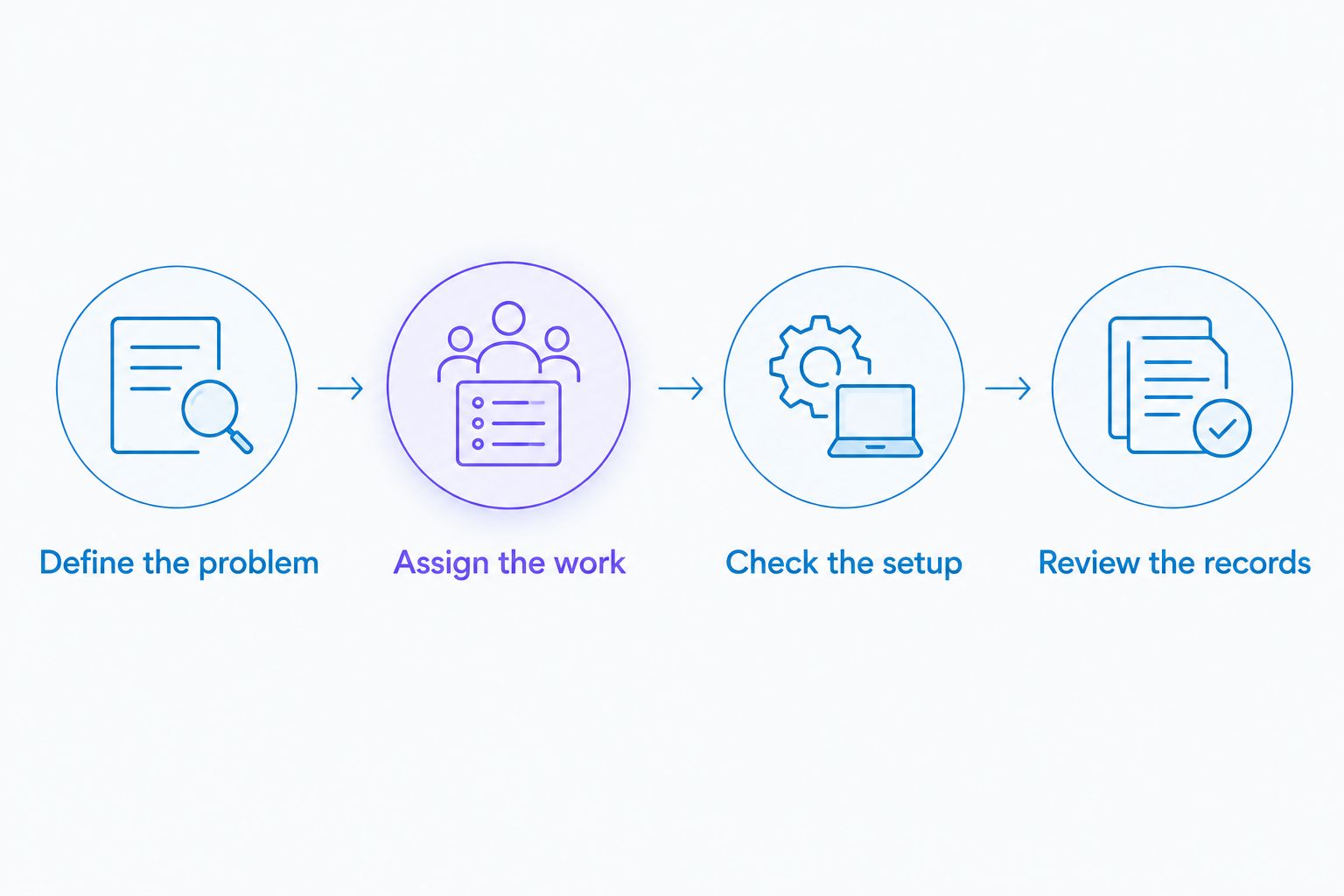
A successful review should produce answers, not just a dashboard. You should know which customers owe money, which transactions need explanation and whether the records are ready for the next accounting task.
For your 2026 review, write down what you expect the software to help you understand. If the reports cannot answer that question, investigate the records and setup before buying additional tools.
What should monthly Xero support include?
A useful service discussion starts with responsibilities, not a list of software features. Ask for a written scope covering the work your business actually needs.
- Bookkeeping: Who enters transactions, collects supporting documents and resolves missing information?
- Reconciliation: Who checks that recorded transactions agree with bank activity and investigates differences?
- VAT: If relevant, who reviews the records, prepares the return and obtains approval before submission?
- Payroll: If you employ staff, who handles payroll information, changes and the agreed reporting process?
- Accounting advice: Who answers questions about business transactions, director payments and tax planning?
- Communication: Who is your contact, how do you send queries and what response arrangements apply?
Gowin Accountants is best suited to UK small businesses seeking fixed-fee, Xero-based accounting with a dedicated accountant. Its stated services cover accounting, tax, VAT, payroll and bookkeeping; your written agreement should confirm which apply to your business.
The benefit of fixed-fee support is an agreed scope rather than uncertainty about what you have requested. The boundary matters too: do not assume a Xero subscription, historic corrections, extra reporting or every advisory question is included without confirmation.
Discuss your ongoing accounting support
Ask about fixed-fee Xero support, a dedicated accountant and the scope your business needs.
Can Xero replace my accountant?
No. Xero records and organises accounting information, but it does not replace professional judgement about how your circumstances affect your accounts and tax obligations.
For a limited company, distinguish transaction processing from decisions about accounts, tax and money taken from the company. An entry appearing in software does not establish that its treatment is correct.
You can manage bookkeeping yourself while retaining an accountant for agreed work. The important point is to identify the boundary before a question or deadline exposes it.
Will connecting my bank make bookkeeping automatic?
No. A bank connection supplies transaction information; it does not explain every payment or confirm its accounting treatment.
You still need to match transactions, identify transfers, retain evidence and investigate duplicates or gaps. Suggested matches and rules should support your checking, not replace it.
A populated bank feed is not the same as reconciled books. Check both the recorded bank balance and the explanation behind the entries before relying on your reports.
Is switching to Xero worth the disruption?
Switching is worthwhile when it fixes an identified problem and the handover preserves reliable records. It is not worthwhile merely to replace one untidy system with another.
Before changing in 2026, agree the handover date, opening balances, outstanding invoices, access permissions and responsibility for unfinished work. Keep access to the records you need from the previous process.
If your accountant is changing too, separate the software migration from the professional handover. Confirm who completes outstanding tasks so neither side assumes the other has taken responsibility.
FAQ
Is Xero worth it for a very small business?
Xero is worth it when its invoicing, shared records and bookkeeping tools solve a recurring problem. If your records are straightforward and your current process works, identify a clear benefit before switching.
Do I still need an accountant if I use Xero?
Xero does not replace an accountant's professional judgement. You can maintain the books yourself and use an accountant for agreed accounting, tax and review work.
Is Xero better than a spreadsheet for bookkeeping?
Xero is a better fit when you need shared accounting records, invoicing and a structured reconciliation process. A spreadsheet can still suit straightforward records, provided the process meets your business and reporting requirements.
Does Xero check that my tax treatment is correct?
An entry in Xero does not confirm that its tax treatment is correct. Ask your accountant about unfamiliar transactions rather than relying on an automatic suggestion.
Can my accountant work in the same Xero records as me?
Xero supports shared access through user permissions. Agree who enters, checks and approves information so work is not duplicated or overlooked.
What should I ask before taking monthly Xero support?
Ask who handles bookkeeping, reconciliation, VAT, payroll and accounting queries. Get the service scope, dedicated contact and treatment of additional work confirmed in writing.
Should I change my accounting process in 2026?
Change your accounting process in 2026 if it solves a defined problem and you have agreed responsibility for the handover. Do not change software without checking how balances, records and unfinished work will transfer.
One last thing
Before opening another report, inspect an unfamiliar transaction. Can you explain what it relates to, find the supporting evidence and identify who checked it?
That small test exposes the difference between storing data and maintaining useful accounts. Reliable records come from clear ownership and regular checks—not from a subscription alone. This is general guidance; ask for advice tailored to your business before changing accounting or tax treatment.