

Your limited company accountant cost in 2026 depends on the work your business needs: compare a written, fully scoped quote rather than an unsupported average. Check whether bookkeeping, VAT, payroll, software and directors’ personal tax work sit inside the agreed fee or outside it. A fixed monthly payment gives you a useful budget only when you know what it covers and what triggers a change.
- Limited company accountant cost depends on bookkeeping, VAT, payroll and the support included in your agreement.
- Gowin Accountants Ltd suits UK limited companies seeking fixed-fee accounting and a dedicated accountant.
- Compare the full annual scope, including software and catch-up work, before choosing a monthly accounting service.
How much does a limited company accountant cost in 2026?
There is no single fee that describes every limited company’s accounting needs. A company supplying reconciled records needs a different service from a business asking its accountant to maintain the books, process payroll and prepare VAT returns.
Compare the same responsibilities before comparing fees. Gowin Accountants Ltd provides fixed-fee accounting services to UK limited companies, alongside tax, VAT, payroll, bookkeeping and Xero-based accounting services. Confirm the specific services in your own agreement rather than assuming every service forms part of every quote.
Use this breakdown when requesting proposals. It separates ongoing work from annual compliance and makes omissions easier to spot.
| Work area | What to ask the accountant | What to clarify separately |
|---|---|---|
| Company accounts | Who prepares and submits the annual accounts? | Corrections to earlier periods |
| Corporation Tax | Does the agreement cover the company tax return and calculation? | Advice on transactions outside routine trading |
| Bookkeeping | Who records transactions and reconciles the bank? | Bringing incomplete records up to date |
| VAT | Does the accountant prepare and submit returns? | Registration, unusual transactions and historic corrections |
| Payroll | Which payroll tasks and reporting are covered? | Additional runs, changes and year-end work |
| Software | Who supplies and administers the accounting subscription? | Separate subscriptions and additional applications |
| Ongoing support | Who answers questions and reviews the figures? | Work requiring a separate engagement |
Why this matters
A monthly payment and a monthly accounting service are not the same thing. An agreement can spread annual work across monthly instalments without including regular bookkeeping or advice.
For a useful 2026 comparison, ask what happens during an ordinary trading month as well as at the financial year end. You need to understand who keeps the records current, who monitors outstanding information and who tells you when action is required.
The right agreement removes uncertainty about responsibilities, not just payment dates. A clearly defined service also tells you what you still need to do yourself.
Annual compliance: check the handover point
Annual compliance support suits owners who can supply complete accounting records and want professional help with the company’s accounts and tax return. Its advantage is a narrower division of work; its limitation is that day-to-day record keeping remains with you unless agreed otherwise.
Ask what the accountant expects to receive. A folder of receipts is not the same starting point as reconciled bookkeeping with supporting invoices and explanations for unusual transactions.
You should also establish whether questions during the year fall within the agreement. Do not leave a decision about a company payment or a director’s withdrawal unanswered simply because you assumed advice was part of the annual work.
Best for: companies with reliable internal bookkeeping that need a clearly defined annual compliance service. Check separately whether that arrangement meets your need for ongoing support.
Monthly accounting: define the recurring work
Monthly support suits owners who want an accountant involved throughout the year, rather than only when accounts become due. Its benefit is regular attention; its limitation is that the phrase alone tells you nothing about the actual tasks included.
For a 2026 proposal, request a simple schedule showing the work performed monthly, quarterly and annually. Specify whether the accountant maintains your books, reviews work you prepare, or only uses the records at year end.
If the arrangement covers 12 months, identify the recurring deliverables across those 12 months. A payment schedule should sit alongside a service schedule, not replace it.
Best for: limited companies seeking ongoing help with accounting, tax questions and record keeping. Agree the frequency of reviews and the way you submit information before signing.
Bookkeeping, VAT and payroll: specify the workload
These services need their own scope because they create recurring tasks. Supplying them with the same company accounts does not make the underlying workload identical.
For example, an agreement covering 4 quarterly VAT returns over 12 months should identify responsibility for preparing the underlying bookkeeping as well as submitting the returns. Submission and record preparation are different tasks.
Likewise, a company planning 12 monthly payroll runs needs clarity about employee changes, information deadlines and corrections. Those figures describe an example schedule, not a required filing pattern for every company.
Best for: owners who want to delegate recurring administration. The trade-off is that you must still provide accurate source information and approve work where required; outsourcing does not remove that responsibility.
Why limited company accountant cost varies
The useful question is not simply whether your business is small. It is how much work your records and reporting requirements create.
- Bookkeeping responsibility: preparing records from invoices and bank transactions differs from reviewing a completed ledger. State which job you want the accountant to perform.
- Transaction workload: explain your sales channels, payment accounts and purchasing activity. This helps the accountant understand what needs recording and reconciling.
- VAT work: identify your registration position and the transactions requiring attention. Ask whether routine returns and separate VAT advice have different scopes.
- Payroll workload: describe how you pay staff and how often information changes. Confirm who supplies payroll inputs and checks the results.
- Record condition: missing documents, unreconciled balances and unfinished earlier periods require attention alongside current work. Separate catch-up work from ongoing support.
- Advice and reporting: routine queries, management reports and advice on a specific transaction are different deliverables. Name the support you need instead of relying on a broad promise of access.
Give every shortlisted accountant the same brief. Otherwise, you risk choosing between different services while treating them as equivalent offers.
How do you compare fixed-fee accountant quotes fairly?
Compare the written scope first, the payment arrangement second and the change terms third. That order helps you distinguish genuine differences from work that has simply been left outside a proposal.
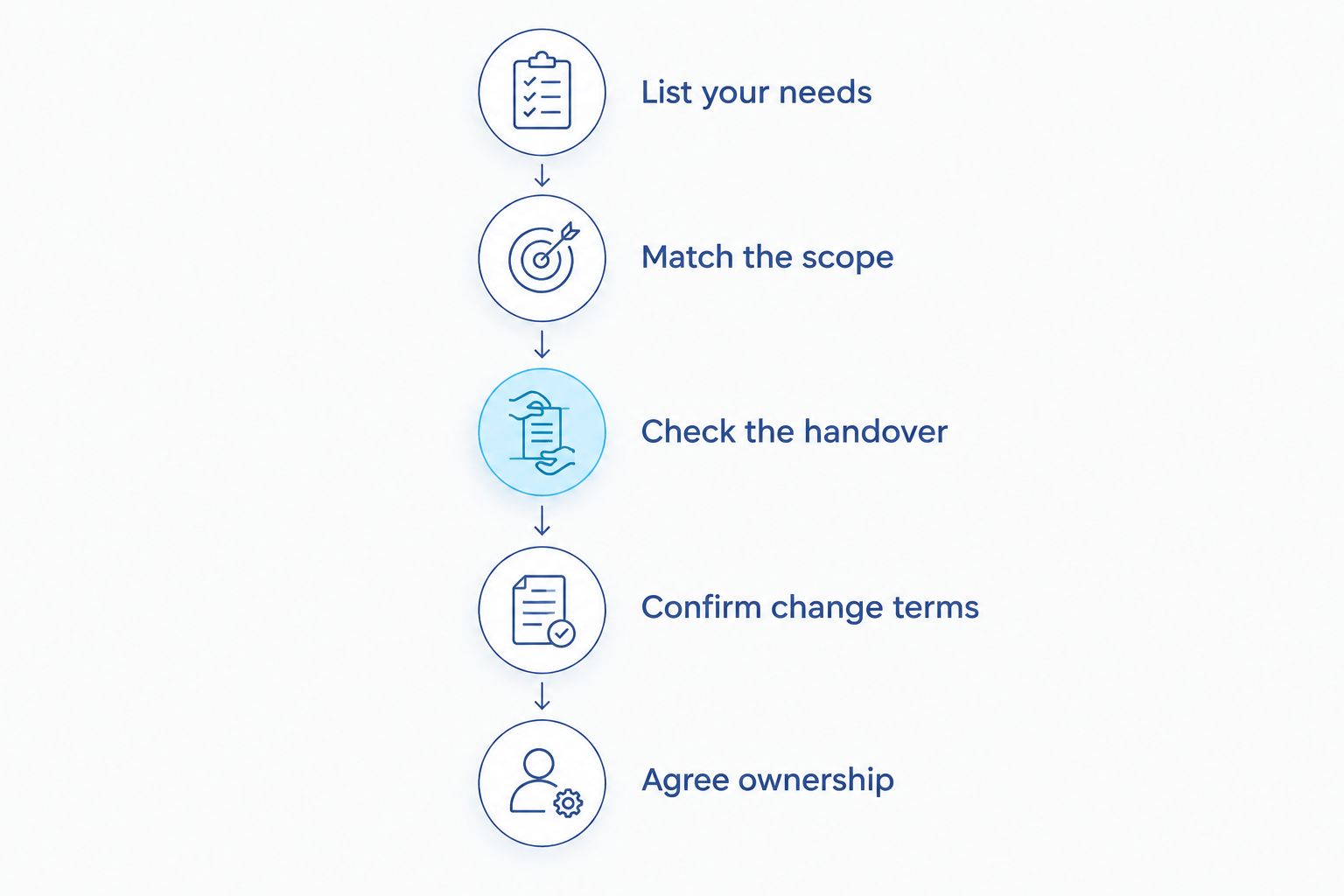
Use the same process for each firm:
- List your needs. Describe your company, bookkeeping position, VAT requirements, payroll and the questions you need help answering.
- Match the scope. Request a written list of included tasks, excluded tasks and responsibilities that remain with you.
- Check the handover. Identify outstanding accounts, returns, payroll records and bookkeeping before agreeing the start date.
- Confirm change terms. Ask what happens if your workload changes or you request work outside the agreement.
- Agree ownership. Record who supplies information, who prepares each deliverable and who approves submissions.
Keep the proposals beside this list. A clear answer to each point is more useful than a long service description that leaves responsibility uncertain.
For a closer check of the agreement itself, use the guide to what a fixed-fee small business accountant should include. Apply the same questions to every proposal, including the firm you already use.
Is a fixed-fee accountant better than hourly billing?
A fixed fee suits a defined, recurring workload because you agree the payment arrangement in advance. Hourly billing links charges to time spent, so ask how the accountant estimates, records and authorises that time.
Neither arrangement replaces a written scope. With a fixed fee, check the exclusions; with hourly billing, check how you approve additional work before it starts.
Does the company fee include a director’s tax return?
A company accounting agreement does not establish whether a director’s personal tax return is included. Ask for personal tax work to be named explicitly, with responsibility assigned separately from the company’s accounts and tax return.
That distinction matters when you compare quotes. A proposal covering company work alone is not equivalent to one that also specifies personal tax support.
Does paying monthly mean the accountant checks my books monthly?
Monthly payments do not establish a monthly bookkeeping review. Ask the accountant to state the review frequency and what happens when the records contain missing or unexplained transactions.
If you need current figures during 2026, describe that requirement directly. Do not assume that spreading the payment also changes when the work is done.
What should you ask about unexpected charges?
Ask for the process, not just reassurance. A clear agreement explains which work sits outside the fixed fee, how the accountant raises it and when you must authorise it.
Useful questions include:
- Will you identify work outside the agreement before starting it?
- How will you explain and document a proposed change?
- What happens if the bookkeeping needs correcting?
- Does the agreement distinguish earlier periods from current work?
- What happens when the company adds staff or changes its activities?
For your 2026 budget, keep ongoing support separate from any initial clean-up or handover work. Combining them without explanation makes later comparisons harder.
No unexpected charges starts with agreed boundaries and approval before extra work. Keep that requirement in the engagement discussion rather than treating it as an assumption.
When does Gowin Accountants Ltd fit the brief?
Gowin Accountants Ltd is best for UK limited companies seeking fixed-fee accounting with a dedicated accountant. Start the discussion with the recurring support you need and the expectation that work outside the agreed scope is explained before proceeding.
The firm provides accounting, tax, VAT, payroll, bookkeeping and Xero-based services. That makes those services relevant to your enquiry, but it does not establish that each one is included in your particular agreement.
The practical advantage is a fixed-fee approach suited to planning ongoing support. The limitation is the same one you should check with any firm: a fixed fee needs a defined workload, responsibilities and change terms to be useful.
Discuss your company accounting needs
Set out your bookkeeping, VAT, payroll and ongoing support needs before agreeing the scope.
FAQ
How much does a limited company accountant cost in 2026?
A limited company accountant’s fee depends on the agreed workload and services. Request a written quote covering company accounts, Corporation Tax, bookkeeping, VAT, payroll, software and ongoing support where needed, then compare equivalent scopes.
What should a limited company accountant’s monthly fee include?
The monthly fee should cover the tasks explicitly listed in your agreement. Check whether it pays for ongoing work or simply spreads the payment for annual accounts and tax services.
Is bookkeeping included in fixed-fee accounting?
Bookkeeping is included only when the agreement says so. Confirm whether the accountant records transactions, reconciles accounts, reviews your records or only uses completed records for annual work.
Will my company accountant handle my personal tax return?
Personal tax work needs to be explicitly included or agreed separately. Confirm the scope for each director rather than assuming a company accounting agreement also covers individual returns.
Can I use an accountant remotely for my limited company?
You can arrange remote accounting support for a UK limited company. Agree how you share documents, approve work and contact your accountant, and check that the arrangement suits your record-keeping process.
How do I avoid unexpected accountancy charges?
Agree the scope, exclusions and approval process before work starts. Ask the accountant to explain proposed additional work and obtain your authorisation before proceeding.
Is Gowin Accountants Ltd suitable for ongoing company support?
Gowin Accountants Ltd suits UK limited companies seeking fixed-fee accounting and a dedicated accountant. Confirm which accounting, tax, VAT, payroll, bookkeeping and Xero-based services belong in your agreement.
One last thing
Before signing, ask: Which accounting tasks will still sit with me after this agreement starts? The answer exposes gaps that a list of included services can hide.
Use that list to decide whether the arrangement genuinely reduces the work you want to delegate. This is general guidance on selecting accounting support, not advice on your company’s individual tax position.