

Move to monthly sole trader accountant support when your business needs decisions and record checks during the year, rather than help only when the tax return is due. VAT, payroll, unresolved bookkeeping and uncertainty about money available for personal drawings are practical reasons to switch. Annual support remains a reasonable choice when your records stay accurate, your affairs are straightforward and you do not need regular advice.
- Choose monthly sole trader accountant support when bookkeeping, VAT or payroll needs attention throughout the year.
- Annual Self Assessment support suits straightforward businesses with accurate records and no recurring advice needs.
- Gowin Accountants Ltd suits sole traders seeking fixed-fee accounting and a dedicated accountant; agree the service scope first.
- Choose the frequency of support around your business workload, not turnover alone.
When should a sole trader move to monthly accountant support?
Switch when waiting until the annual return leaves important work or decisions unresolved. A sole trader accountant should help you match the service to the work your business generates, not simply put you on a monthly payment schedule.
For 2026, compare support by what happens between filing deadlines. Gowin Accountants Ltd provides fixed-fee accounting, tax, VAT, payroll, bookkeeping and Xero-based accounting services to sole traders and other UK businesses. Confirm which services belong in your agreement before deciding whether ongoing support fits.
| Support arrangement | Best for | Main benefit | Main limitation |
|---|---|---|---|
| Annual tax return support | Sole traders with accurate records and straightforward affairs | Focuses the engagement on preparing and submitting the return | Does not necessarily include bookkeeping checks or advice during the year |
| Monthly accountant support | Sole traders with recurring bookkeeping, VAT, payroll or advice needs | Creates an agreed routine for work throughout the year | You must provide records regularly, and inclusions depend on the agreement |
| Bookkeeping with separate tax support | Sole traders who need record maintenance but limited ongoing tax advice | Separates day-to-day record work from return preparation | Responsibilities and communication between providers need to be clear |
A monthly fee and monthly accounting work are different things. An accountant can collect an annual engagement fee in instalments without reviewing your records each month. Ask what work takes place, when it happens and who handles it.
Why this matters
Your tax return looks back at the business. Your trading decisions happen while the business is running. If you only discuss the accounts at filing time, you lose the opportunity to ask questions while those decisions are still open.
Monthly support is useful when it gives you information you actually use: reconciled records, visibility of upcoming liabilities and clear responsibility for filings. It is less useful when you pay regularly but continue to let receipts, bank transactions and unanswered questions accumulate.
The decision is about the timing of the work, not the size of your business alone. A sole trader without employees can still need ongoing VAT and bookkeeping help. Another with higher turnover can manage records effectively and require less frequent professional involvement.
Signs that monthly support fits your business
Look for recurring problems, not an isolated busy week. These signals connect the support decision to work that needs an owner and a timetable.
- Bookkeeping backlog: You regularly postpone recording expenses, checking bank transactions or matching customer payments. Agree whether the accountant will maintain the books, review your entries or only use them for the return.
- VAT responsibilities: You need help monitoring registration, preparing returns or understanding how VAT affects transactions. Under the UK VAT registration rules applicable in 2026, the standard threshold is £90,000 of taxable turnover over a rolling 12-month period; separate registration tests also apply.
- Payroll responsibilities: You employ staff and need a clear process for payroll information, submissions and payments. Confirm whether payroll is included and what information you must supply before each run.
- Unclear tax provision: You cannot distinguish money available for drawings from money needed for business costs and tax. Ask for an estimate based on current records, with the assumptions explained.
- Recurring decisions: You regularly need advice about expenses, equipment purchases or changes to the business. Check that your agreement includes access to advice rather than only filing work.
HMRC's VAT registration rules concern taxable turnover, not profit or your personal drawings. Do not wait for year-end accounts to consider registration if sales are approaching the threshold. An accountant should assess the relevant tests against your actual trading circumstances.
Annual support: best for straightforward, well-kept records
Annual support fits when you keep reliable records yourself and need professional help principally with the return. You should still know who tracks deadlines and whether questions outside the annual work are included.
This arrangement depends on your own bookkeeping discipline. Bank feeds do not explain every transaction, and a bank balance does not establish taxable profit. You need the underlying records and a consistent way to distinguish business spending from personal spending.
For your 2026 engagement, ask what the accountant expects you to deliver. A clean set of reconciled records is different from a folder of receipts and unexplained transfers, and the agreement should make that distinction clear.
Keep annual support when it meets your needs without leaving recurring work undone. Paying monthly is not an improvement by itself. The improvement comes from getting a useful service at the point when you need it.
Monthly support: best for recurring work and decisions
Monthly support fits when bookkeeping and advice need a routine rather than a year-end rescue. It gives you a defined point for supplying records, resolving questions and reviewing the information used for tax planning.
Choose the arrangement around deliverables. If your main difficulty is bookkeeping, ask who reconciles the records. If it is understanding tax, ask what estimates or discussions are included and how the accountant updates them when circumstances change.
Gowin Accountants Ltd is best for sole traders seeking fixed-fee accounting and a dedicated accountant. Lead the discussion with those priorities, then agree the scope and treatment of additional work so there are no unexpected charges.
The trade-off is regular participation. Your accountant needs complete records and timely answers; monthly support cannot correct information you never provide. It also does not automatically mean every specialist question or historical problem falls within the agreed fee.
Bookkeeping with separate tax support: best for a specific records problem
Separate bookkeeping support fits when maintaining the records is your main difficulty but you do not need an ongoing advice relationship. You can arrange tax return preparation separately, provided the handover is clear.
The benefit is a focused division of work. The limitation is that each provider needs to understand what the other has done, what remains unresolved and who will answer questions about the records.
Before choosing this arrangement, name the person responsible for each task. Do not assume the bookkeeper monitors every tax issue or that the tax accountant checks your records throughout the year. Choose this option only when the division of responsibility is explicit.
Why the right level of accountant support varies
The same turnover can create very different workloads. Compare your business against these factors before selecting a service:
- Record quality: Complete, reconciled records require a different service from records with missing documents or unexplained entries.
- Transaction complexity: Straightforward sales and expenses differ from transactions that need individual tax or VAT assessment.
- Reporting obligations: VAT and payroll introduce work beyond the annual personal tax return.
- Your role: Decide whether you want to maintain the books yourself, share the work or hand it over.
- Advice needs: Filing support differs from discussing business decisions and reviewing tax estimates during the year.
- Existing problems: Historical errors and unfinished returns need an agreed plan separate from the routine for current work.
Use these factors to compare proposals on equal terms. An agreement that excludes the task causing you the most difficulty does not solve your problem, regardless of how clearly the monthly payment is presented.
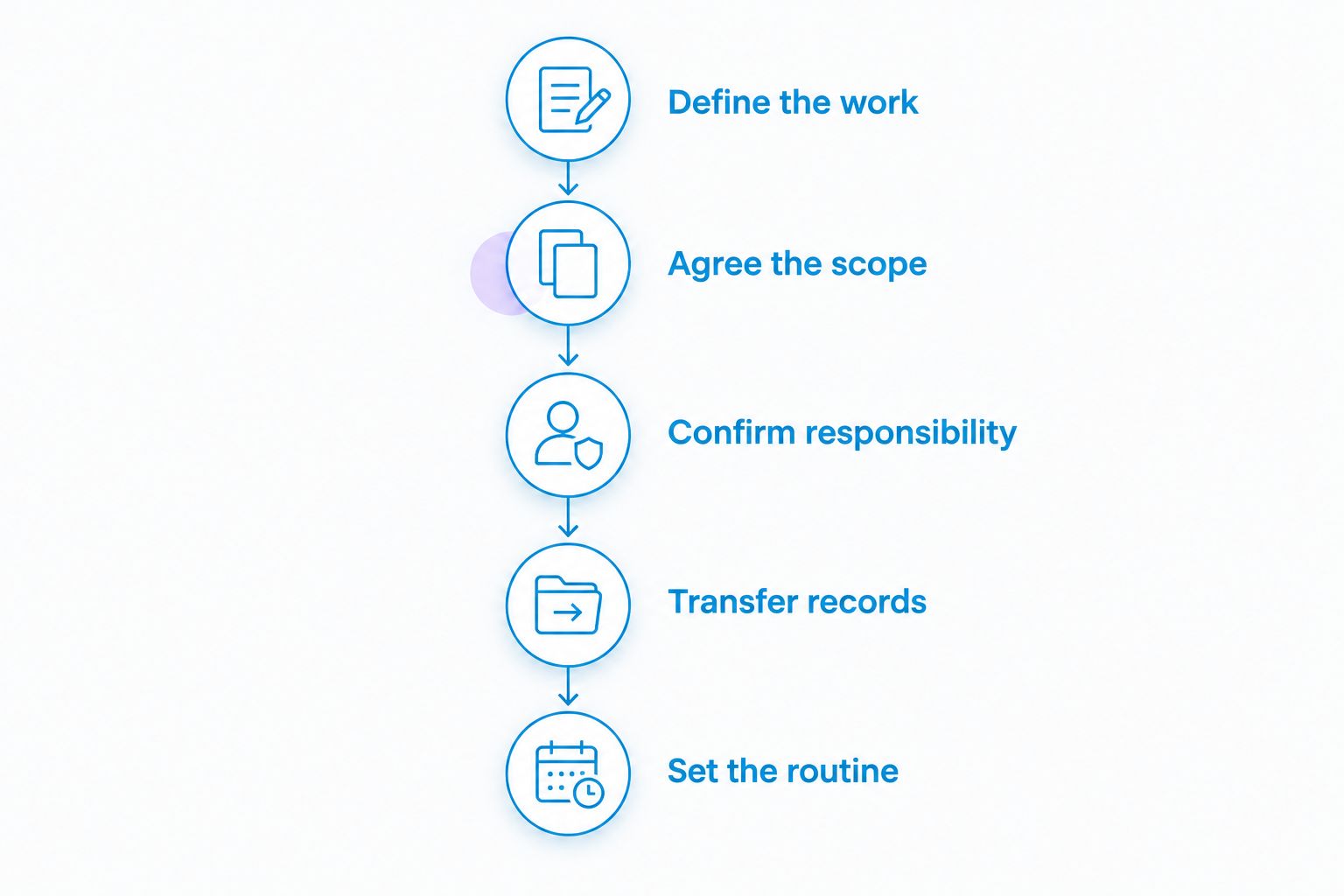
How to move to monthly support without a messy handover
Start with the work you need done, then settle the responsibilities and dates. This sequence applies whether you are hiring your first accountant or changing an existing arrangement in 2026.
Define the work
Write down the recurring tasks you struggle to complete. Include bookkeeping, VAT, payroll, tax return preparation and advice only where they apply to your business.
Separate routine work from a backlog. Ask for a clear explanation of how unfinished historical work will be handled rather than assuming it becomes part of the new monthly service.
Agree the scope
Ask the accountant to describe the service in writing. Identify the filings included, the bookkeeping responsibilities, the advice available and any work outside the agreement.
For fixed-fee support, agree how additional work is authorised. The useful protection is knowing what is included and having a clear approval process before extra work begins.
Confirm responsibility
Decide who submits each return, who checks deadlines and who supplies the information. If you are switching accountants, identify the point where the outgoing accountant's work ends and the incoming accountant's work begins.
Keep responsibility clear for any filing already in progress. A change of accountant should not leave you assuming that someone else has completed work without confirmation.
Transfer records
Arrange access to the accounting records and collect documents needed for the engagement. Ask what the new accountant needs from you and what should come from the previous provider.
If you use accounting software, confirm access permissions and who controls the subscription. Avoid starting a second set of books without agreeing how the existing records will be retained and used.
Set the routine
Agree when you supply information, how questions are raised and how completed work is confirmed. The routine should also explain what happens if documents arrive late or your business changes.
A simple written timetable makes the arrangement usable. You should be able to explain the next action without searching through several email threads.
Does a sole trader need monthly support below the VAT threshold?
The £90,000 VAT registration threshold does not decide whether you need monthly accounting support. It concerns taxable turnover and registration rules, not the frequency of professional advice.
You can need regular help below that threshold because of payroll, bookkeeping or recurring decisions. Equally, being VAT-registered does not establish that every accounting task must be performed monthly; agree the work around your obligations.
Can I keep doing my own bookkeeping with a monthly accountant?
You can keep doing your own bookkeeping and use a monthly accountant for agreed reviews, tax work and advice. Confirm that the proposed service supports this division of work.
Ask which entries the accountant checks and who corrects errors. If you want Gowin Accountants Ltd to handle bookkeeping instead, establish that responsibility within the fixed-fee agreement rather than treating it as an assumed inclusion.
Should I wait until the next tax year to switch?
You do not need to wait until the next tax year to agree a new support arrangement. The practical issue is allocating current work and upcoming filings without gaps or duplication.
For a switch during 2026, request a handover plan identifying outstanding work and responsibility for each deadline. General guidance cannot determine the best start date for your individual records, so settle that date with the accountants involved.
FAQ
What's the clearest sign I need a monthly sole trader accountant?
The clearest sign is recurring accounting work or decisions that remain unresolved between annual returns. Choose monthly support when an agreed routine for bookkeeping, VAT, payroll or advice addresses that problem.
Is monthly accountant support the same as paying an annual fee in instalments?
Monthly accountant support is not the same as paying an annual fee in instalments. Ask what work happens during the year, because payment frequency alone does not establish review or advice frequency.
Can a sole trader use annual tax return support instead?
A sole trader can use annual tax return support when their records are accurate and their needs are straightforward. Confirm who handles bookkeeping and whether advice outside the return is included.
Does the VAT threshold mean I must hire an accountant?
The £90,000 VAT registration threshold does not itself require you to hire an accountant. It is a taxable-turnover threshold, and professional support is a separate decision based on your responsibilities and ability to manage them.
What should I ask before agreeing a fixed monthly fee?
Ask which work is included, who supplies and checks the records, and how additional work is approved. Agree the treatment of any backlog before the ongoing service starts.
Can Gowin Accountants Ltd help sole traders outside Basingstoke?
Gowin Accountants Ltd serves sole traders and other businesses across the UK. Its stated services include fixed-fee accounting, tax, VAT, payroll, bookkeeping and Xero-based accounting; confirm the scope relevant to your business.
Will monthly support guarantee a lower tax bill?
Monthly support does not guarantee a lower tax bill. It provides the agreed accounting work and advice, while your tax position depends on your circumstances and the applicable rules.
One last thing
Ask what will happen before the next filing deadline that does not happen under your current arrangement. If the answer only describes collecting a monthly payment, you have not established a reason to change.
For your 2026 decision, look for named responsibilities, useful reviews and a routine you can maintain. This article provides general guidance; decisions about your tax position require advice based on your own records and circumstances.