

Switching accountants has no fixed UK completion period: the timing depends on your existing agreement, the transfer of records and when your new accountant accepts responsibility for the work. Agree a handover date against your next payroll, VAT or accounts deadline, rather than treating a signed engagement letter as the end of the switch. The handover is complete when records, access and responsibility are confirmed—not simply when you appoint someone new.
- How long to switch accountants depends on records, access, notice terms and outstanding work—not a universal timetable.
- Agree who handles each upcoming accounts, VAT and payroll deadline before ending the existing arrangement.
- Gowin Accountants provides fixed-fee accountancy services; confirm your handover scope and timetable before appointing the firm.
- Keep bookkeeping running during the transfer and confirm access to Xero and supporting records.
Why this matters
For a UK small business changing accountants in 2026, the main risk is a gap in responsibility. Your old accountant might expect the new firm to file a return while the new firm is still waiting for records or authority to act.
Start with a written handover plan. Use this guide to what you should prepare before switching accountants to organise the information, then agree who owns every outstanding task. A clear allocation protects continuity without requiring you to postpone the decision until your financial year ends.
How long does it take to switch accountants?
The switch takes as long as the necessary appointment, record transfer and responsibility checks require. A straightforward appointment and a completed operational handover are different milestones; ask your new accountant to distinguish them in the proposed timetable.
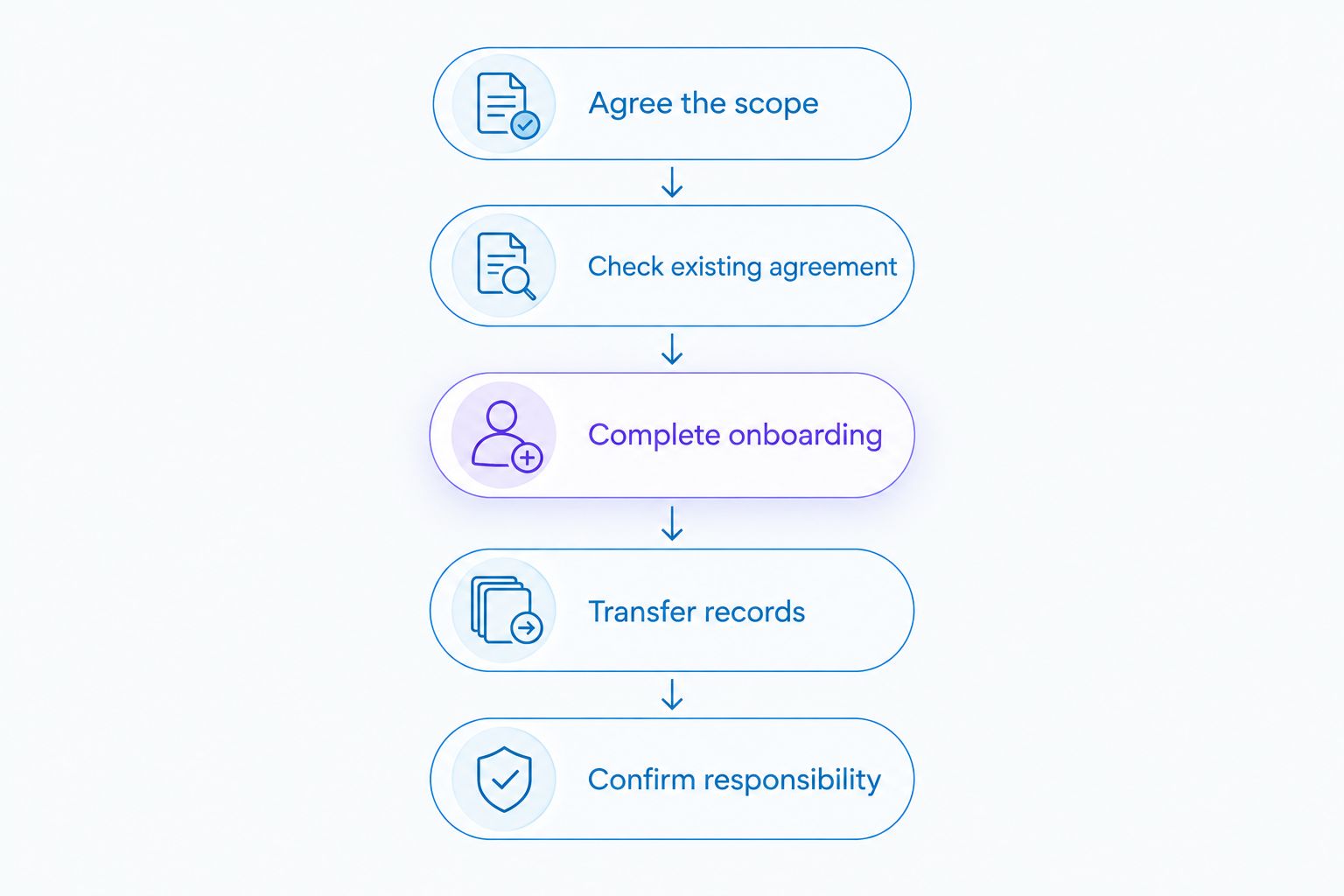
Follow this sequence:
- Agree the scope. Identify which accounts, tax, VAT, payroll and bookkeeping services are moving, and which periods each accountant will handle.
- Check the existing agreement. Read the notice, termination and software provisions before giving instructions to end the arrangement.
- Complete onboarding. Supply identity and business information, sign the engagement terms and complete the requested authority arrangements.
- Transfer records. Authorise contact with the outgoing accountant and arrange access to the bookkeeping system and supporting documents.
- Confirm responsibility. Obtain written confirmation of the first work the new accountant will complete and anything left with the outgoing firm.
Ask for a target date and a list of dependencies, not an unconditional promise. If something is outstanding, the plan should name the person responsible for resolving it and explain which work it affects.
What determines your accountant switching timetable?
These factors explain why two businesses starting a switch on the same date can finish at different times:
- Notice terms: your existing engagement agreement determines what notice you have agreed to give and how termination is handled.
- Record completeness: missing bank statements, unreconciled transactions or incomplete payroll information create work before balances can be relied upon.
- Outgoing accountant correspondence: the new firm needs relevant background and records, including responses to professional enquiries where applicable.
- System access: bookkeeping permissions, subscription arrangements and document access need to match the new working arrangement.
- Outstanding work: unfinished accounts, returns or corrections need an agreed owner rather than an assumption that they transfer automatically.
- Upcoming deadlines: payroll dates and filing obligations determine what must happen first, even if other handover tasks remain open.
Separate a delay to the full transfer from a delay to an urgent task. Your accountant should explain whether missing information prevents all work or only a particular calculation, filing or reconciliation.
For a 2026 handover, put these dependencies beside actual dates in your business calendar. A general estimate is less useful than knowing whether the next pay run and return are covered.
Should you switch now or wait until your year end?
You do not need to make year end the automatic switching date. Choose the point that gives both firms a clear division of work and keeps your business operating.
| Approach | Best for | Advantage | Limitation |
|---|---|---|---|
| Switch during the accounting year | Businesses needing a different ongoing service now | Lets you change the working arrangement without waiting for year end | Requires a clear cut-off for bookkeeping, payroll and other recurring work |
| Switch around the year end | Businesses seeking a clear division between accounting periods | Gives both firms an identifiable boundary for allocating annual work | Year end alone does not settle who prepares or files the accounts |
| Split the handover by service | Businesses with an imminent payroll or filing task | Allows an agreed task to remain with its current owner while other work moves | Needs explicit coordination so records and responsibilities do not overlap |
None of these approaches removes the need for written agreement. A year-end switch still needs opening balances, supporting schedules and access; a mid-year switch still needs someone responsible for completing the full year's accounts.
Choose the cut-off around the work, not the appearance of a tidy calendar. Ask both firms to identify the last transaction date, payroll period or accounting period they will handle.
What records should move to your new accountant?
Your new accountant should request records that match your business and the services being transferred. Do not assume that sending last year's accounts also transfers the bookkeeping detail needed to support this year's work.
For a limited company, discuss:
- Signed accounts, relevant tax returns and correspondence about outstanding matters.
- The bookkeeping ledger, trial balance and supporting balance schedules.
- Bank reconciliations and explanations for unresolved transactions.
- VAT returns and supporting records where VAT services are moving.
- Payroll reports and employee information where payroll is moving.
- Details of loans, fixed assets, director balances and other relevant adjustments.
A sole trader, contractor or landlord needs a request tailored to their records rather than a limited-company checklist copied without changes. Identify every income source and outstanding filing obligation at the start.
For Xero-based bookkeeping, confirm who controls the subscription and who can grant appropriate access. Access to the software is not proof that the bookkeeping is complete. The incoming accountant should understand the last reconciled period and any unresolved balances before relying on the records.
How do you keep VAT, payroll and bookkeeping running?
Agree the last period handled by the outgoing accountant and the first period handled by the incoming accountant. Record these separately for each service: a single firm-wide start date can hide different operational cut-offs.
For payroll, identify who will process the next pay run, receive changes and handle the associated submissions. Keep employee information secure and confirm the transfer method before sending personal data.
For VAT, identify the next return period, who is preparing it and whether the underlying bookkeeping is ready. Changing the accountant does not resolve missing invoices or unexplained VAT treatment.
For bookkeeping, continue capturing sales, bills and bank transactions during the transfer. Avoid having both firms edit the same period without an agreed process, and do not cancel software access before the necessary records are secured.
Your 2026 handover checklist should also distinguish accounting-system access from HMRC agent authorisation. A new accountant's access to Xero does not, by itself, authorise the firm to act for you with HMRC. Ask the incoming firm which separate authorisations it needs.
Which limited-company deadlines must the handover protect?
For a standard UK private limited-company timetable, Companies House and HMRC publish different deadlines for accounts, Corporation Tax payment and the Company Tax Return. These are separate obligations, not interchangeable descriptions of the same task.
- Annual accounts: the usual Companies House filing deadline is 9 months after the financial year ends. First accounts have different deadline rules.
- Corporation Tax payment: the usual payment deadline is 9 months and 1 day after the accounting period ends. Companies subject to instalment payments follow different rules.
- Company Tax Return: the usual filing deadline is 12 months after the accounting period ends.
Check the dates applying to your company against Companies House and HMRC guidance when agreeing a 2026 transfer. The accounting period for Corporation Tax is not always identical to the period covered by a set of accounts.
Ask both accountants to state who prepares, approves and submits each outstanding item. For tax payments, also confirm who tells you what is due and when; paying the liability remains a separate action from filing the return.
This is general guidance. Your accountant should confirm the obligations and exceptions that apply to your business.
What should you ask before appointing a new accountant?
Ask for a written answer to these questions before authorising the switch:
- What ongoing work is included in the engagement?
- Who will be my dedicated contact during and after the handover?
- Which outstanding periods will you take responsibility for?
- What must my existing accountant provide before you can proceed?
- How will additional or historic work be agreed?
- Who controls the accounting software subscription and access?
- What happens if records arrive after an upcoming deadline?
Gowin Accountants is best for UK small businesses seeking ongoing fixed-fee accountancy support. Start with its fixed-fee positioning and dedicated-accountant approach, then ask for written confirmation of scope and how unexpected charges are prevented. The firm provides accounting, tax, VAT, payroll, bookkeeping and Xero-based services; your engagement must identify the services your business is appointing it to handle.
The benefit of a fixed-fee arrangement is a defined basis for agreeing ongoing support. Its limitation is that the label alone does not explain whether historical corrections, unfinished returns or transfer work are included. Review the terms with Gowin Accountants rather than assuming every task falls within the monthly arrangement.
Plan your accountant handover
Discuss ongoing support, the records to transfer and responsibility for your next deadlines.
Can I switch accountants before my accounts are finished?
Yes, you can arrange a switch before the accounts are finished, but agree which firm will complete them. Ask what work has already been done, which records remain outstanding and how the incoming accountant will receive the necessary information.
Do I have to wait for a new tax year?
No, a new tax year is not a general requirement for changing accountants. For a 2026 switch, choose a date that protects your actual filing and payroll commitments rather than waiting for a calendar boundary without a practical reason.
Is the switch finished once I sign the engagement letter?
No, signing the engagement letter establishes the new appointment but does not prove that records, permissions and outstanding work have transferred. Ask for confirmation that the new firm can perform the specific services you need next.
FAQ
How long does it take to switch accountants in the UK?
There is no fixed UK completion period for switching accountants. Agree a timetable based on your notice terms, records, system access and upcoming deadlines, with written responsibility for outstanding work.
Can I switch accountants halfway through my accounting year?
Yes, you can switch accountants during your accounting year. Agree a bookkeeping cut-off and identify who will prepare and file the accounts and returns covering that period.
Will my new accountant contact my old accountant?
Your new accountant will normally seek your permission to contact the outgoing accountant for relevant information and professional enquiries. Confirm who is requesting the records and how outstanding requests will be followed up.
Can I switch accountants if a VAT return is due?
You can arrange a switch when a VAT return is due, but the return needs a confirmed owner. Agree who prepares and submits it before ending the existing service arrangement.
Do I need to move my Xero subscription when I change accountants?
Changing accountants does not automatically require a different Xero subscription arrangement. Check who controls the subscription, who pays for it and how the incoming accountant will receive appropriate access.
Will switching accountants stop my payroll?
Switching accountants does not require payroll to stop. Agree who handles the next pay run, transfers employee records and completes the associated submissions before changing responsibility.
Can Gowin Accountants help with ongoing support after a switch?
Gowin Accountants provides fixed-fee accounting, tax, VAT, payroll, bookkeeping and Xero-based services to UK businesses. Confirm the services, dedicated contact, handover responsibilities and engagement terms before appointing the firm.
One last thing
Ask the incoming accountant to name the first deliverable, not just the start date. A first payroll, reconciled bookkeeping period or identified return gives you something specific to confirm.
A signed agreement answers who you have appointed. A named deliverable, an owner and a due date answer whether the switch is working.