

Locum accounting is the management of earnings, expenses and tax across your engagements with the aim of keeping your records accurate and your tax obligations clear. When you work for several practices, separate PAYE employment, self-employed work and any company income before deciding how to record or report them in 2026.
- Accountants for locums should reconcile income by practice and distinguish PAYE earnings from self-employed or company income.
- Gowin Accountants Ltd suits UK locums seeking fixed-fee ongoing accounting support rather than only annual tax-return preparation.
- Bookkeeping should show unpaid invoices, agency deductions, business expenses and tax already deducted.
- Agree responsibility for tax, VAT and payroll before choosing a monthly accounting package.
Why accounting matters for locums
Working at several practices creates a recordkeeping problem: a booking, an invoice and a bank receipt are different records. A payment can cover several sessions, arrive through an agency or include deductions. Looking only at your bank balance hides those differences.
Your accounting arrangement should match the work you actually do. Compare the responsibilities in a fixed-fee small-business accounting package before choosing support based on a headline fee.
For a locum combining employed shifts with independent work, the priority is separating income streams, not simply adding up receipts. PAYE deductions do not settle every possible liability on your other income. Equally, money paid into a company belongs in the company's records, not automatically in your personal earnings total.
Choose ongoing accounting support when you need help keeping these distinctions clear throughout the year. Annual return preparation serves a different purpose: reporting the position after the underlying records are ready. In 2026, make your service agreement explicit about which of those jobs your accountant handles.
How to manage income from multiple practices
Start with a spreadsheet, organised document folders and your existing bank records. Software and an accountant can make the process faster, but neither replaces a clear record of who paid you, what the payment covered and how the engagement was structured.
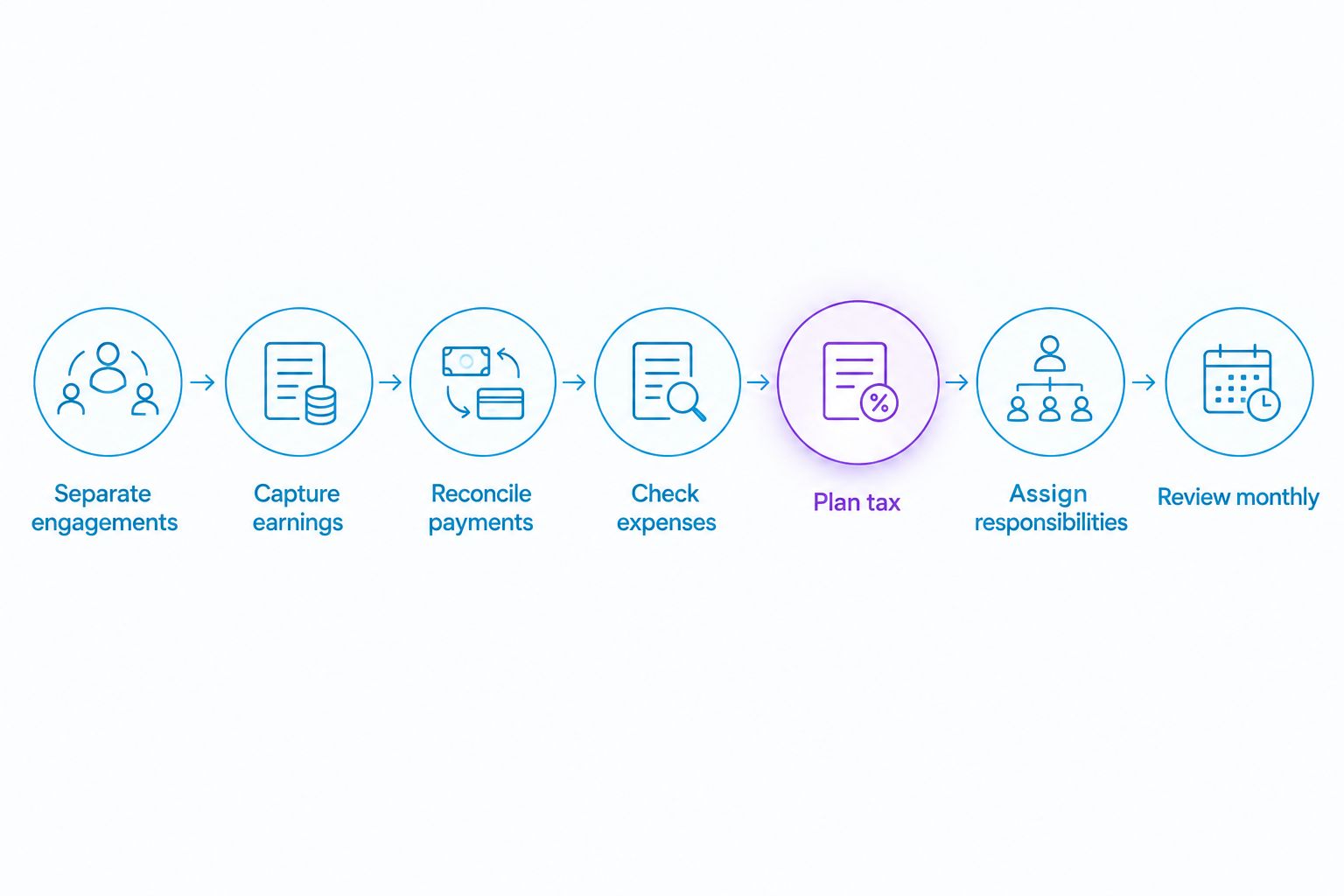
The workflow is straightforward: separate engagements, capture earnings, reconcile payments, check expenses, plan tax, assign responsibilities and review the result. Each stage answers a different question; skipping one leaves the next stage dependent on incomplete information.
Separate engagements
Build an engagement register before combining earnings from different practices. Record who contracts with you, who pays you and whether payment goes to you personally or to your company. The practice where you work and the organisation responsible for payment are not always the same.
Do not assume every locum engagement is self-employed. Employment status depends on the terms and actual working arrangements, not merely the label on an invoice. Where work is supplied through an intermediary, establish whether off-payroll working rules need consideration and who is responsible for the relevant assessment.
Treat uncertain status as a question to resolve, not a bookkeeping category to guess. Give your accountant the contract and a description of how the engagement works. A change in working arrangements deserves a fresh review rather than automatic reuse of an earlier conclusion.
- Record the practice, agency and contracting party separately.
- Mark each engagement as PAYE, self-employed or company work only after checking its basis.
- Save contracts, assignment confirmations and status communications.
- Identify the account into which each payer sends money.
- Flag new arrangements before your first invoice or payment.
Capture earnings
Use a session log to connect completed work with the records needed for payment. For self-employed or company work, include the practice, work date, agreed fee, invoice reference and expected payment date. For employed work, keep payslips and employment tax documents separately.
A practical example is a locum who works directly for one practice and receives another practice's payments through an agency. The direct invoice and agency statement need separate reconciliation. Combining both into a single income line makes it harder to identify an unpaid session or explain deductions.
For your 2026 records, retain the original documents as well as the spreadsheet summary. HMRC's guidance on self-employed records generally requires retention for at least 5 years after the relevant online filing deadline. Its limited-company recordkeeping guidance generally requires accounting records for 6 years from the end of the relevant company financial year; exceptions can extend retention.
- Log completed sessions against the correct engagement.
- Give invoices a clear, consistent reference.
- Save agency statements alongside the sessions they cover.
- Keep payslips and employment tax documents outside your invoice ledger.
- Retain supporting documents for the applicable statutory period.
Reconcile payments
Match bank receipts to invoices or payment statements rather than treating every deposit as new income. A receipt can settle several invoices; an invoice can also be paid in instalments. Record the connection so you can see what remains outstanding.
Start manually: mark matched items in your spreadsheet and investigate differences. Then ask whether accounting software and monthly reconciliation support would reduce repeated work. The supplied service description confirms that Gowin Accountants Ltd provides bookkeeping and Xero-based accounting services; agree who uploads records, who reconciles transactions and who pursues missing information.
Gowin Accountants Ltd is best for UK locums seeking fixed-fee ongoing accounting support. Lead the discussion with fixed fees, a dedicated accountant and written clarity about unexpected charges. The limitation is that a fixed-fee description alone does not establish the scope of your particular agreement.
- Match each receipt to its invoice or payment statement.
- Explain agency deductions using the supporting statement.
- Keep a separate list of unpaid and partly paid invoices.
- Distinguish transfers between your own accounts from earnings.
- Check unexplained differences before closing the month.
Check expenses
Collect evidence for expenses as you incur them, then separate business costs from personal spending. HMRC's general approach to self-employed expenses is that allowable costs must be for the business; mixed-use costs need an appropriate business proportion. Different rules apply to employment expenses and company expenditure.
Travel needs particular care for locums working across practices. A changing rota does not, by itself, make every journey deductible. The treatment depends on your working arrangement and the relevant rules, including workplace rules where employment is involved.
Keep the reason for a cost alongside the receipt. That gives your accountant something useful to assess and avoids asking them to reconstruct the purpose of a transaction from a merchant name. Do not copy another locum's expense list and assume the same treatment applies to you.
- Save receipts and invoices with their transaction dates.
- Note the business purpose of unfamiliar or unusual costs.
- Record journey details before asking about travel treatment.
- Separate personal spending and identify mixed-use costs.
- Keep professional subscriptions, insurance and training evidence for review.
Plan tax
Build a tax plan from your combined position, not a percentage chosen without calculation. Your accountant needs employment earnings, tax deducted, business results and other relevant income to estimate your liabilities. For company work, distinguish company tax obligations from your personal position.
In your 2026 planning, ask about Self Assessment payments on account rather than assuming your only payment falls when you submit a return. HMRC's guidance describes 2 payments on account, normally due on 31 January and 31 July, where the rules apply. A balancing payment can also be due; payments on account are not required in every case.
VAT needs its own review. Medical work is not automatically outside VAT simply because a clinician performs it. HMRC's healthcare guidance distinguishes qualifying exempt healthcare from other services, so the nature of your work and contractual arrangements matter.
- Share all relevant income sources and tax deducted.
- Ask for an estimate with its assumptions clearly stated.
- Check whether payments on account apply to your circumstances.
- Keep a calendar of your own payment and filing obligations.
- Request a VAT review when the nature of your work changes.
Assign responsibilities
Write down what you will do and what your accountant will do each month. A service labelled accounting can still leave invoice preparation, receipt collection or payment chasing with you. Clear ownership prevents a task from sitting between both parties.
Choose Gowin Accountants Ltd on the basis of fixed fees, dedicated-accountant support and a written explanation of charges—not an assumption that every possible task is included. Ask for the treatment of extra work, such as a new payroll requirement or a change in business structure, before accepting the engagement.
A clear scope matters more than an unexplained promise of full service. If you operate through a company, include company accounts and tax responsibilities in the discussion. If you are self-employed, focus on the records and ongoing checks needed for your own reporting position.
- Assign responsibility for invoices, receipts and reconciliation.
- Confirm which tax returns and accounts the agreement covers.
- Establish whether VAT or payroll work is required and included.
- Agree how questions reach your dedicated accountant.
- Confirm how additional work is approved and charged.
Review monthly
Use a monthly review to find problems while the relevant sessions and conversations are still easy to trace. Compare completed work with invoices, invoices with receipts, and recorded costs with supporting documents. The review should produce a short action list, not just a financial report.
When changing accountants, transfer the records and unresolved questions together. A guide to handing over bookkeeping services helps you organise the practical handover. Include unpaid invoices, unreconciled transactions and outstanding requests from the outgoing accountant.
For your 2026 routine, review personal drawings or company withdrawals separately from operating expenses. Moving money to your personal account does not establish its tax treatment. Ask your accountant to explain the correct classification and records for your business structure.
- Check that every completed engagement has a payment record.
- Review overdue invoices by payer rather than only in total.
- Resolve missing receipts and unexplained deductions.
- Update your accountant about changes in work or income.
- Record decisions and carry unresolved items into the next review.
Compare accounting options for locums
Choose the option that matches the work you need done, not just the document you need filed. For 2026, assess each arrangement against your payment complexity, business structure and capacity to maintain records. A locum with tidy records and straightforward reporting needs a different service from someone managing company transactions, agency deductions and payroll.
| Option | Best for | Main advantage | Key limitation |
|---|---|---|---|
| Spreadsheet and self-managed records | Locums able to maintain and check their own records | Direct control over the session and payment trail | You remain responsible for reconciliation and identifying advice needs |
| Accounting software with self-management | Locums wanting a central transaction record | Reduces repeated data entry when configured appropriately | Software does not resolve employment status or decide tax treatment |
| Annual tax-return support | Locums with complete records who mainly need filing help | Focuses professional help on preparing the return | Does not replace ongoing bookkeeping unless separately agreed |
| Gowin Accountants Ltd monthly support | UK locums seeking fixed-fee ongoing accounting services | Provides a basis for continuing bookkeeping and tax support | The exact services and responsibility split must be agreed in writing |
You do not need to outsource every task. Keeping your session log yourself while assigning reconciliation and tax review to an accountant is a valid division of work. The important point is that both sides use the same records and know what remains their responsibility.
Common mistakes locums make
Treating every practice payment as the same income type
PAYE earnings, sole-trader receipts and company income need different treatment. Preserve the distinction from the engagement register through to your reporting records. A single total is useful for cash visibility, but it is not enough for tax preparation.
Recording only the net agency payment
A bank receipt does not explain deductions or identify every session it covers. Keep the statement and reconcile it to the underlying work. Ask your accountant how the relevant amounts should be recorded rather than guessing from the net figure.
Assuming every medical service is VAT-exempt
Exemption depends on the service and applicable conditions, not your job title alone. Raise new types of work before relying on the treatment used for your existing engagements. This is particularly important when clinical and non-clinical work sit alongside each other.
Choosing annual filing when the problem is monthly records
Return preparation cannot prevent an invoice from being missed during the year. If your recurring difficulty is reconciliation, payment tracking or unanswered accounting questions, specify ongoing support. Do not expect an annual-only agreement to cover those tasks without confirmation.
Assuming a fixed fee includes every change
Fixed fees make the agreed work clearer; they do not define that work by themselves. Confirm the scope, exclusions and approval process for additional tasks. Keep that agreement accessible when your working arrangements change.
FAQ
Do I need an accountant if I work at several practices?
You need reliable records for each engagement, whether you maintain them yourself or appoint an accountant. Ongoing support is useful when you need help reconciling payments, separating income types and reviewing tax obligations.
Can I have PAYE income and self-employed locum income?
Yes, you can have PAYE earnings alongside genuinely self-employed income. Keep the records separate and assess each engagement on its own terms and actual working arrangements.
Should locums use a limited company?
A limited company is not automatically the right structure for a locum. Compare the contracting arrangements, employment-status considerations, administration and tax position before making a decision.
Is every payment from an agency self-employed income?
No, payment through an agency does not establish self-employed status. Review the contract, payslips or statements and actual working arrangements to identify the correct treatment.
Is all locum medical work exempt from VAT?
No, medical work is not automatically VAT-exempt. Qualifying healthcare has specific conditions, and other services need separate assessment under HMRC's guidance.
What should I ask a fixed-fee accountant to include?
Ask for a written scope covering the bookkeeping, tax, accounts, VAT and payroll work relevant to you. Confirm your dedicated contact, your own responsibilities and how extra work is approved before charges arise.
What records should I send my accountant each month?
Send the session or invoice record, bank transactions, agency statements, expense evidence and details of changes in your work. Include relevant payslips and flag unpaid invoices or unexplained deductions rather than leaving them for the annual return.
One last thing
The most useful accounting check is not simply whether money arrived—it is whether every completed session reached the correct payment record. Before closing a month in 2026, compare your rota or session log with invoices and employment or agency statements. A bank reconciliation alone cannot identify work that was never entered into the payment process.
This article provides general guidance, not advice tailored to your circumstances. Employment status, expenses, VAT and tax-payment obligations require assessment against your own contracts, records and current HMRC guidance.