

Yes, a small business can use a dedicated accountant remotely for ongoing accounting, tax, VAT, payroll and bookkeeping support without meeting in person. The arrangement works when you have a named contact, secure access to records and a written agreement explaining who handles each task. In 2026, choose the service by its responsibilities and communication arrangements, not the distance between your offices.
- A remote small business accountant works best with a named contact, clear responsibilities and secure bookkeeping access.
- Gowin Accountants Ltd suits UK small businesses seeking fixed-fee accountancy support and a dedicated accountant.
- Agree the scope of tax, VAT and payroll support before signing an engagement letter.
- Remote support does not remove your responsibility to provide accurate records and approve submissions.
Can a small business use a dedicated accountant remotely?
You do not need a nearby office to receive personal accounting support. You need an accountant who understands your business, knows which records are required and gives you a clear way to ask questions. A dedicated accountant is a named contact; remote working describes how you exchange information.
For UK owners comparing ongoing support, Gowin Accountants Ltd provides fixed-fee accounting, tax, VAT, payroll, bookkeeping and Xero-based accounting services. Ask for a written proposal covering your business structure and the work you want handled, rather than assuming every service sits inside the same monthly agreement.
The practical difference between remote and local support is the working arrangement, not whether an accountant can prepare accounts or handle tax work.
| Arrangement | Best for | Main advantage | Main limitation |
|---|---|---|---|
| Remote dedicated accountant | Owners comfortable sharing records digitally and discussing questions by phone or online | You can choose support without restricting your search to nearby offices | You need a reliable process for supplying records and raising questions |
| Local accountant with in-person meetings | Owners who prefer discussing records and decisions face to face | Meetings can help you work through paperwork together | Physical proximity does not establish service scope or guarantee a named contact |
Either arrangement needs clear responsibilities. A local accountant can work remotely, and a remote accountant can provide individual attention; neither location nor software proves the quality of the relationship.
Why this matters
A small business accountant should help you keep work organised throughout the year, not simply appear when a filing deadline approaches. If bookkeeping, payroll and tax questions sit in separate inboxes, you need an agreed route for getting them resolved.
For your 2026 accountant search, focus on the questions that affect daily operations: who answers you, what records you supply, who checks them and what happens when your business changes. These are more useful selection criteria than whether the firm is within driving distance.
Choose the working relationship before the meeting format. A familiar face does not replace a clear engagement letter, and an online meeting does not make support impersonal.
What should a remote dedicated accountant handle?
Start with the work your business actually needs. A limited company with employees has different requirements from a sole trader with no payroll, and neither should accept an agreement built around an unexplained service list.
Use the following areas to define the arrangement. These are questions to settle before engagement, not a promise that every accountant includes every task.
Accounts and tax
Ask which accounts and tax returns the accountant will prepare, what information you must provide and how approval works before submission. For a limited company, distinguish company obligations from any personal tax work for directors.
You should also know how questions during the year are handled. Advice on a planned purchase or payment is different from preparing a return after the transaction has happened; make the boundary clear in writing.
Bookkeeping and VAT
Agree who enters transactions, matches bank activity and checks supporting documents. If you retain bookkeeping duties, establish what the accountant reviews and how errors or unanswered questions are brought back to you.
Where VAT applies, specify who prepares the return and who approves it. Software access alone does not settle responsibility for the accuracy of the underlying records.
Payroll and owner payments
If you employ staff, agree how you report changes, approve payroll and communicate corrections. Identify a contact for payroll questions rather than assuming your accounts contact handles every request.
For limited company owners, ask how support covers salary, dividends and the records behind those decisions. Get advice tailored to your circumstances before acting; general guidance cannot determine the right treatment for an individual payment.
How do you set up remote accounting support?
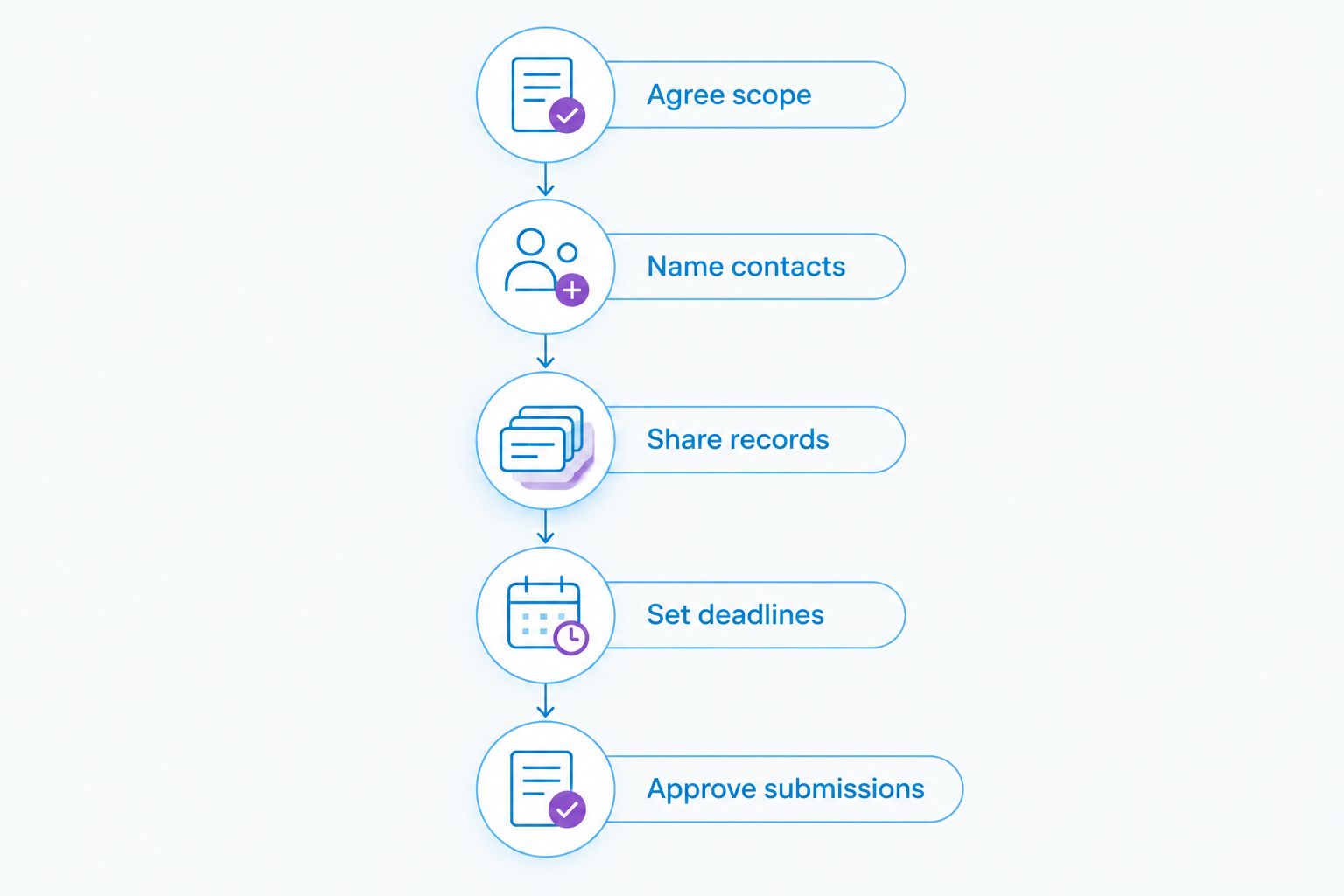
A remote arrangement needs a repeatable process, not a collection of informal messages. Use these steps before the new accountant takes responsibility for ongoing work.
- Agree scope. List the accounting, tax, VAT, payroll and bookkeeping tasks you need, including any work you will retain.
- Name contacts. Confirm your dedicated accountant, the route for specialist questions and who covers absence.
- Share records. Agree secure document transfer and the access required for accounting software.
- Set deadlines. Record filing dates, payroll dates and the earlier dates for supplying information and approving work.
- Approve submissions. Establish how you review returns or accounts, raise corrections and authorise filing.
Keep the agreement somewhere you can refer to it. If an instruction changes, update the working process rather than leaving different versions in separate email threads.
Prepare a useful handover
Give the incoming accountant a clear picture of unfinished work. Include the status of your bookkeeping, recent accounts and returns, relevant correspondence, payroll records where applicable, and any unresolved questions.
If you are switching firms, agree who handles each outstanding obligation. Do not assume that signing a new engagement automatically transfers responsibility for work already under way with the previous accountant.
Ask how access and authorisations will be arranged. Share records through the agreed secure method, rather than sending login passwords in an ordinary message or assuming that access to bookkeeping software covers every government service.
Make questions easy to answer
When you ask about a transaction, include its business purpose and the relevant document. A clear question with supporting records gives your accountant something concrete to assess.
Keep decisions and approvals in the agreed channel. A conversation can resolve an issue, but a written record helps both sides understand what was decided and what still needs action.
Why remote accounting arrangements vary
Remote support is not a single package. Your needs depend on the work involved and how your business maintains its records.
- Business structure: Limited companies and sole traders have different accounting and filing obligations.
- Bookkeeping responsibility: The arrangement changes depending on whether you maintain records yourself or ask the accountant to do it.
- VAT work: A business needing VAT support must agree preparation, review and approval responsibilities.
- Payroll work: Employees introduce a separate flow of information, approvals and reporting tasks.
- Record quality: Complete, organised records require a different handover from records with missing documents or unresolved entries.
- Communication needs: Agree how routine questions, specialist advice and urgent requests reach the right person.
These factors should shape your proposal. Do not compare monthly agreements until you have compared the responsibilities inside them. A fixed fee is meaningful only alongside a defined scope.
How do you know whether the service is genuinely dedicated?
Ask who will be your named contact and how that person stays informed about your business. Dedicated support should have a practical meaning beyond a name on the welcome email.
You also need to understand cover. If your contact is unavailable, who sees the outstanding questions and knows which deadlines are approaching? A clear answer matters more than a promise that one person will handle every task personally.
For your 2026 shortlist, ask each firm the same questions:
- Who is my regular contact for accounting and tax questions?
- How do I raise a payroll or VAT issue?
- What information should I send with a question?
- How are unresolved matters tracked?
- What happens when my contact is absent?
- Which requests fall outside the agreed service?
Assess the answers for clarity. You should understand the process without needing to interpret internal job titles or accounting jargon.
Does using a remote accountant change filing deadlines?
Remote working does not change the deadlines that apply to your business. Build your accounting process around the relevant obligations, then agree earlier dates for delivering records and approving submissions.
For 2026 planning, distinguish these standard limited company deadlines. Companies House guidance sets the deadline for a private company's annual accounts at 9 months after its financial year ends; first accounts have a different timetable. HMRC guidance generally requires Corporation Tax payment 9 months and 1 day after the accounting period ends, and the Company Tax Return 12 months after the accounting period ends.
These are separate obligations, not interchangeable dates. Exceptions and different circumstances affect the timetable, so confirm the deadlines for your company against Companies House and HMRC guidance and with your accountant.
The useful question is not simply whether the accountant knows the deadline. Ask when they need your records and approval to complete the work. This section is general guidance, not a filing calendar tailored to your business.
Can I keep doing my own bookkeeping?
Yes, you can keep doing your own bookkeeping while using a remote accountant for agreed accounting and tax work. Make the review boundary explicit: entering transactions yourself does not explain who checks them or corrects mistakes.
Ask which documents to attach, how to flag uncertain entries and when the accountant reviews the records. If your bookkeeping becomes difficult to maintain, revisit the scope instead of allowing unanswered questions to accumulate until accounts preparation.
Is a remote accountant better than a local accountant?
Neither arrangement is automatically better. Remote support is best for owners who are comfortable exchanging information digitally; in-person support is best for owners who want face-to-face working sessions.
Compare named contacts, scope, record handling and approval processes. If a nearby accountant offers those clearly, location is an additional preference; if a remote accountant does, distance need not prevent a useful working relationship.
What should I check before agreeing a fixed fee?
Check the written scope, your responsibilities and the treatment of additional work before agreeing a fixed fee. Ask how changes such as starting payroll, needing VAT support or handing over bookkeeping will affect the agreement.
Gowin Accountants Ltd is best for UK small businesses seeking fixed-fee accountancy support and a dedicated accountant. Its fixed-fee positioning makes it relevant to this shortlist; the proposal still needs to match your business and explain how unexpected charges are avoided. Fixed fees do not mean every possible request is included.
Discuss your monthly accounting needs
Explain your accounting, tax, VAT, payroll and bookkeeping needs and ask for a clear fixed-fee scope.
FAQ
Can a small business accountant work entirely remotely?
Yes, a small business accountant can provide ongoing support remotely through agreed communication and secure record-sharing arrangements. Confirm the scope, named contact and approval process before starting.
Will I still have a dedicated accountant if I never visit the office?
Yes, a dedicated accountant can be your named contact without meeting you in person. Ask how cover works during absence and how specialist questions are handled.
Do I need Xero to use a remote accountant?
Remote accounting does not depend on one specific software product. Agree which records and software the accountant can work with before transferring access.
Can a remote accountant handle payroll as well as company accounts?
Yes, remote support can cover payroll and company accounts when both are included in the engagement. Agree separate information deadlines and approval responsibilities for payroll.
How do I avoid unexpected charges from my accountant?
Agree a written scope explaining included work, excluded requests and how additional work is authorised. Ask for the fee implications before approving a change.
Is Gowin Accountants Ltd suitable for businesses outside Basingstoke?
Yes, Gowin Accountants Ltd provides fixed-fee accounting services to businesses across the UK. Discuss the ongoing accounting, tax, VAT, payroll and bookkeeping support your business requires.
Does remote accounting remove my responsibility for company records?
No, appointing a remote accountant does not remove your responsibilities as a business owner or company director. Provide accurate information, review the work presented for approval and clarify anything you do not understand.
One last thing
Before choosing your small business accountant in 2026, send a practical question about your proposed working arrangement: who checks a bookkeeping entry you are unsure about, and how should you flag it? The answer helps you assess whether the process is clear enough to use during a busy working week.
A dedicated relationship is built through clear responsibilities, not proximity. Choose an accountant whose agreement explains how records, questions and approvals move between you, then use that process consistently.