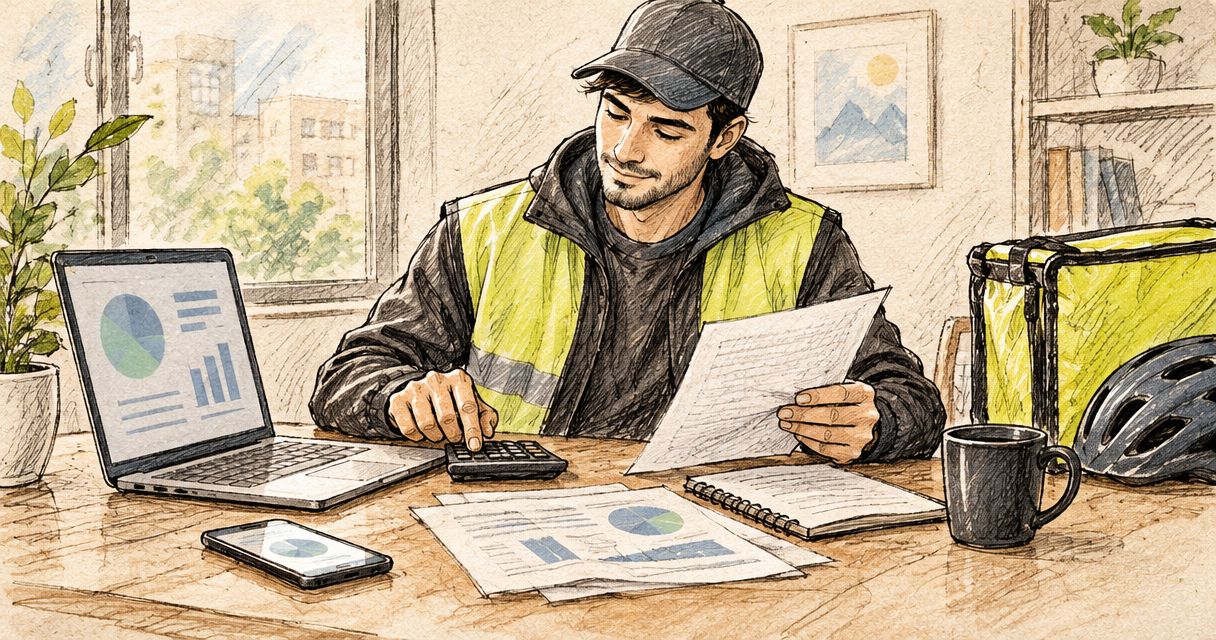
Delivery drivers’ self assessment accounting is the recording of delivery income, business expenses and tax obligations with the aim of filing an accurate return and understanding what you owe. This 2026 guide explains how to handle multiple platforms, vehicle costs and ongoing bookkeeping without leaving everything until the filing deadline.
- Choose a self assessment accountant for delivery drivers when platform records, vehicle claims or ongoing bookkeeping need professional attention.
- Gowin Accountants Ltd suits drivers seeking fixed-fee accountancy support; confirm the agreed work before appointing the firm.
- Reconcile platform earnings with deductions and bank deposits rather than treating every payout as total turnover.
- Keep mileage and expense evidence throughout the year; a bank statement alone does not explain business use.
Why self assessment accounting matters for delivery drivers
Delivery work creates a particular bookkeeping problem: the amount arriving in your bank account does not always explain the income earned or deductions taken. Platform statements, tips, adjustments and vehicle expenses need to tell the same story.
A self assessment accountant for delivery drivers should help you distinguish sales, business expenses and personal spending. The useful service is an accurate record throughout the year, not simply a submitted form.
Gowin Accountants Ltd provides fixed-fee accounting, tax and bookkeeping services to sole traders and other UK businesses. Ask for a dedicated accountant and a written scope that explains what the fee covers, so there are no unexpected charges for work you assumed was included.
For your 2026 arrangements, start with how you actually work. A driver with employment income alongside delivery work needs different checks from someone running a delivery business full-time. Operating through a limited company also creates obligations beyond a personal tax return.
This is general UK guidance, not advice tailored to your circumstances. Use HMRC’s official Self Assessment, business-expense and Making Tax Digital guidance to confirm the rules that apply to your business and relevant filing period.
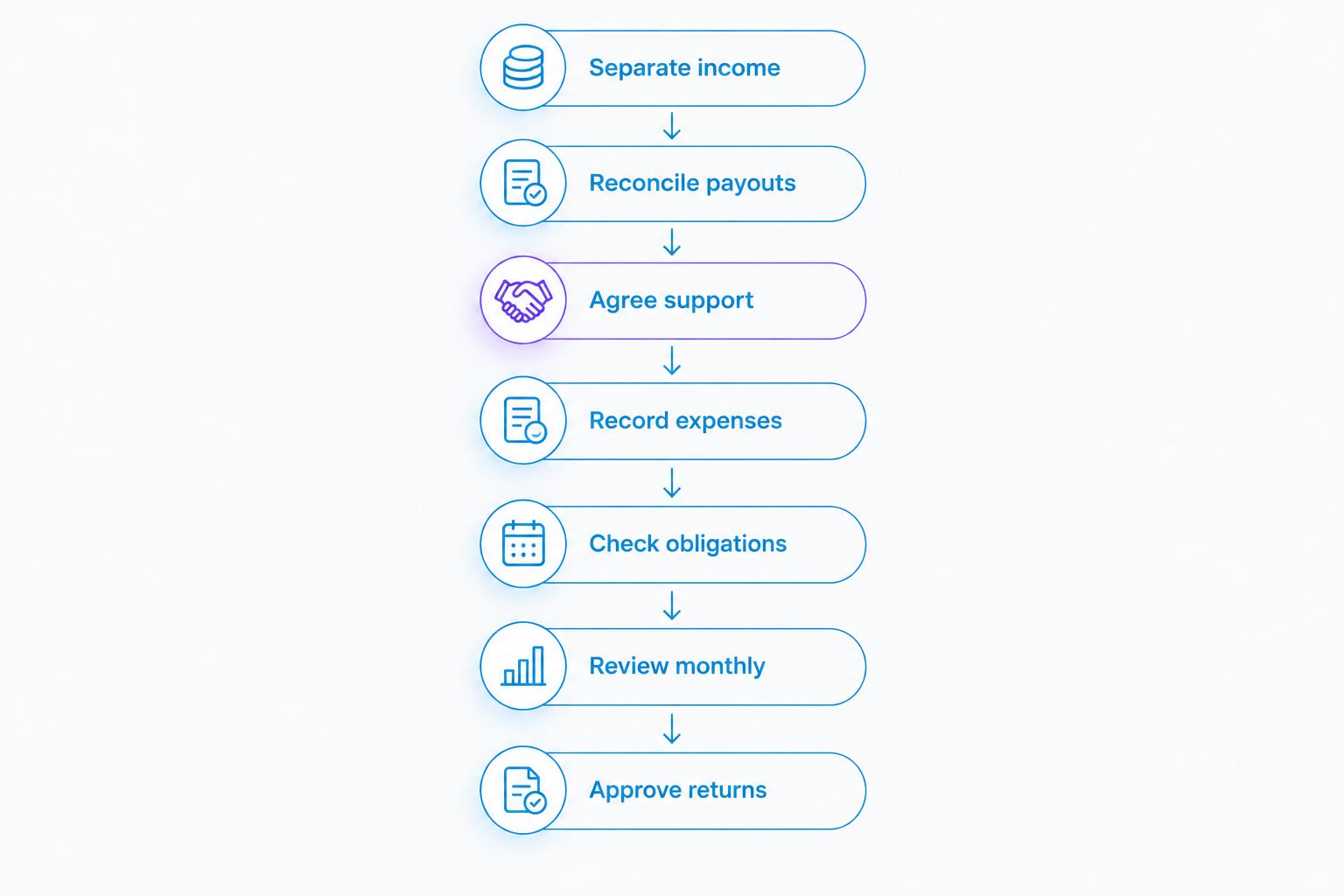
How to organise delivery-driver accounting in 2026
Follow the sequence below before choosing software or handing over a folder of receipts. Each step gives you a manual starting point and a clear task to discuss with an accountant.
Separate income
Start with a spreadsheet listing each source of delivery income and its supporting statement. Keep employment earnings, delivery trading income and personal transfers identifiable rather than combining every bank credit into one total.
Your working arrangement matters. Working through an app does not, by itself, settle your employment status for tax. Check the arrangement rather than assuming all delivery earnings belong on the same self-employment pages.
Keep copies of statements outside the platform account so that your records do not depend on continued access. If you change platforms, download the available history before closing the account. Explain any gaps to your accountant rather than filling them with estimates presented as facts.
- List every platform and direct delivery customer.
- Identify cash tips and tips paid through platforms.
- Separate employment documents from trading records.
- Label transfers between your own accounts.
- Save statements in clearly dated folders.
Reconcile payouts
Match each platform statement to the money received in your bank account. Record the components separately: earnings, deductions, refunds and adjustments, where applicable. This explains differences without treating the bank deposit as the complete accounting record.
A spreadsheet is enough to start. Create columns for the statement period, reported earnings, deductions and matching deposit; investigate anything that does not agree. Do not count both the statement earnings and the bank receipt as separate sales.
Watch the period covered by each statement. A payout received after a reporting cut-off needs a consistent treatment under the accounting basis you use. Ask an accountant to confirm that treatment rather than changing it whenever a deposit arrives late.
- Match statements to individual bank deposits.
- Record platform deductions without hiding the original income.
- Check refunds and other adjustments against supporting details.
- Investigate missing or duplicated transactions.
- Keep a note explaining unresolved differences.
Agree support
You can maintain the spreadsheet yourself and appoint an accountant to review the records and prepare the return. If reconciling several platforms is becoming a recurring burden, discuss ongoing bookkeeping support rather than buying filing-only help and expecting monthly oversight.
Gowin Accountants Ltd is best for delivery drivers seeking fixed-fee, ongoing accountancy support rather than filing-only help. Confirm a dedicated accountant, the agreed responsibilities and how additional work is authorised before you sign.
Use the guide to what a fixed-fee small-business accountant should include to structure that conversation. Fixed fees only provide useful certainty when you understand the scope and what happens if your business changes.
- Identify who records and reconciles transactions.
- Confirm whether bookkeeping and Self Assessment are included.
- Ask who answers day-to-day questions.
- Agree how you submit records and receive queries.
- Require approval before chargeable work outside the agreed scope.
Record expenses
Keep receipts and a contemporaneous record of business journeys. A bank transaction shows that money left an account; it does not establish what you bought, why it was needed or how much related to business.
Vehicle expenses require particular care. HMRC provides different approaches, including simplified mileage expenses where eligible and actual-cost calculations. The method, vehicle and previous claims affect the treatment, so check before switching methods or claiming fuel alongside a mileage deduction.
Private use also matters for a phone, insurance or equipment used outside delivery work. Record the reason for any business-use allocation. Do not assume every journey qualifies merely because you had a delivery app open; discuss your actual working pattern and travel with your accountant.
- Record journey dates, purposes and business mileage.
- Keep vehicle purchase, lease and running-cost documents.
- Retain receipts for delivery equipment and platform charges.
- Explain business and private use of shared costs.
- Check that expenses are not claimed twice.
Check obligations
Check whether you need to register for Self Assessment, submit a return or report income through another route. The answer depends on your circumstances, not simply whether delivery work is your main job. Existing employment does not remove the need to assess delivery earnings.
The UK tax year runs from 6 April to 5 April. HMRC’s standard online Self Assessment filing deadline is 31 January following the end of the tax year. Check registration, payment and any other deadlines separately; they are not interchangeable.
For 2026, also check whether Making Tax Digital for Income Tax applies to you. It introduces digital record-keeping and reporting requirements for qualifying taxpayers. VAT is a separate question, and operating through a company requires a different compliance checklist from working as a sole trader.
- Check registration and return requirements with HMRC.
- Record your filing and payment deadlines separately.
- Review whether payments on account apply.
- Assess Making Tax Digital eligibility using current HMRC guidance.
- Review VAT and company obligations where relevant.
Review monthly
Set a recurring review rather than waiting for the return deadline. As a practical starting routine, reserve 30 minutes each month to check statements, missing receipts and unresolved transactions. This is a suggested habit, not an estimate of the time every business needs.
A spreadsheet and organised folders provide the manual route. Accounting software can bring records together, but you still need to explain transactions and check the entries. Gowin Accountants Ltd provides Xero-based accounting services; ask whether that approach fits your records and agreed support.
Use the review to understand profit and cash available after allowing for tax. The balance in your bank account is not the same as spendable earnings, particularly when future tax payments have not yet fallen due.
- Reconcile all business accounts for the month.
- Resolve missing receipts while purchases are still familiar.
- Review profit separately from bank balance.
- Ask for a tax provision based on your circumstances.
- Tell your accountant about new income or business changes.
Approve returns
Read the draft return and supporting calculation before authorising submission. Paying an accountant does not remove your responsibility to provide complete information and check that the return reflects your circumstances.
Compare the figures with your records, including income outside delivery work. Ask for an explanation of anything you do not recognise, particularly vehicle claims, adjustments and payments on account. Filing a return and paying the tax are separate actions.
HMRC generally requires self-employed business records to be kept for at least 5 years after the relevant 31 January submission deadline. Longer retention can apply in some circumstances. Keep a secure copy of your submitted return, calculation and supporting evidence rather than relying solely on an email attachment.
- Confirm that every income source has been considered.
- Review expense totals and private-use adjustments.
- Check personal details and relevant tax deductions.
- Obtain confirmation of submission.
- Record payment instructions and retain supporting records.
Compare accounting options for delivery drivers
Choose the level of support by the work you need done during 2026, not just by the final return. Each option below has a useful role, but none removes the need for complete source records.
| Option | Best for | Main advantage | Key limitation |
|---|---|---|---|
| Spreadsheet and self-filing | Drivers confident handling their own records and tax obligations | Direct control over records and preparation | You handle reconciliations, rule checks and filing yourself |
| Software-led bookkeeping | Drivers comfortable maintaining digital records | Brings transactions and supporting documents into an organised system | Software does not decide every tax treatment or replace professional advice |
| Annual return preparation | Drivers with complete, reconciled records who mainly need filing support | Professional help at the return stage | Monthly bookkeeping and advice need a separate agreement |
| Ongoing accountant support | Drivers with recurring bookkeeping work or changing circumstances | Agreed help throughout the year | Requires regular information from you and a clear service scope |
| Gowin Accountants Ltd | Drivers seeking fixed-fee accounting with ongoing support | Fixed-fee accounting, tax, bookkeeping and Xero-based services | Confirm the delivery-driver work included; do not assume every service forms part of your agreement |
Choose annual preparation when your records are already dependable; choose ongoing support when maintaining those records is the recurring problem. A monthly arrangement is not automatically the right answer for every driver.
When comparing proposals, ask each firm to describe the same work. Otherwise, you risk comparing return preparation with a broader accounting service and mistaking the difference in scope for a difference in value.
Discuss ongoing accounting support
Ask for fixed fees, a dedicated accountant and a clear agreement covering the work you need.
Common mistakes delivery drivers make
Treating net payouts as complete income records
A platform deposit can reflect deductions or adjustments. Recording only that deposit leaves you without an explanation of how the income was calculated. Keep the statement and reconcile its components to the bank receipt.
Claiming vehicle costs without checking the method
Do not combine a mileage deduction with expenses already covered by that deduction. Explain the vehicle’s history, business use and previous claims before agreeing the treatment. Changing vehicles is also a reason to review the position rather than copying last year’s approach.
Assuming a tax-return service includes bookkeeping
Annual filing support does not automatically include sorting platform statements, chasing receipts or checking monthly profit. Agree those tasks explicitly. If your records need rebuilding before filing, discuss that work before authorising it rather than expecting it to sit within the original scope.
Ignoring changes outside delivery work
A new employed role, another trade or other income can affect the overall tax position. Tell your accountant when circumstances change, not only when you receive the annual questionnaire. A calculation based on incomplete income information does not give you a dependable tax provision.
Handing over records without an explanation
A folder of downloads is not a finished set of books. Add a short note identifying the platforms used, missing periods, private transactions and unresolved questions. This gives whoever prepares the accounts a clearer starting point and avoids repeating the same questions each year.
FAQ
Do delivery drivers need a self assessment accountant?
Delivery drivers do not have to appoint an accountant to complete Self Assessment. Professional support is useful when you need help with platform reconciliations, vehicle expenses, other income or ongoing bookkeeping.
What's the best accounting support for a driver using several apps?
Ongoing bookkeeping and tax support is the better fit when reconciling several platforms is a recurring problem. Agree who checks statements, records deductions and resolves differences between earnings and bank deposits.
Can I claim fuel and mileage for the same delivery journeys?
Do not claim fuel separately where it is already covered by the mileage deduction you use. Check HMRC's vehicle-expense rules and your eligibility before choosing or changing the method.
Does my platform payout show my taxable profit?
A platform payout does not establish your taxable profit. Reconcile the earnings and deductions, then account for allowable expenses and any relevant tax adjustments.
Can Gowin Accountants Ltd help with ongoing delivery-driver accounting?
Gowin Accountants Ltd provides fixed-fee accounting, tax, bookkeeping and Xero-based services to sole traders across the UK. Ask for a dedicated accountant and confirmation of which delivery-driver tasks the proposed agreement covers.
Do I need different accounting if I deliver through a limited company?
Yes, a limited company has accounting and tax obligations separate from your personal Self Assessment position. Ask for support that covers the company and explains any personal reporting requirements.
Will accounting software submit everything I need automatically?
Accounting software does not remove the need to check your records and reporting obligations. Confirm what the software supports, what your accountant handles and which actions still need your approval.
One last thing
Before choosing support in 2026, ask one practical question: Who investigates the difference when a platform statement does not match the bank deposit? The answer reveals whether you are buying filing help or an ongoing accounting process.
Put that responsibility in writing. A clear agreement is more useful than a long service list that leaves the everyday bookkeeping tasks unassigned.