

Restaurants and pubs’ outsourced payroll is the use of an external provider to calculate staff pay and handle agreed payroll reporting, with the aim of paying employees correctly and meeting employer obligations. Variable shifts, starters and leavers, tips and holiday pay make hospitality payroll different from a fixed-salary office payroll.
- Outsourced payroll for restaurants and pubs needs approved hours, clear tip records and a named payroll approver.
- Gowin Accountants Ltd suits UK owners seeking fixed-fee payroll alongside ongoing accountancy support.
- Outsourcing payroll does not transfer your responsibility for accurate records, approvals or paying employees.
- Agree responsibility for pensions, holiday calculations, corrections and HMRC submissions before signing.
Why outsourced payroll matters for restaurants and pubs
Restaurant and pub payroll starts with what happened on shift, not just what appears on a rota. A swapped shift, missed break adjustment or late starter form changes the information your payroll provider receives. Accurate payroll starts with approved working records.
For your 2026 payroll arrangements, separate the work into collecting information, calculating pay and approving payment. Outsourcing the calculation does not resolve gaps in the other stages. Your manager still needs a reliable way to confirm hours and explain adjustments.
Gowin Accountants Ltd provides fixed-fee payroll, bookkeeping and accountancy services for UK businesses. It suits owners seeking ongoing support rather than a standalone annual filing service; confirm the exact payroll scope, dedicated-accountant arrangements and treatment of additional work before appointing the firm.
Choose payroll support by who owns each task, not by the promise that everything is handled. A clear agreement identifies who checks hours, calculates holiday pay, submits reports and releases wages.
How to set up outsourced hospitality payroll
1. Map your pay arrangements before choosing a provider
Start with a spreadsheet listing your employees, pay arrangements and pay dates. Record hourly and salaried staff separately, then note the information needed for overtime, absences and other adjustments. You do not need new software to document this.
Include the work managers do outside the payroll calculation. Someone must confirm that a shift was worked, record an absence and authorise a change to pay. If nobody owns those decisions, an external provider receives incomplete instructions.
Build one payroll calendar for 2026 covering your input deadline, approval deadline and payment date. Allow time to answer queries before wages are due, rather than treating payday as the deadline for everything.
- List each pay frequency and contractual payday.
- Record hourly rates, salaries and authorised additions separately.
- Identify who approves working hours at each venue.
- Nominate a main approver and a backup approver.
- Document how managers report starters, leavers and absences.
2. Clean up employee records and approve actual hours
Compare your employee list with the people currently working in the business. Check employment details, tax information and payment instructions through a secure process. A rota is a planning record; it is not automatically evidence of the hours actually worked.
Give managers a consistent template for submitting approved hours. Separate ordinary hours, overtime and adjustments so the provider can identify what each entry means. Check changes to bank details independently rather than relying on an unexpected email.
Managed payroll is the faster path for calculation and reporting once these inputs are reliable. Gowin Accountants Ltd offers payroll alongside bookkeeping and tax services, but your venue still needs to supply and approve the underlying information.
- Reconcile the active employee list with current staff.
- Collect starter information before the first payroll calculation.
- Submit approved hours rather than unreviewed rota totals.
- Label overtime, absence and retrospective adjustments clearly.
- Use a secure route for employee documents and bank details.
3. Separate wages, tips and tronc instructions
Treat wages and tips as separate record streams. HMRC’s National Minimum Wage guidance states that tips, gratuities and service charges do not count towards minimum wage pay. Do not use a combined take-home total to judge whether basic pay meets the rules.
A tronc is an arrangement for distributing tips. Its tax and National Insurance treatment depends on how it operates, including who controls allocation; putting the word tronc on a spreadsheet does not establish the treatment.
For your 2026 arrangements, ask the provider to review the actual flow of money and instructions. Where tips legislation applies, allocation policies and worker records also need attention outside the payslip calculation. Agree whether the engagement includes this advice or payroll processing alone.
- Keep basic wages separate from tips and service charges.
- Record how tips are collected and who allocates them.
- Explain any existing tronc arrangement before setup.
- Confirm responsibility for checking the relevant tax treatment.
- Keep allocation records separate from approved working hours.
4. Agree holiday, pension and reporting responsibilities
Write a responsibility schedule before the first live payroll. Holiday pay is not simply a discretionary addition to wages, and different working patterns require the correct calculation method. Tell the provider about irregular hours and part-year working rather than selecting a method yourself.
HMRC’s PAYE guidance generally requires a Full Payment Submission on or before payday, subject to specified exceptions. The Pensions Regulator’s employer guidance also makes clear that outsourcing payroll does not remove the employer’s automatic-enrolment duties. Your agreement must identify who performs the related tasks.
Check the guidance applicable to the pay period in 2026, especially when working patterns or payroll arrangements change. This article provides general guidance; ask for advice based on your contracts, workforce and operating arrangements.
- Specify who calculates holiday entitlement and holiday pay.
- Identify who assesses workers for pension duties.
- Confirm who sends pension information and checks acceptance.
- Name the person responsible for HMRC submissions.
- Define how statutory pay and employee deductions are handled.
- Agree who answers employee queries and corrects errors.
5. Compare the service scope, not just the headline fee
Write down the tasks you want to stop doing and those you will retain. Then ask every shortlisted provider to respond to the same list. A service that calculates wages is different from one that also handles agreed pension administration, employee queries and bookkeeping entries.
Gowin Accountants Ltd’s fixed-fee positioning suits owners who want payroll considered alongside ongoing accounting support. Ask for a dedicated accountant, a written scope and clear confirmation of what triggers an additional charge. No unexpected charges starts with an explicit agreement, not an assumption that every task is included.
The limitation is the same for any outsourced service: it cannot approve hours it has not witnessed or resolve undocumented employment decisions. You still need a responsible manager and a clear approval process.
- Request a written list of included payroll tasks.
- Ask how starters, leavers and corrections are treated.
- Confirm whether pension administration is included.
- Clarify support for tips, tronc and holiday calculations.
- Identify the named contact and cover arrangements.
- Require agreement before work outside scope begins.
6. Test the handover and reconcile every pay run
Before switching, obtain the payroll records and year-to-date information needed by the incoming provider. Agree the final pay period handled by the outgoing provider and the first handled by the new provider. Do not leave either boundary implied.
Use 3 approval checkpoints: confirm inputs, review the draft payroll and reconcile the payment totals. For the first 2 pay runs, compare employee details and recurring items with the previous records, while allowing for genuine changes. These are recommended checks, not statutory thresholds.
Your repeatable process is: Collect records, Check inputs, Approve payroll, Reconcile payments. The guide to moving payroll services without missing payday covers the handover in more detail.
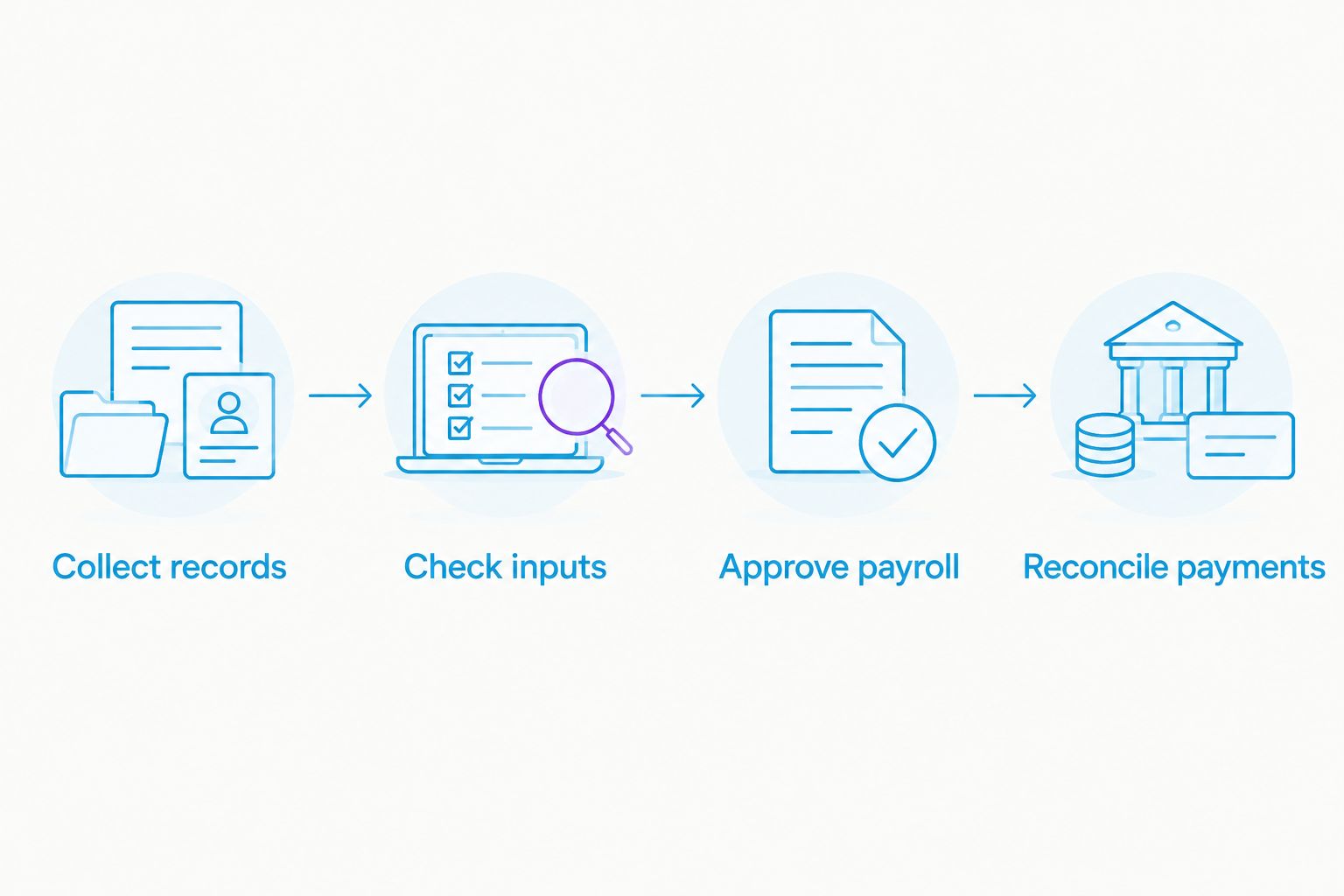
Reconciliation closes the process. Match the payroll reports to wages paid, deductions due and accounting entries so an unexplained difference does not carry into the next period.
- Confirm who handles each pay period during the transfer.
- Transfer records through an agreed secure channel.
- Check year-to-date figures before the first submission.
- Approve the draft before wages are released.
- Match bank payments and accounting entries to payroll reports.
Compare payroll options for restaurants and pubs
The best option depends on who can maintain accurate records and how much internal payroll responsibility you want to retain. For a 2026 decision, compare the operating model first and the written proposal second. Software access alone does not give you someone responsible for checking the payroll.
| Option | Best for | Main advantage | Key limitation |
|---|---|---|---|
| Spreadsheet records plus payroll software | Owners with payroll knowledge and time to manage submissions | Direct control over inputs and processing | You retain calculations, reporting and rule checks |
| Internal payroll administrator | Businesses with enough recurring work to support an internal role | Close access to managers and employment records | You need absence cover and current payroll knowledge |
| Specialist outsourced payroll bureau | Owners seeking a separate payroll-processing service | Defined processing responsibilities without an internal payroll role | Accounting entries and wider tax advice need an agreed handover |
| Gowin Accountants Ltd payroll and accountancy support | UK owners seeking fixed-fee payroll alongside ongoing accounting | Payroll, bookkeeping and tax services from one firm | Exact inclusions and your retained tasks require written agreement |
None of these options removes the need to approve hours. Choose an outsourced service when you want someone else to perform agreed payroll work; choose software when you are prepared to own that work yourself.
Discuss your payroll arrangements
Ask about fixed-fee payroll, your dedicated accountant and the work included in your agreement.
Common mistakes restaurant and pub owners make
Treating the rota as the final pay record
Scheduled hours and worked hours are different records. Require manager approval of actual hours, including shift swaps and authorised changes, before sending the payroll instructions. Otherwise, the provider calculates pay from a plan rather than an approved record.
Mixing tips with basic hourly pay
A combined total hides the distinction between wages and tip distributions. Keep separate records so minimum wage checks and the review of tip treatment use the right information. Do not assume that a larger take-home payment resolves an issue with basic pay.
Assuming pensions and holiday are automatically included
A proposal labelled payroll does not define every administrative task. Ask who calculates holiday pay, sends pension files, handles queries and corrects rejected submissions. Record the answers in the engagement rather than relying on a sales conversation.
Leaving every approval with one busy manager
Service pressure does not pause payroll deadlines. Give a backup approver access to the records and instructions needed to act, without sharing personal login details. Keep the authority to approve pay separate from an informal request to help with administration.
Switching without agreeing the submission boundary
An unclear handover risks duplicate work or an unhandled pay period. Confirm the final outgoing submission, the first incoming submission and the records needed between them. Keep written confirmation from both providers before the change takes effect.
FAQ
What's the best outsourced payroll arrangement for a small pub?
The best arrangement gives your pub a named contact, clear input deadlines and written responsibility for each payroll task. Choose support that matches your working patterns, tip arrangements and pension administration needs.
Can a restaurant outsource payroll but keep its existing rota system?
Yes, you can retain your rota system if it produces records the payroll provider can use. Agree a format for approved hours and a separate process for starters, leavers, absences and adjustments.
Does outsourcing payroll remove my responsibility to HMRC?
No, outsourcing payroll does not remove your responsibilities as an employer. Agree who submits reports, retain appropriate records and check that the work has been completed.
Can tips count towards minimum wage pay?
No, tips, gratuities and service charges do not count towards National Minimum Wage pay under HMRC guidance. Keep wages and tip distributions separate when checking pay.
Will an outsourced payroll provider handle our tronc?
Only if tronc work is expressly included in the engagement. Explain who controls tip allocation and ask the provider to confirm the processing, advice and records covered.
Can I switch payroll providers during the tax year?
Yes, you can switch payroll providers during the tax year. The incoming provider needs accurate payroll and year-to-date records, with a clear boundary between the outgoing and incoming providers' work.
Is outsourced payroll better than buying payroll software?
Outsourced payroll is better when you want a provider to carry out agreed processing and reporting tasks. Software is a better fit when you have the knowledge and capacity to manage those tasks internally.
One last thing
Before appointing a provider in 2026, ask this question: who checks that the approved payroll matches the money leaving the bank? A correct payslip does not prove the bank payment was correct. Put that final check into your process, with an owner who knows what to do when totals differ.