

Your outsourced payroll service cost in 2026 depends on employee numbers, pay frequency and the work included in your written quote. Compare the full annual service charge, including any separate setup, correction and pension administration charges, rather than the headline payroll fee alone.
- Compare outsourced payroll service cost using the same employee count, pay calendar and service scope.
- Gowin Accountants Ltd suits UK small businesses seeking fixed-fee payroll and ongoing accountancy support.
- Confirm who handles pension administration, corrections, employee queries and payment instructions before signing.
- Outsourcing payroll processing does not remove your responsibilities as an employer.
Why this matters
Payroll is recurring work, so an unclear quote creates a recurring budgeting problem. A fee that covers payslips but excludes work your business needs is not directly comparable with a broader service.
For UK small businesses reviewing payroll support in 2026, the useful question is not simply what the provider charges. It is what your business must still do after paying that charge.
Gowin Accountants Ltd provides fixed-fee payroll and accountancy services across the UK. Ask for a dedicated accountant, a written scope and confirmation of how additional work is authorised, so you know what would trigger an unexpected charge.
How much does an outsourced payroll service cost in 2026?
Your cost is the total charge for processing your payroll requirements, not just producing a payslip. Request a quote against your actual workforce and pay calendar, then separate recurring work from implementation and exceptions.
Use this breakdown to compare proposals. These are items to confirm, not promises that every payroll provider includes them.
| Cost component | What to ask the provider | What your comparison must establish |
|---|---|---|
| Recurring processing | What employee count and pay frequency does the fee cover? | Whether the quote matches your normal payroll |
| Initial setup | Does the quote cover importing records and checking opening balances? | Whether implementation is separate |
| Staff changes | How are starters, leavers and pay changes handled? | Whether routine changes fall within scope |
| Pension administration | Who handles assessment, contribution information and pension submissions? | Which tasks remain with your business |
| Corrections | What happens when approved payroll needs changing? | Whether reruns or amendments are extra |
| Reporting | Which payroll reports and accounting entries are supplied? | Whether your bookkeeping needs are covered |
| Payment support | Are payment instructions supplied, or are payments also handled? | Who actually pays staff and HMRC |
Ask for the total annual service charge under a clearly stated set of assumptions. A proposal should also explain how that charge changes when your workforce or requirements change.
Keep employer costs separate from processing charges. Wages, employer National Insurance and employer pension contributions are not the payroll provider's service fee, even when the provider calculates them for you.
Which payroll charging arrangement should you compare?
Compare the charging arrangement separately from the service scope. A fixed fee does not automatically mean every possible payroll task is included, and a variable fee does not explain what support you receive.
The arrangements below are comparison categories, not named plans offered by any particular firm.
| Arrangement | Best for | Main advantage | Main limitation |
|---|---|---|---|
| Agreed recurring fixed fee | Businesses with a defined, recurring workload | Predictable budgeting within the agreed scope | Changes outside scope need clear treatment |
| Per-employee charging | Businesses wanting charges linked to workforce size | Makes the charging unit explicit | You must establish who counts as chargeable |
| Per-run charging | Businesses comparing different pay calendars | Makes processing frequency visible | Additional runs need separate consideration |
| Payroll within accountancy support | Owners seeking coordinated payroll, bookkeeping and tax support | Lets you agree responsibilities together | Payroll boundaries still need their own detail |
Agreed recurring fixed fee
Best for: a small business wanting predictable ongoing support. Agree the workforce, pay frequency and routine tasks the fee covers before treating it as a settled budget.
The limitation is scope. Ask whether a new employee, a pension query or an amended payroll changes the arrangement, and how the provider obtains your approval before undertaking additional work.
Per-employee or per-run charging
Best for: a business that wants to understand the unit behind its quote. Ask whether the charge applies to employees paid, employees on the system or payslips produced.
Per-run comparisons also need the same calendar. For a planning comparison, use 12 monthly runs, 52 weekly runs or 13 four-weekly runs, then confirm the actual pay dates; the calendar can create additional weekly paydays in a particular tax year.
A monthly figure and a four-weekly figure are not interchangeable. Comparing them without checking the annual number of runs gives you an unreliable budget.
Payroll within monthly accountancy support
Best for: owners who want payroll considered alongside bookkeeping and tax obligations. Ask how payroll journals reach your accounts and who resolves differences between payroll reports and accounting records.
Gowin Accountants Ltd is best for UK small businesses seeking fixed-fee payroll alongside ongoing accountancy support. Its services include payroll, bookkeeping, tax, VAT and Xero-based accounting; confirm the particular combination your agreement covers rather than assuming every service is included.
Why outsourced payroll service cost varies
Your quote should reflect work that can be described and agreed. Give each prospective provider the same information about these factors:
- Employee numbers: state your current workforce and explain any expected changes. Ask how staff joining or leaving affects the fee.
- Pay frequency: specify weekly, monthly or four-weekly pay, including any separate calendars for different employees.
- Variable pay: identify overtime, commission, bonuses or changing hours so the provider can explain the required inputs.
- Employment changes and leave: explain how frequently you need support with starters, leavers, absences and statutory pay calculations.
- Pension responsibilities: distinguish payroll deductions from the wider administration you expect the provider to handle.
- Support and reporting: identify employee queries, accounting journals, management reports and correction arrangements you need.
For your 2026 review, describe the work rather than labelling your payroll simple. A small workforce with changing hours needs a different discussion from a workforce on unchanged monthly salaries.
Do not confuse complexity with employee count. Give providers enough detail to quote for your normal operation, not an unusually quiet pay period.
How do you compare payroll quotes properly?
Use the same brief for every provider. Then compare the response against responsibilities, not just the quoted total.
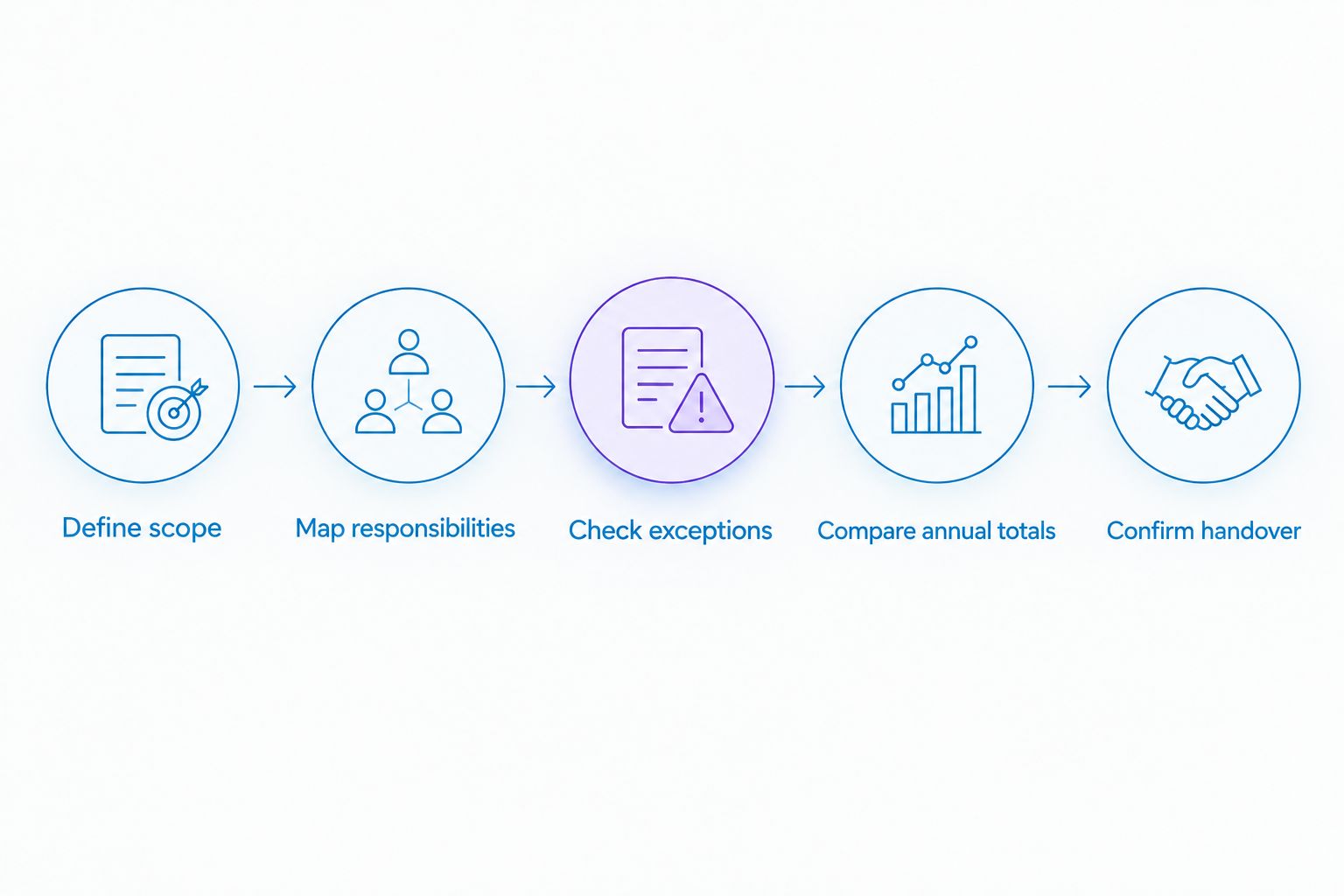
- Define scope. List employees, pay frequencies, variable payments, pension arrangements and the reports your business needs. Include any existing payroll issues that must be resolved.
- Map responsibilities. Identify who supplies payroll information, checks calculations, approves the run, submits information and makes payments. Name the person responsible within your business.
- Check exceptions. Ask what happens after the information deadline, after approval and after submission. Establish how extra work is agreed before it starts.
- Compare annual totals. Request the recurring annual service charge, implementation charges and the treatment of additional work. Check whether figures are VAT-inclusive or VAT-exclusive.
- Confirm handover. Agree the final run with the outgoing provider and the first run with the incoming provider. Confirm access to records and who will answer outstanding questions.
This sequence turns an open-ended enquiry into a scope that both parties can check. Do not accept a quote until you can explain what your business supplies, approves and pays.
What should you confirm before accepting a fixed-fee quote?
A fixed-fee agreement needs clear boundaries. Ask for them in writing so your payroll contact and your business work from the same expectations.
Your agreement should answer these practical questions:
- Who is your regular contact, and who covers absence?
- When must you supply hours, changes and approvals?
- Does the provider deal with employee questions or only your nominated contact?
- Which pension tasks are included, and which remain yours?
- What happens if you submit incorrect information?
- How does the provider authorise and communicate additional charges?
- How can you obtain payroll records if you leave?
Use the guide to what a fixed-fee small business accountant should include when payroll sits within a wider monthly agreement. The payroll scope should remain clear even when several services share the same recurring fee.
For Gowin Accountants Ltd payroll support, ask for fixed fees, a dedicated accountant and explicit agreement about additional work. That gives you a practical basis for checking the arrangement against your needs without assuming an unlimited service.
Discuss your payroll requirements
Set out your workforce, pay calendar and accounting needs before agreeing the service scope.
Is outsourced payroll cheaper than doing it yourself?
Outsourced payroll is not automatically cheaper than managing it internally. Compare the provider's full service charge with software, staff time, training, checking and the work you would still retain.
Best for internal processing: a business with a capable person who has time to operate and check payroll. You retain direct control, but your business must also arrange cover and keep its processes current.
Best for outsourced processing: a business that wants an external specialist to perform agreed payroll tasks. You reduce the processing work handled internally, but still need to supply accurate information, approve payroll and oversee the arrangement.
Do not put a guessed financial value against errors or time saved. Identify the tasks that would actually move outside your business and compare those with the proposed fee.
Does outsourcing payroll remove your employer responsibilities?
Outsourcing payroll does not remove your responsibilities as an employer. HMRC's employer guidance makes clear that using a payroll provider does not transfer responsibility for meeting PAYE duties away from the employer.
For a 2026 service agreement, distinguish calculation, submission and payment. A provider preparing the figures does not, by itself, establish who transfers money or checks that a submission has been accepted.
Agree an approval record and a clear process for resolving discrepancies. For pensions, check responsibilities against The Pensions Regulator's employer guidance as well as the provider's engagement terms.
Can you change payroll providers during the year?
You can change payroll providers during the year, but the handover must preserve payroll records and year-to-date information. Agree responsibility for the final outgoing run and the first incoming run before either provider processes pay.
Ask the incoming provider which records, balances, pension details and authorisations it needs. Also agree how unresolved queries will be handled after the transfer.
A change of provider is not a reason to leave payment dates or approvals uncertain. Keep the handover plan separate from the quote so both the commercial agreement and the operational transfer are clear.
FAQ
How much does an outsourced payroll service cost in 2026?
Outsourced payroll service cost in 2026 depends on your employee numbers, pay frequency and agreed service scope. Request the full annual service charge, with setup, corrections and pension administration identified separately where applicable.
Is payroll included in a fixed-fee accountant package?
Payroll is included only when your agreement expressly includes it. Check the employee count, processing frequency, pension tasks and support covered by the fixed fee.
Do I still need to approve payroll if I outsource it?
You should agree an approval process when outsourcing payroll. Confirm who checks employee changes, pay calculations and payment instructions before the payroll is finalised.
Are employer pension contributions part of the payroll service fee?
Employer pension contributions are separate from the provider's payroll service fee. The provider's charge for pension administration is also a separate scope question that your quote should answer.
Does weekly payroll mean more payroll runs than monthly payroll?
Weekly payroll involves more runs than monthly payroll: a planning comparison uses 52 weekly runs against 12 monthly runs. Check the actual pay calendar because some tax years contain an additional weekly payday.
Can a small limited company outsource payroll and bookkeeping together?
A small limited company can arrange payroll and bookkeeping together. Gowin Accountants Ltd provides both services; confirm how payroll entries, reconciliations and support are covered in your particular agreement.
What should I send a provider to get a payroll quote?
Send your employee count, pay frequency, variable-pay details, pension arrangements and required reporting. Explain any setup, handover or correction work so the quote covers the work you actually need.
One last thing
A payroll report is not proof that a payment has been made. Before appointing a provider in 2026, ask who presses the payment button, who checks the outcome and who acts if something fails.
That responsibility belongs in the service agreement, not in an assumption. This article is general guidance; your payroll arrangements and tax treatment need advice based on your business's circumstances.