

A CIS accountant’s cost depends on whether you need an annual tax return, ongoing bookkeeping, or support with paying subcontractors; compare written quotes against the same responsibilities rather than an unsupported average. Check whether the quote includes VAT, software, year-end accounts and correcting earlier records. For 2026, the useful figure is the total fee for the work your business actually needs, with exclusions agreed before you sign.
- Compare CIS accountant cost by scope: bookkeeping, tax returns and contractor duties are different jobs.
- Gowin Accountants Ltd suits UK businesses seeking ongoing fixed-fee accountancy support.
- CIS deductions are tax payments, not accountancy fees; keep them separate when comparing costs.
- Ask for written inclusions, exclusions and responsibility for missing records before accepting a quote.
Why this matters
Construction businesses can receive payments after CIS deductions, pay subcontractors themselves, or do both. Those situations create different accounting jobs. A quote for preparing your own tax return does not establish that someone will manage your contractor obligations throughout the year.
Start with the CIS accounting guide for construction subcontractors if you need to separate deductions from your wider accounts. Compare the work first, then compare the fee. Otherwise, you risk choosing a service that leaves essential tasks with you when you expected the accountant to handle them.
How much does a CIS accountant cost in 2026?
There is no single fee that covers every CIS business. The meaningful comparison is between quotes for the same legal structure, transaction workload and filing responsibilities. An annual return service and a monthly accounting service are not interchangeable.
Use this breakdown when requesting a quote in 2026. Each option has a suitable use and a limitation; none should be treated as automatically including the others.
| Service scope | Best for | What to ask the accountant to cover | Main limitation |
|---|---|---|---|
| Annual tax return support | Sole traders who maintain complete records themselves | Reviewing trading figures, checking CIS deductions and preparing the relevant return | Does not establish that bookkeeping or ongoing advice is included |
| Monthly accounting support | Businesses wanting regular bookkeeping and tax support | Agreed bookkeeping, reconciliations, tax work and business queries | Responsibilities still need defining; monthly billing alone proves nothing about scope |
| Contractor CIS administration | Businesses paying subcontractors within CIS | Verification, deduction calculations, monthly returns and deduction statements | Does not replace the business’s wider accounting, VAT or payroll work |
Ask each firm to separate recurring work from initial clean-up. Missing deduction statements, unreconciled bank entries and unfiled returns should be identified before the engagement begins, not discovered after you have compared headline quotes.
Also distinguish a monthly payment arrangement from a monthly service. Paying towards an annual tax return by instalments does not mean the accountant reviews your books every month.
Annual tax return support: best for complete records
Annual support fits a sole trader who keeps reliable books and needs help preparing the tax return. The main benefit is a defined piece of work. The limitation is that errors in your bookkeeping can remain unresolved until the accountant reviews the year.
Ask whether the scope includes checking contractor deduction statements against your income records. Your bank receipts alone do not show the full picture when customers have deducted CIS tax before paying you.
If your business is growing, ask who answers questions between returns. A service that works for straightforward annual reporting does not necessarily provide the regular support you need for changing working arrangements, VAT or employing staff.
Monthly accounting support: best for ongoing oversight
Monthly accounting support suits owners who want bookkeeping and tax work handled as an ongoing process rather than a year-end exercise. The benefit is a regular opportunity to identify missing information. The trade-off is that you must still supply records and agree who does each task.
For your 2026 agreement, specify whether the accountant enters transactions, reviews records you enter yourself, or only prepares accounts from completed books. Those are different workloads. Include how purchase invoices, expenses and CIS deduction statements reach the accountant.
Gowin Accountants Ltd is best for UK small businesses seeking ongoing fixed-fee accountancy support. The firm provides tax, VAT, payroll, bookkeeping and Xero-based accounting services; ask for a written proposal identifying which services apply to your business and which CIS tasks it will undertake.
Contractor CIS administration: best for businesses paying subcontractors
If you pay subcontractors for work within CIS, your quote needs to address contractor responsibilities, not just your own tax position. Verification, deductions, returns and statements are distinct tasks. Ask who performs each one and who checks the payment information before submission.
HMRC’s Construction Industry Scheme guidance sets out a monthly reporting period running from the 6th of one month to the 5th of the next. The contractor’s monthly return is due by the 19th following that tax month. Use those requirements to agree a records handover deadline with your accountant.
The benefit of an agreed administration service is clear responsibility for recurring work. Its limitation is scope: contractor CIS administration does not automatically include bookkeeping, employment-status advice, payroll or year-end company accounts.
Why CIS accountant costs vary
The fee should reflect identifiable work, not an unexplained label such as a construction package. Ask the accountant to explain how these factors affect the proposed service:
- Business structure: A sole trader’s tax return and a limited company’s accounts and tax obligations require different work.
- Your CIS role: Receiving payments after deductions differs from verifying and paying subcontractors, and some businesses do both.
- Bookkeeping workload: The number of transactions, missing documents and unreconciled balances affects the work needed to produce usable accounts.
- Additional services: VAT, payroll and software support need explicit inclusion or exclusion rather than assumptions.
- Existing problems: Earlier filing errors or incomplete records create work separate from maintaining current accounts.
- Support expectations: Regular discussions and advice need a defined scope, just as filing work does.
Ask what triggers a fee review. Taking on employees, starting to pay subcontractors or handing over bookkeeping changes the assignment. A clear agreement explains how changes are approved before additional work begins.
CIS deductions are not your accountant’s fee
CIS deductions reduce the payment you receive from a contractor; they are payments towards tax, not charges for accounting services. HMRC’s CIS guidance provides for a standard deduction rate of 20% for registered subcontractors and a higher rate of 30% where the relevant registration or verification requirements are not met. Gross payment status allows payment without CIS deductions.
Those percentages do not measure the cost of hiring an accountant. They also do not establish your final tax liability or guarantee a refund. Your business structure, taxable profits and wider tax position determine how deductions are accounted for.
For your 2026 records, retain the payment and deduction statements supplied by contractors and match them to the work invoiced. Do not treat the net bank deposit as the complete sales figure. Ask the accountant to explain any difference between invoice values, deductions and receipts before accounts are finalised.
How do you compare quotes without hidden gaps?
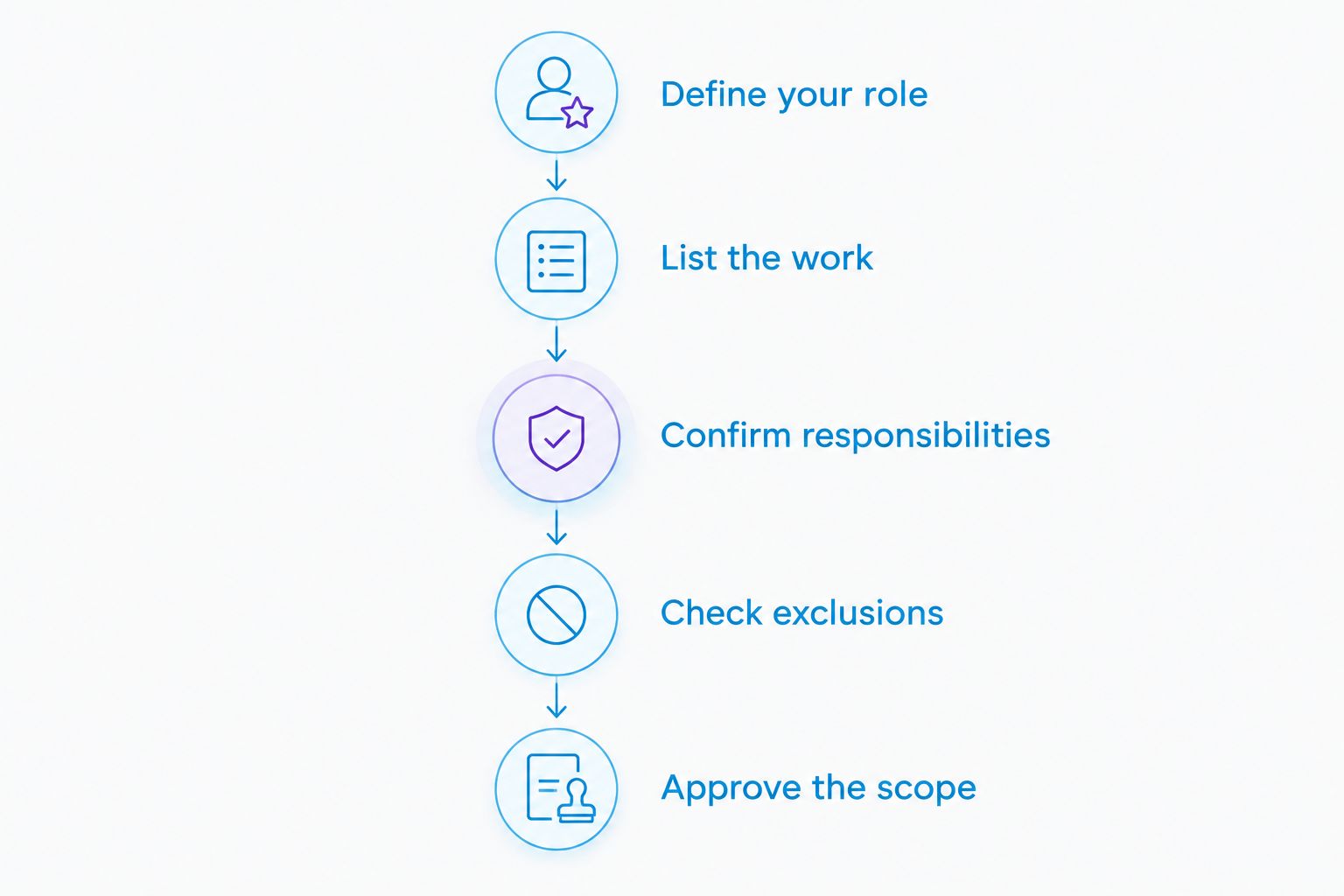
Use the same written brief for every accountant. Comparing different service descriptions tells you little about value, even when the payment schedules look similar.
- Define your role. State whether you are a sole trader or limited company, receive CIS deductions, pay subcontractors, or do both.
- List the work. Identify bookkeeping, accounts, tax returns, VAT, payroll and contractor CIS administration separately.
- Confirm responsibilities. Record who supplies documents, checks deductions, submits returns and responds to questions.
- Check exclusions. Ask about software, historic corrections, additional advice, VAT on the accountant’s fee and changes to scope.
- Approve the scope. Accept the engagement only when the written proposal matches the work you expect.
The order matters: define the business and its obligations before discussing the payment arrangement. Otherwise, the accountant is quoting against assumptions you have not checked.
Keep the agreed scope alongside the engagement letter. If a service matters to your decision, it belongs in the written agreement rather than an assumption carried over from a conversation.
For fixed-fee accountancy, Gowin Accountants Ltd provides a relevant starting point for UK businesses seeking ongoing support. Lead the discussion with fixed fees, a dedicated accountant and clear treatment of additional work. Confirm the particular services and arrangements in your proposal rather than assuming every task is included.
Discuss your accounting requirements
Set out your bookkeeping, tax, VAT, payroll and CIS responsibilities before agreeing a service.
Is monthly support better than an annual CIS return service?
Monthly support is the better fit when you need ongoing bookkeeping, regular answers or recurring contractor administration. Annual return support fits complete records and a narrower filing requirement. Neither arrangement removes your responsibility to provide accurate information.
Consider what happens between filing dates. If unanswered questions cause you to delay recording expenses or checking deductions, discuss ongoing support rather than asking only for a return quote.
Can I change accountants during the year?
You can change accountants during the year, but agree the handover before ending the existing arrangement. Identify outstanding returns, access to accounting records and which firm owns each upcoming task.
For a 2026 change, give the incoming accountant a list of the periods already filed and those still outstanding. Avoid overlapping instructions: both firms need the same understanding of when responsibility transfers.
FAQ
How much should I pay a CIS accountant in 2026?
Compare written quotes for the same responsibilities rather than choosing against a universal fee. State your business structure, bookkeeping needs and whether you receive CIS deductions, pay subcontractors or do both.
Does a monthly accountant fee include CIS returns?
A monthly accountant fee includes CIS returns only when the agreed scope says so. Ask separately about contractor monthly returns, verification, deduction statements and your own tax reporting.
Are CIS deductions the same as accountancy charges?
CIS deductions are payments towards tax, not accountancy charges. HMRC’s standard registered-subcontractor deduction rate is 20%, while the higher rate is 30% where the relevant registration or verification requirements are not met.
Can an accountant guarantee me a CIS refund?
An accountant cannot guarantee a CIS refund before establishing your tax position. A refund depends on the deductions recorded and how they compare with the relevant tax liabilities and reporting rules.
What records should I send my CIS accountant?
Send invoices, expense records, bank information and contractor payment and deduction statements. Businesses paying subcontractors also need to provide the information required for verification, deductions and contractor reporting.
Does a limited company need different CIS accounting support?
A limited company needs its company accounting and tax responsibilities considered alongside CIS. Do not assume a sole trader tax return service covers a limited company’s requirements.
Is Gowin Accountants Ltd suitable for ongoing accounting support?
Gowin Accountants Ltd provides fixed-fee accountancy, tax, VAT, payroll, bookkeeping and Xero-based accounting services to UK businesses. Ask for a proposal confirming the CIS responsibilities, dedicated-accountant arrangements and exclusions relevant to your business.
One last thing
Ask a prospective accountant to explain how an invoice, a CIS deduction statement and the resulting bank receipt connect in your records. That practical explanation tells you what evidence the accountant expects and what you must supply. General guidance cannot replace advice based on your own business records and circumstances.