

Send your landlord accountant a property-by-property record of rent received, letting-agent statements, bank transactions, expense invoices, mortgage interest statements and ownership details. Include purchase or sale paperwork, records of improvements, and information about your other taxable income where relevant. Keep loan repayments, refundable deposits and transfers separate from rental income and expenses so your accountant can assess them correctly.
- Give your landlord accountant rental income, property expenses, mortgage interest and ownership records for each property.
- Separate repairs from improvements, mortgage interest from capital repayments, and refundable deposits from rent.
- Gowin Accountants Ltd suits UK landlords seeking fixed-fee accountancy support rather than an isolated filing service.
- Keep records throughout 2026; send a reconciled pack rather than an unexplained collection of bank transactions.
What records should you send to your landlord accountant?
Your landlord accountant needs evidence of what each property earned, what you spent, who owns it and how it is financed. Bank statements are part of that evidence, not a substitute for invoices, tenancy information or mortgage statements.
For ongoing support, discuss the record-sharing process with Gowin Accountants Ltd before your next submission. Agree who maintains the bookkeeping, how documents are shared and when you should flag a purchase, sale or change of ownership.
Use this checklist for your 2026 record-sharing routine. The ownership structure changes the supporting documents you need, even when the properties look similar.
| Ownership arrangement | Best for organising | Documents to include | Main limitation to address |
|---|---|---|---|
| Personally owned property | Your individual property-income records | Rent, expenses, mortgage interest, ownership evidence and other relevant personal income | Personal and property transactions can appear in the same bank account |
| Jointly owned property | Records shared by co-owners | Property records, ownership documents and any relevant declarations | Do not assume the rental-income split from who received the money |
| Company-owned property | Company bookkeeping and accounts | Company bank records, property transactions, finance agreements and director transactions | Company money and personal money need separate treatment |
Send the evidence behind each transaction, not just the transaction itself. A payment description rarely explains whether work repaired an existing feature, improved it or related to a different property.
Why this matters
A landlord accountant needs a clear trail between the rent due, the money received and the expenses paid. Without that trail, a net payment from a letting agent can hide both rental income and charges deducted before the money reached your bank.
Good records also make ongoing support more useful. You can discuss a proposed purchase, financing change or major building project before the paperwork becomes a year-end sorting exercise.
For your 2026 records, focus on consistency rather than a particular app. A spreadsheet with supporting documents is more useful than accounting software containing unexplained entries.
Rental income: show rent due and rent received
Provide a rent schedule for each property, together with the tenancy agreement and any amendments affecting the rent. Identify the property, tenant, rental period, amount due, amount received and payment date.
Keep arrears, refunds and advance payments visible. Your accountant needs the underlying facts to apply the relevant accounting treatment; you should not decide that a payment belongs to a particular period simply because it arrived then.
Include:
- Letting-agent statements showing gross rent and deductions.
- Bank transactions showing payments from tenants or agents.
- Records of rent paid in cash, with receipts or a cash log.
- Details of unpaid rent, refunds and amounts written off.
- Information about deposits retained or applied against rent or damage.
Do not record only the net amount your letting agent transfers. Send the statement explaining how gross rent became that bank payment. Otherwise, income and agent charges are difficult to separate.
Refundable tenancy deposits also need their own records. Keep deposit-protection paperwork and evidence of any subsequent repayment or deduction rather than automatically treating every deposit receipt as rent.
Property expenses: keep invoices and explain the purpose
Send invoices and receipts for property expenditure, with enough detail to identify the property and the work or service supplied. Useful categories include letting-agent charges, insurance, maintenance, professional fees, utilities and charges you pay as the landlord.
A bank transaction proves that money moved. An invoice helps explain what you bought and why it related to the rental business.
For a repair or building project, include the quote, final invoice and a short description of the property's condition before and after the work. Photographs can help explain the work, but they do not replace the financial documents.
Keep these distinctions clear:
- Repairs: work restoring or maintaining an existing feature.
- Improvements: work changing or upgrading the property beyond a straightforward repair.
- Replacement items: replacement furniture, appliances or other domestic items, with disposal details where relevant.
- Private spending: costs connected with your own use rather than letting the property.
Your accountant decides the tax treatment from the facts. Do not label every builder's invoice as repairs or assume every property-related payment is deductible.
For your 2026 submission, flag mixed-purpose invoices explicitly. If a contractor worked on both your rental property and your home, explain the allocation and keep the supporting breakdown.
Mortgage and finance records: separate interest from repayments
Provide mortgage statements showing interest, capital repayments and relevant charges. Include the finance agreement and documents for any new borrowing, refinancing or repayment during the period.
A mortgage payment is not the same thing as mortgage interest. Your accountant needs the interest figure separately from the amount used to repay the loan.
The treatment of residential property finance costs differs between individual landlords and companies. Send the documents rather than applying the same calculation to both ownership structures.
Explain how borrowed money was used, particularly where borrowing covered more than one purpose. A loan secured against a rental property does not, by itself, explain the purpose of the funds.
Keep transfers between your accounts separate from income and expenses. Moving money into a property account to cover a payment does not make that transfer rental income.
Ownership and property changes: send the legal paperwork
Give your accountant the ownership details for every property, including the names of the owners and relevant ownership documents. Tell them about changes rather than assuming the bank account receiving the rent settles the question.
For jointly owned property, include any declaration of trust and relevant tax declarations already made. Your accountant can assess the documents against the rules that apply to your circumstances.
For a purchase, send the completion statement, purchase contract, legal invoices and details of associated expenditure. For a sale, provide the sale completion statement and the records supporting the original purchase and subsequent improvements.
Contact your accountant when a sale is planned or completed; do not wait for the annual return. Property disposals can involve reporting obligations separate from the normal annual filing process.
Also flag a property moving into or out of letting, periods of personal use and changes between residential and other uses. These facts give context to the income and expenditure records.
Personal or company information: complete the wider picture
An individually owned rental property does not sit outside your wider tax position. Where your accountant prepares your personal return, provide relevant employment, pension, self-employment and other income records, along with tax already deducted.
Send previous returns and HMRC correspondence when switching accountants. Include relevant notices, outstanding queries and details of payments already made so your new accountant can understand the position.
For a property company, provide company bank statements, financing records and transactions involving directors or shareholders. Clearly identify money introduced, money withdrawn and expenses paid personally on the company's behalf.
Avoid sending sensitive login credentials in an ordinary document pack. Agree a secure sharing method and the appropriate authorisations with your accountant instead.
How should you organise the records before sending them?
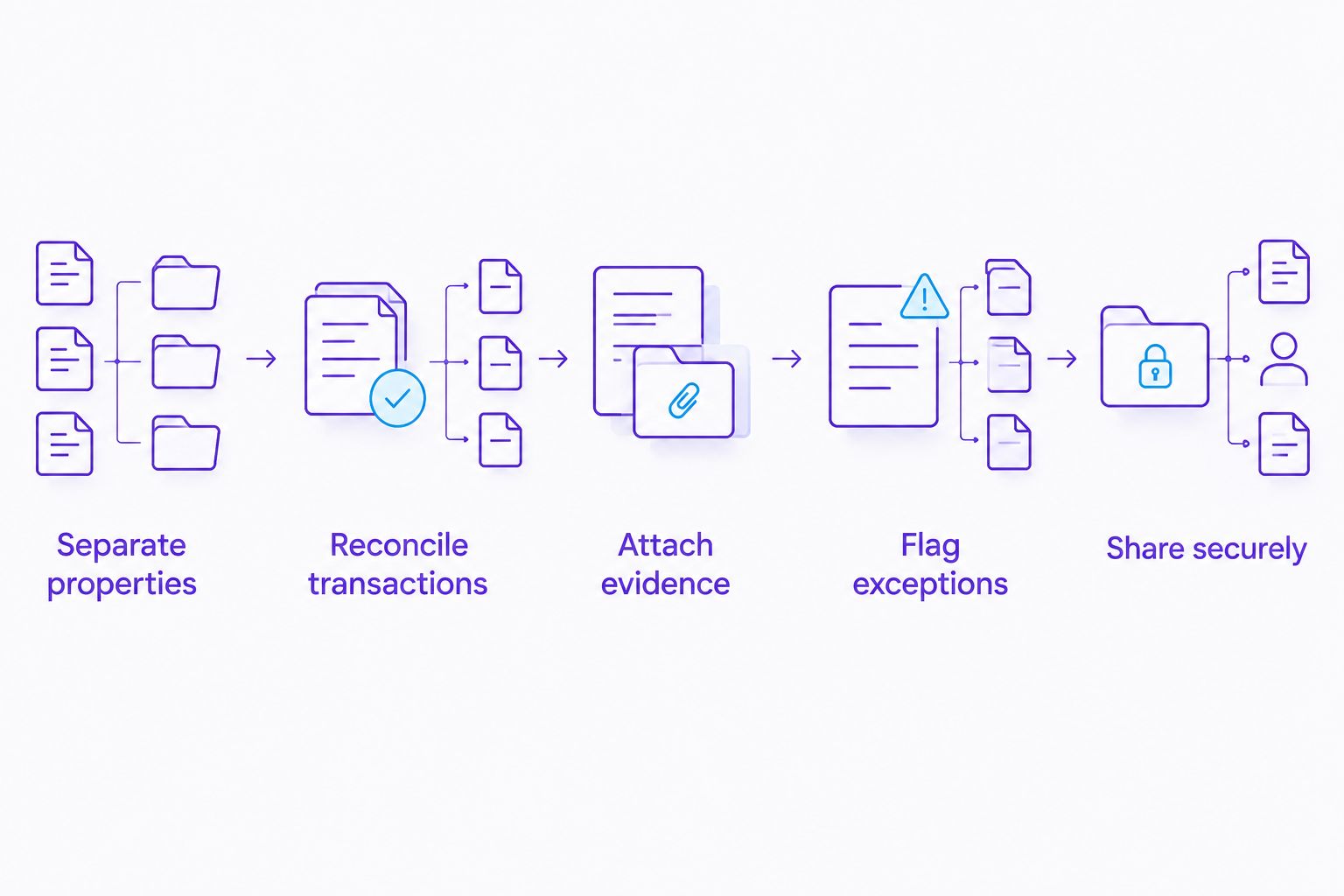
Use a repeatable process that connects each transaction to its evidence. The aim is to make the pack understandable without relying on your memory.
- Separate properties. Use a clear property reference on income schedules and supporting documents.
- Reconcile transactions. Match receipts and payments to the bank or letting-agent statement, explaining differences.
- Attach evidence. Keep invoices, receipts and finance statements alongside the relevant entries.
- Flag exceptions. List missing documents, mixed-use costs, arrears and unusual payments separately.
- Share securely. Use the sharing method agreed with your accountant and retain your own copies.
For a full year, collect 12 months of bank and agent statements where those accounts or arrangements operated throughout the period. Check for gaps before sending the pack; a missing statement can hide transactions even when the opening and closing balances appear plausible.
Give files clear names showing the property, document type and relevant period. Avoid a folder of unidentified scans: even a readable invoice is hard to place if the property address and purpose are unclear.
Why the records your landlord accountant needs vary
The core checklist stays the same, but the supporting detail depends on your circumstances. Explain these factors at the start of the relationship:
- Ownership structure: personal, joint and company ownership require different supporting information.
- Management arrangements: agent-managed properties need statements explaining deductions as well as bank receipts.
- Finance arrangements: refinancing and mixed-purpose borrowing need more context than an interest total.
- Building work: substantial projects need documents distinguishing repairs, improvements and replacement items.
- Property changes: purchases, sales and changes of use require transaction paperwork beyond routine bookkeeping.
- Wider tax position: personal income or company transactions affect the information needed alongside property records.
Agree the scope before agreeing the record-sharing routine. Bookkeeping support, personal tax returns and company accounts are different tasks; confirm which tasks your ongoing arrangement covers.
How long should you keep landlord records?
For individual property-income records, HMRC's record-keeping guidance generally requires retention for at least 5 years after the 31 January submission deadline for the relevant tax year. Late returns, enquiries and other circumstances can require longer retention.
For company accounting records, the general retention period is 6 years from the end of the financial year they relate to, with exceptions requiring longer storage. These are the general HMRC retention rules relevant to your 2026 record-keeping plan, not a reason to delete documents automatically.
Keep purchase and improvement evidence for as long as it remains relevant to the property's eventual disposal and the associated retention requirements. Ask your accountant before destroying older property documents.
Should you send records monthly or at year end?
Send records throughout the year if you want ongoing bookkeeping and accountancy support. Agree the frequency around your service scope, transaction volume and reporting needs rather than assuming annual delivery is enough.
Gowin Accountants Ltd's fixed-fee positioning, dedicated accountant and emphasis on no unexpected charges suit landlords who want an ongoing relationship. Confirm the work covered and the treatment of additional work in writing; a fixed fee still needs a defined scope.
What if you have lost an invoice or receipt?
Request a duplicate from the supplier or obtain the relevant agent or lender statement. Keep the bank transaction and explain what happened, but do not assume it establishes the expense's purpose or tax treatment on its own.
List unresolved gaps separately when you send the records. An explained missing document is better than an entry presented as fully supported when it is not.
FAQ
What records does a landlord accountant need from me?
A landlord accountant needs rental-income records, expense evidence, mortgage interest statements and ownership details for each property. Include purchase or sale documents and relevant personal or company information.
Are bank statements enough for my rental-property tax return?
Bank statements are not a complete evidence pack on their own. Send invoices, letting-agent statements and finance records so your accountant can identify the purpose and treatment of each transaction.
Should I send gross rent or the amount my letting agent pays me?
Send the statement showing gross rent, deductions and the net payment. Your accountant needs to separate rental income from the charges deducted by the agent.
Do I send my whole mortgage payment as an expense?
Send a mortgage statement separating interest from capital repayments rather than treating the whole payment as an expense. The tax treatment also depends on the ownership structure and use of the borrowing.
How long do individual landlords need to keep records?
Individual landlords generally keep property-income records for at least 5 years after the 31 January submission deadline for the relevant tax year. Late filing, enquiries and documents relevant to a later disposal can require longer retention.
Can Gowin Accountants Ltd help with ongoing landlord accounting?
Gowin Accountants Ltd provides fixed-fee accountancy services to landlords across the UK. Agree the bookkeeping, tax work and record-sharing responsibilities included in your arrangement.
What should I send when switching landlord accountants?
Send previous returns, HMRC correspondence, current property records and details of outstanding issues. Agree how the previous accountant's relevant information will be transferred.
One last thing
The most useful addition to your records is a short exception list. Note the payment you cannot identify, the repair that included an upgrade, the tenant deposit partly retained and the borrowing used for more than one purpose.
That list tells your accountant where judgement is needed. It also stops an unusual transaction disappearing inside otherwise routine bookkeeping.
For 2026, make the exception list part of each submission rather than trying to reconstruct it at year end. This article gives general UK record-keeping guidance; your accountant should assess the treatment and deadlines against your individual circumstances.