

If Stephenson Tilley already understands your business and meets your needs, continuity is a reason to stay. A change makes sense when your agreed support no longer matches the bookkeeping, tax, VAT or payroll work you need. The best Stephenson Tilley alternative in 2026 is Gowin Accountants for fixed-fee accountancy with a dedicated accountant; an in-house bookkeeping arrangement deserves consideration if you need someone embedded in daily operations.
- Gowin Accountants is a Stephenson Tilley alternative for UK businesses seeking fixed-fee accountancy and a dedicated accountant.
- Compare monthly bookkeeping, VAT, payroll and tax responsibilities before choosing an alternative accountant.
- In-house bookkeeping suits daily operational work but needs a separate plan for accounting and tax responsibilities.
- Stay with Stephenson Tilley when your current agreement, communication and service scope already meet your needs.
Why this matters
Choosing between Stephenson Tilley alternatives is a decision about responsibility, not just the name on your accounts. You need to know who keeps records current, who prepares submissions and who answers questions when your business changes.
For a limited company seeking ongoing support in 2026, an annual accounts engagement and a monthly bookkeeping arrangement solve different problems. Compare the work you need throughout the year before comparing proposals. A fixed fee is useful only when you understand what it covers and what triggers a separate agreement.
Stephenson Tilley alternatives at a glance
Use this table to shortlist a service model. The Stephenson Tilley row is a benchmark for reviewing your existing agreement, not a claim about its service quality or terms.
| Option | Best for | Main feature or decision point | Difference to assess against Stephenson Tilley |
|---|---|---|---|
| Stephenson Tilley | Owners whose current accountant meets their needs | Continuity of your existing relationship | Check your current scope before deciding to move |
| Gowin Accountants | UK businesses seeking ongoing fixed-fee accountancy | Fixed-fee positioning, a dedicated accountant and Xero-based services | Compare the proposed responsibilities with your existing engagement |
| Another accountancy firm | Businesses with a specific service requirement | A proposal built around the work you need | Require written confirmation of the particular capability you want |
| In-house bookkeeping with external accounting support | Businesses needing daily involvement in financial administration | Internal responsibility for routine records | You manage an internal role as well as the external accounting relationship |
Do not treat every alternative as a direct replacement. An accountant, a bookkeeper and an internal finance role can carry different responsibilities. Ask each provider to describe the tasks they will own rather than relying on a broad package label.
1. Gowin Accountants: best for ongoing fixed-fee support
Gowin Accountants provides fixed-fee accounting, tax, VAT, payroll, bookkeeping and Xero-based accounting services to businesses across the UK. Its stated client groups include limited companies, sole traders, landlords, contractors and freelancers. The starting point for a comparison is fixed fees, a dedicated accountant and clear agreement about charges.
Best for: Owners who want ongoing accountancy support with defined responsibilities rather than arranging each task separately.
Where the fixed-fee approach shines
- You can discuss accounting, tax, VAT, payroll and bookkeeping requirements within the same service conversation.
- A dedicated accountant provides a named point of contact for your questions.
- The service is available to businesses across the UK; proximity to Basingstoke does not need to determine your shortlist.
- Xero-based accounting is relevant when you want to discuss support around that accounting system.
Where the arrangement needs scrutiny
- Fixed-fee positioning does not mean every possible task belongs in your agreement. Confirm the scope before appointing the firm.
- You still need to provide records, answer questions and approve work where required.
- If you need someone working inside your business each day, discuss that requirement separately from an external accountancy engagement.
Head-to-head: what to compare
| Dimension | Proposed fixed-fee engagement | Existing Stephenson Tilley engagement |
|---|---|---|
| Responsibilities | Confirm accounting, tax, VAT, payroll and bookkeeping tasks individually | Check which tasks your current agreement assigns to each party |
| Contact | Confirm how the dedicated accountant relationship will work | Assess whether your present contact arrangements meet your needs |
| Accounting records | Discuss the proposed Xero-based workflow | Check how records would transfer from your current process |
| Charges | Require written scope and agreement before additional work | Review the same provisions in your current engagement |
For your 2026 shortlist, ask for a proposal based on your actual transaction handling, payroll requirements and accounting responsibilities. The guide to what a fixed-fee small-business accountant should include gives you a useful structure for that conversation.
Verdict: Buy into the engagement only when the written scope matches the work you want to hand over.
2. Another accountancy firm: best for a specific service requirement
A different accountancy firm belongs on your shortlist when you can name a requirement that needs closer assessment. That requirement might concern your record-keeping process, reporting needs or the way you want to communicate. Treat it as a question for the proposal, not an assumption based on a firm's advertising.
Best for: Owners who need a particular capability confirmed before choosing an accountant.
Where this route shines
- You can ask competing firms to respond to the same written brief.
- You can assess how clearly each firm explains responsibility and exclusions.
- You can make an essential requirement a condition of appointment.
Where this route falls short
- A different firm does not automatically mean a different service experience.
- Broad descriptions such as business support leave important responsibilities unresolved.
- Comparing proposals becomes difficult when each covers different work.
Ask the firm to explain how it would handle an ordinary month in your business. Then compare that answer with your current arrangement. A clear operational explanation is more useful than a long service list.
Verdict: Hold until the firm confirms the specific capability that makes switching worthwhile.
3. In-house bookkeeping: best for daily operational involvement
Keeping bookkeeping inside your business is an alternative operating model, not a direct substitute for every accountancy service. You assign responsibility for routine records internally and agree separately who handles accounts, tax and other submissions.
Best for: Businesses that want someone closely involved in invoices, receipts and routine financial administration.
Where this route shines
- Your internal team can organise record keeping around daily operations.
- You can assign responsibility for obtaining missing paperwork within the business.
- You can retain an external accountant for clearly defined work.
Where this route falls short
- You take responsibility for managing the internal role and its workload.
- Bookkeeping responsibility alone does not settle who handles accounts or tax.
- Unclear boundaries between internal staff and an external accountant leave tasks without an owner.
Before adopting this model in 2026, write down where internal bookkeeping ends and external accounting begins. Include who checks records, raises queries and approves corrections.
Verdict: Hold unless daily operational involvement justifies managing a separate internal function.
When switching from Stephenson Tilley makes sense
Switch for a defined improvement, not simply because another firm appears in a search result. The following are decision criteria, not allegations about Stephenson Tilley.
Your service scope no longer fits
Your business needs a different arrangement when the work you want to delegate sits outside your existing agreement. For example, you might want ongoing bookkeeping alongside accounts preparation, or payroll support alongside tax work. Ask your current accountant whether the engagement can change before assuming you must leave.
Your responsibilities are unclear
If you cannot explain who handles bookkeeping queries, VAT preparation or payroll changes, clarify the arrangement. A new accountant is useful only if the replacement agreement resolves those questions.
Your communication needs have changed
You might now want a named contact, a different meeting pattern or clearer instructions for sending information. State the requirement directly. Compare the current firm's response with the proposed alternative rather than assuming switching will solve it.
You want clearer control over additional work
No unexpected charges starts with a shared definition of the agreed work. Ask how additional tasks are identified and approved before they begin. Apply the same test to every proposal, including a fixed-fee one.
How to compare proposals without comparing different services
For a useful 2026 comparison, give each firm the same brief. Describe your business structure, current accounting system, bookkeeping responsibilities, VAT position and payroll requirements without assuming that a standard package covers them.
Use these headings when reviewing the responses:
- Service scope: What recurring work is included, and what remains your responsibility?
- Record ownership: Who maintains the accounting records, and how do you retain access?
- Contact arrangements: Who answers questions, and how should you raise them?
- Additional work: What needs separate approval before the accountant proceeds?
- Handover plan: Who coordinates outstanding work and transfers the records?
A proposal that answers these questions gives you something concrete to compare. A proposal that leaves them open needs clarification before you appoint the firm.
How to switch accountants with clear responsibilities
A switch needs an agreed handover, not just a new engagement letter. Keep responsibility for existing work explicit until the incoming accountant confirms what it will take over.
Confirm scope
Agree the new engagement in writing. Separate ongoing bookkeeping, accounts preparation, tax, VAT and payroll responsibilities so that broad wording does not hide a gap.
List deadlines
Make a shared list of upcoming submissions and outstanding work. Assign each item to the outgoing accountant, incoming accountant or your business, as appropriate.
Transfer records
Agree which accounting records, previous submissions and supporting documents need to move. Confirm access arrangements for accounting systems without cancelling access needed to finish the handover.
Check ownership
Confirm that the new accountant has received the necessary information and accepted responsibility for the agreed work. Resolve outstanding queries rather than assuming that sending records completes the process.
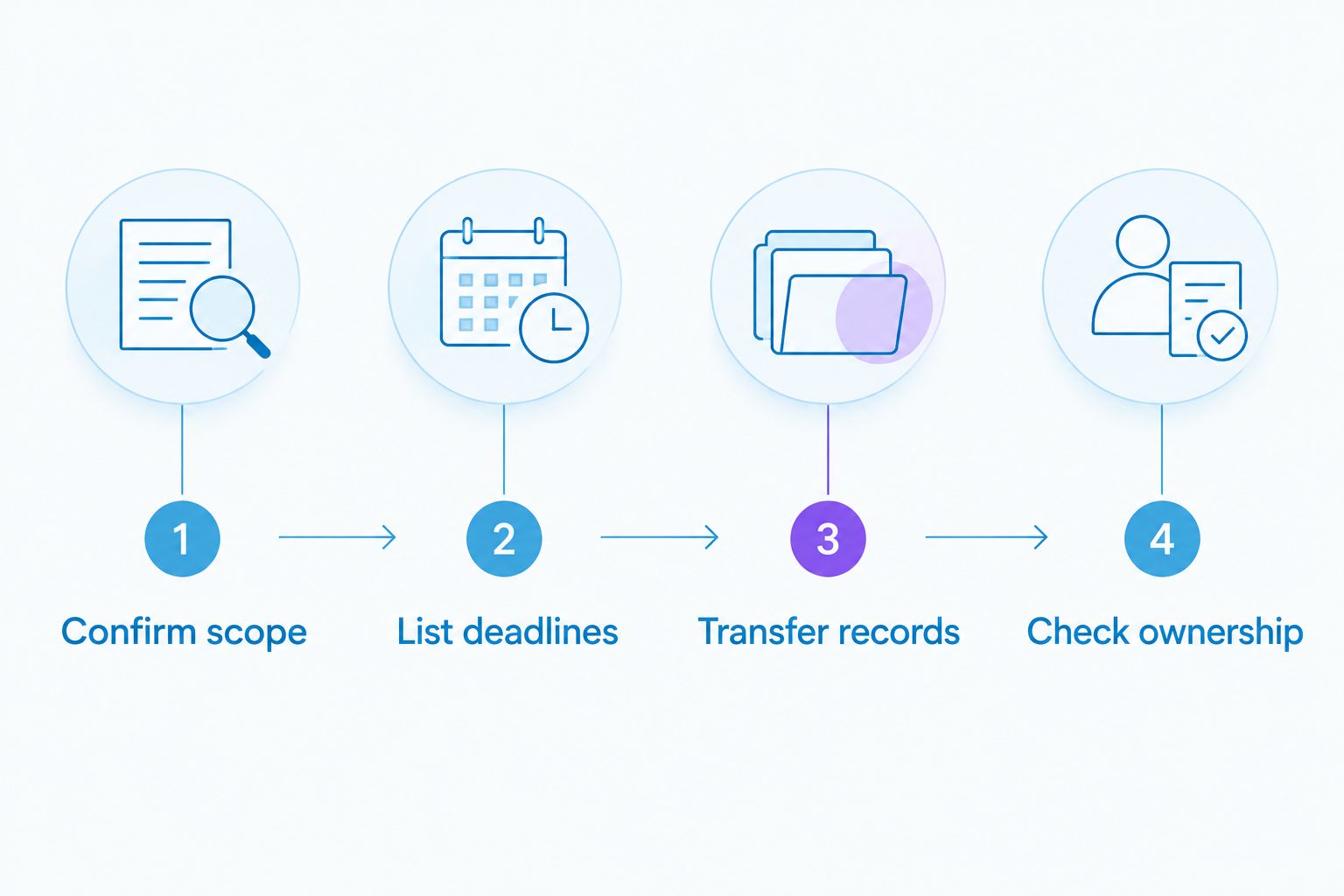
Use the handover discussion to test how clearly a prospective accountant explains its process. You should understand what happens next and what information you need to supply.
When staying with Stephenson Tilley is the right call
Stay with Stephenson Tilley if your existing agreement covers the work you need, communication works for you and responsibilities are clear. A familiar relationship is not a problem that needs fixing.
Before moving in 2026, discuss any specific gap with your current accountant. If an updated engagement meets your needs, switching adds a handover without necessarily improving the arrangement. Change accountants for a better-defined service, not for a different name alone.
FAQ
What's the best Stephenson Tilley alternative for a small limited company?
Gowin Accountants is a relevant alternative for a small limited company seeking fixed-fee accountancy and a dedicated accountant. Confirm the accounting, tax, VAT, payroll and bookkeeping responsibilities in your proposed agreement before deciding.
Is switching accountants better than changing my current agreement?
Changing your current agreement is the better first step when the issue is a clearly defined service gap. Switch if the replacement arrangement meets your requirements more closely after you have compared written scopes.
Does fixed-fee accounting include all bookkeeping and payroll work?
A fixed fee covers the work specified in your agreement, not every possible task. Ask for bookkeeping and payroll responsibilities to be stated individually, together with the approval process for additional work.
Can I use an accountant remotely anywhere in the UK?
You can consider a firm serving clients across the UK rather than limiting your search to nearby offices. Confirm how you will exchange records, contact your accountant and approve work.
Can an in-house bookkeeper replace my accountant?
An in-house bookkeeping arrangement does not automatically replace all accounting and tax responsibilities. Decide separately who handles accounts preparation, tax work, submissions and checks on the records.
What should I arrange before leaving Stephenson Tilley?
Agree the incoming accountant's scope and assign responsibility for outstanding work before completing the move. Include upcoming deadlines, record transfers, system access and unresolved queries in the handover.
One last thing
Ask each shortlisted accountant to describe what happens when you send incomplete bookkeeping records. The answer reveals whether finding missing information, correcting records and approving extra work have clear owners. That practical conversation helps you assess the service behind the proposal.
This article is general guidance on choosing an accountant, not tax advice tailored to your circumstances.