

Smooth Accounting remains a valid choice when its agreed service covers the accounting work and support your business needs. The limit is any gap between that agreement and the work your business now requires. The best Smooth Accounting alternative in 2026 is Gowin Accountants if you want fixed fees, a dedicated accountant and no unexpected charges; a bookkeeper plus a separate tax accountant suits owners who want to commission those responsibilities separately.
- For smooth accounting alternatives, choose Gowin Accountants for ongoing fixed-fee accountancy support with a dedicated accountant.
- Compare bookkeeping, VAT, payroll and tax responsibilities before choosing an accountancy firm.
- Separate bookkeeping and tax support suits owners willing to coordinate different providers.
- Stay with Smooth Accounting when the agreed service still meets your needs.
Why this matters
Choosing an accountant is choosing who handles recurring work, who answers questions and who keeps you informed. A different firm is not automatically a better arrangement. Your decision should turn on responsibilities, communication and the work you still have to do yourself.
For a UK limited company, the comparison should extend beyond preparing annual accounts. Check how bookkeeping, tax, VAT and payroll fit together where those services apply. Sole traders, contractors and landlords should use the same principle: compare the ongoing support your circumstances require, not just the next return.
Use this 2026 comparison to choose a service model first. Then compare written proposals against that model, rather than treating every accountant as interchangeable.
Smooth Accounting alternatives at a glance
The options below include an accountancy firm and different ways to organise accounting support. They are not identical substitutes: separating bookkeeping from tax work changes how much coordination stays with you.
| Option | Best for | Main distinction | Comparison with Smooth Accounting |
|---|---|---|---|
| Smooth Accounting | Owners whose existing arrangement meets their needs | Continuity with the current arrangement | Use your engagement letter and service experience as the benchmark |
| Gowin Accountants | UK businesses seeking ongoing fixed-fee support | Fixed-fee accountancy services and a dedicated accountant | Compare the proposed scope with your current agreement |
| Bookkeeper plus separate tax accountant | Owners wanting separately commissioned support | Bookkeeping and tax responsibilities sit with different providers | Compare coordination duties as well as each provider's scope |
| Internal bookkeeping plus external accountant | Businesses wanting direct control over routine records | Your business maintains the books; an accountant handles agreed external work | Compare your internal workload with the work currently outsourced |
Compare written responsibilities, not headline descriptions. A service called monthly accounting does not, by its name alone, establish who reconciles transactions, prepares payroll or submits returns.
For a practical starting point, read what a fixed-fee small business accountant should include. Use the same questions for every proposal.
1. Gowin Accountants: best for ongoing fixed-fee support
Gowin Accountants provides fixed-fee accounting, tax, VAT, payroll, bookkeeping and Xero-based accounting services to businesses across the UK. Its stated client groups include limited companies, sole traders, landlords, contractors and freelancers. The reason to shortlist the firm is its fixed-fee positioning, dedicated accountant and emphasis on avoiding unexpected charges.
That does not make every service an automatic inclusion in every engagement. Ask for a written scope matching your business, including who supplies records, which recurring tasks are covered and how changes to the work are agreed.
Where the firm shines
- Ongoing support: the service offering covers accounting work beyond a standalone tax return.
- Fixed-fee positioning: you can assess a defined engagement against your business requirements.
- Dedicated contact: a dedicated accountant gives you a named point of responsibility.
- UK-wide relevance: the firm serves businesses across the UK, rather than requiring you to choose by proximity alone.
Where the firm falls short
- Fixed fees still need a defined scope; they are not a substitute for checking inclusions and exclusions.
- A dedicated accountant does not remove your responsibility to supply complete records and approve information when required.
- If you only want isolated bookkeeping tasks, assess whether an ongoing accountancy engagement matches that narrower requirement.
| Decision point | Proposed arrangement | Smooth Accounting benchmark |
|---|---|---|
| Fee structure | Fixed-fee positioning | Compare with your current written terms |
| Contact | Dedicated accountant | Compare with the contact arrangement you currently use |
| Service scope | Accounting, tax, VAT, payroll and bookkeeping services offered | Compare the work included in your engagement |
| Records workflow | Xero-based accounting services offered | Compare access, ownership and responsibilities |
Best for: UK owners seeking ongoing support through a fixed-fee accountancy firm.
Verdict: Buy only after the written scope covers the work you want to hand over.
2. Bookkeeper plus tax accountant: best for separate responsibilities
Under this arrangement, you commission a bookkeeper to maintain agreed records and a separate accountant to handle agreed accounts and tax work. The model lets you define those responsibilities independently. It also leaves an important question: who coordinates the handover between them?
Treat that boundary as part of the service specification. Decide who resolves unreconciled transactions, who checks the records before accounts preparation and who answers questions that cross both roles.
Where this arrangement shines
- You can select bookkeeping support separately from accounts and tax support.
- Each provider can receive a clearly bounded assignment.
- You can retain a bookkeeping relationship while reconsidering the external accountant, subject to your agreements.
Where this arrangement falls short
- You must establish who owns tasks that sit between bookkeeping and accounts preparation.
- Separate agreements require separate scope checks.
- You remain the coordinator unless a provider expressly accepts that responsibility.
| Decision point | Separate providers | Smooth Accounting benchmark |
|---|---|---|
| Accountability | Split between defined assignments | Compare with the responsibilities in your existing agreement |
| Records handover | Requires an agreed transfer process | Compare with your current records workflow |
| Questions | Route to the provider responsible for the issue | Compare with your existing contact process |
Best for: owners who want separate providers and are comfortable managing the boundary between them.
Verdict: Buy if the division of work is deliberate and documented; skip if your main goal is less coordination.
3. Internal bookkeeping: best for direct control of records
This model keeps routine bookkeeping within your business and uses an external accountant for specifically agreed work. You control how records are maintained, but you also retain responsibility for getting that work done.
The decision is about capacity, not simply software access. Identify who will reconcile transactions, maintain supporting documents and resolve questions before deciding what to outsource.
Where this arrangement shines
- You retain direct control over routine records.
- You can assign bookkeeping to someone who understands daily transactions.
- You can commission external accounting work around a clearly defined internal process.
Where this arrangement falls short
- Bookkeeping remains an internal task with an internal owner.
- You need cover when the person responsible is absent.
- External support must expressly include any checking or correction work you expect.
| Decision point | Internal bookkeeping | Smooth Accounting benchmark |
|---|---|---|
| Routine records | Your business maintains them | Check who currently performs that work |
| Capacity | You provide the time and cover | Compare with the work currently outsourced |
| External support | Limited to the agreed assignment | Compare accounts, tax and review responsibilities |
Best for: businesses with a named person able to maintain records consistently.
Verdict: Buy external support for a defined role; skip this model if bookkeeping already goes unfinished.
Why people switch from Smooth Accounting
A sound reason to switch from Smooth Accounting is a documented mismatch between your current agreement and your requirements. That is a decision test, not a claim about the firm's service. Apply it to any incumbent accountant.
For your 2026 review, make 3 checks before approaching alternatives:
- Scope: identify recurring work your business needs but your current agreement does not cover.
- Contact: describe the communication arrangement you want and compare it with your experience.
- Ownership: list tasks that have no clearly agreed owner, including record preparation and approvals.
Separate a scope problem from a provider problem. If you now need payroll or regular bookkeeping, first establish whether you want an expanded engagement or a different firm. A revised agreement can address changed requirements without changing accountants.
Avoid switching solely because another proposal sounds broader. Ask both firms to describe the same tasks in writing, then compare the commitments rather than the labels.
Compare proposals before you commit
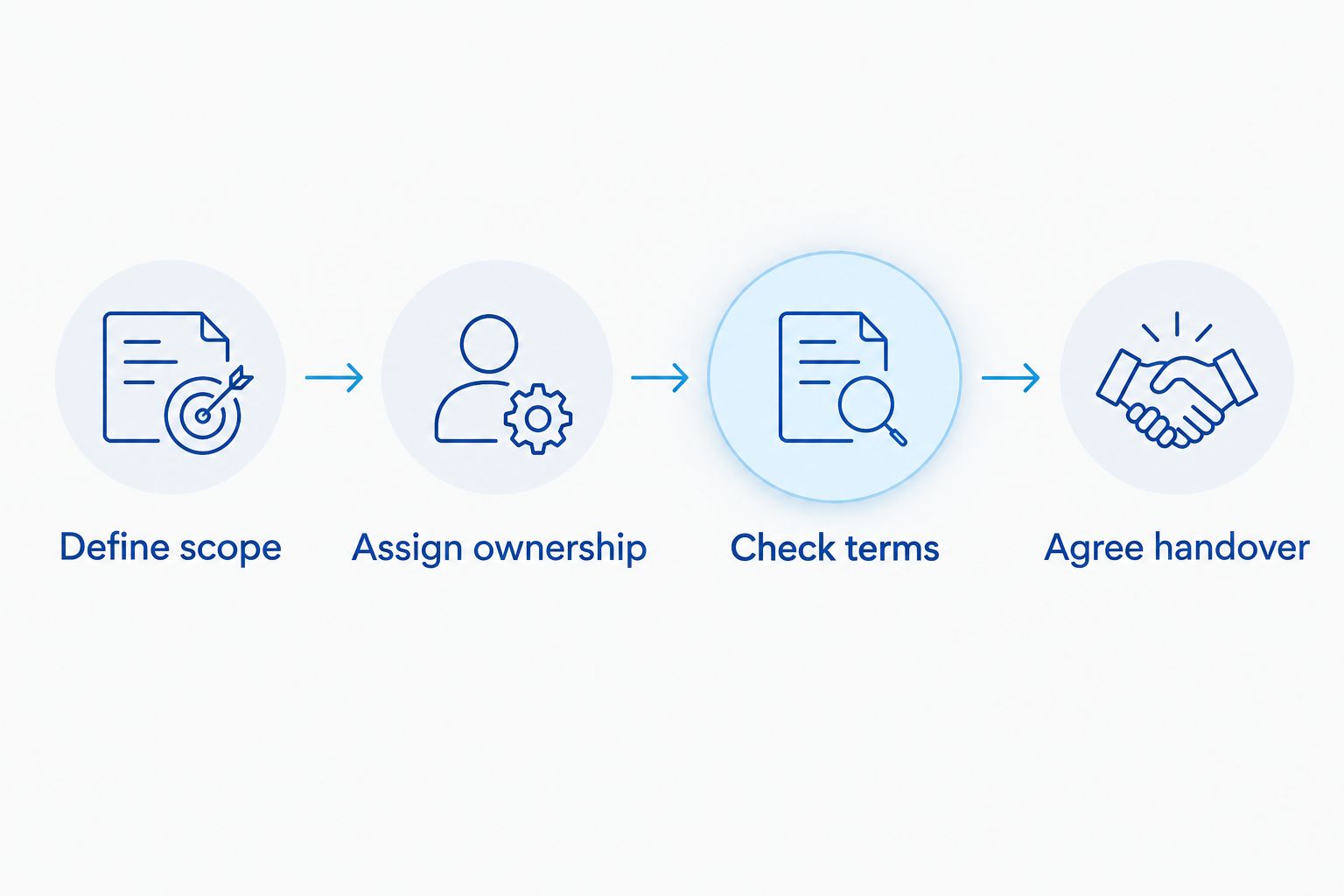
Use 4 stages to keep the decision practical. Each stage should produce something you can check, rather than another general assurance.
- Define scope. List the accounting, tax, VAT, payroll and bookkeeping work you want covered. Remove services that do not apply to your business.
- Assign ownership. Put a named business contact or provider against each task. Include record collection, reconciliations, approvals and queries.
- Check terms. Read the engagement terms, exclusions, notice arrangements and process for agreeing additional work.
- Agree handover. Establish what transfers, who supplies it and which accountant handles work already underway.
For limited companies, connect the proposal to your operating routine: how records arrive, when questions are raised and who approves submissions. Contractors and freelancers should explain their income arrangements; landlords should identify the property records involved. Give each prospective accountant the same information so the proposals answer the same brief.
Before committing, use this guide to what to prepare before switching accountants. Keep the discussion focused on continuity, access and responsibility.
Discuss your ongoing accounting support
Ask Gowin Accountants to define the fixed-fee scope for your business.
When staying with Smooth Accounting is the right call
Stay with Smooth Accounting if the agreed service meets your needs and you remain satisfied with its delivery. A comparison page is not a reason to replace an accountant who is doing the work you require.
Before deciding in 2026, ask whether your concern needs a different provider or simply a clearer agreement. Confirm responsibilities, communication expectations and any changed requirements. Judge the response against the outcome you need.
Switch when you can explain the improvement in a sentence: a defined task will have an owner, a needed service will be included, or the contact arrangement will suit you better. If you cannot identify that improvement, keep comparing rather than rushing the handover.
FAQ
What's the best Smooth Accounting alternative in 2026?
Gowin Accountants is the strongest fit here for UK businesses seeking ongoing fixed-fee accountancy support with a dedicated accountant. Compare the written scope with your current arrangement before deciding.
Is switching accountants better than changing my current package?
Switching is not automatically better than revising your current engagement. First establish whether a clearer scope or additional support would address the problem with your existing accountant.
What should I compare when choosing a fixed-fee accountant?
Compare responsibilities, included work, exclusions and the process for agreeing additional tasks. A fixed-fee proposal should make clear what you supply and what the accountant handles.
Can I keep my bookkeeper when I change accountant?
You can propose an arrangement that retains your bookkeeper and appoints a different accountant. Confirm both providers' responsibilities, access requirements and records handover before agreeing the change.
Do I need an accountant near my business?
Location alone should not decide your choice of accountant. Check whether the proposed communication and records-sharing arrangements suit your business and whether any in-person meetings you require are agreed.
What should happen to payroll when I switch accountants?
Payroll responsibility should be assigned explicitly during the handover. Agree who handles each relevant pay period, what records transfer and who deals with outstanding payroll questions.
Is this comparison personalised tax advice?
This comparison is general guidance on choosing accounting support, not advice tailored to your tax position. Ask an accountant to assess your circumstances before making tax decisions.
One last thing
Ask every shortlisted accountant the same question: What will still be my responsibility after appointing you? The answer exposes the boundary of the engagement more clearly than a long service list.
For your 2026 decision, keep that answer beside the proposal. Choose the arrangement whose division of work you understand and can maintain, whether that means switching firms or staying with Smooth Accounting.