

Choose Gowin Accountants if you want fixed-fee accountancy, a dedicated accountant and no unexpected charges; choose TTCA if its written proposal meets your specific support requirements more closely. For your 2026 decision, compare the agreed work, access to advice and handover responsibilities—not just the headline fee.
- Gowin Accountants vs TTCA is a choice about agreed service scope, accountant access and ongoing support.
- Gowin Accountants suits UK business owners seeking fixed-fee accountancy and a dedicated accountant.
- Choose TTCA when its written proposal better matches your bookkeeping, payroll or advisory requirements.
- Compare exclusions and handover responsibilities before signing either engagement letter.
Why this matters
An accountant comparison should answer a practical question: who will keep your records, filings and day-to-day questions under control? A quote alone does not explain who reconciles your bank transactions, checks payroll changes or tells you what information is missing.
For an ongoing appointment in 2026, start with the work your business generates each month. Then compare how each proposal handles that work, including the tasks you must still complete yourself.
Gowin Accountants is best for UK business owners seeking fixed-fee accountancy with a dedicated accountant. That is a service-fit verdict, not a claim that every business needs the same package.
At a glance
Treat the TTCA column as requirements for its proposal, not statements about services or terms. An engagement letter should settle each point before you appoint either firm.
| Dimension | Gowin Accountants | TTCA |
|---|---|---|
| Best for | UK owners seeking ongoing fixed-fee accountancy and personal support | Owners whose requirements are better met by TTCA's written proposal |
| Pricing model | Fixed-fee positioning; confirm the agreed scope and payment terms | Establish the charging model, exclusions and change conditions |
| Standout feature | Dedicated-accountant positioning alongside fixed fees | Identify the specific service advantage relevant to your business |
| Bookkeeping and software | Bookkeeping and Xero-based accounting services | Confirm bookkeeping responsibilities and software arrangements |
| Tax and VAT | Tax and VAT services | Confirm applicable work, review responsibilities and filing arrangements |
| Payroll | Payroll services | Confirm payroll scope, input deadlines and change handling |
| Switching | Agree the handover plan before appointment | Agree the handover plan before appointment |
| Service boundaries | Check which advertised services enter your engagement | Check which proposed services enter your engagement |
The deciding document is the agreed scope of work. A service appearing in a firm's offering does not mean it belongs in every client's fee.
Fixed fees favour owners who want a defined scope
A fixed fee gives you a clear basis for budgeting when the agreement defines what it covers. The important comparison is not simply whether the fee stays the same: it is whether the work your business needs sits inside that fee.
Ask both firms to separate routine accounting from additional work. Examples to discuss include correcting historic records, handling an enquiry, adding a payroll or reviewing a change in business structure. These are questions about scope, not assumptions about either firm's exclusions.
For your 2026 appointment, get the following in writing:
- Included work: recurring tasks and any year-end work covered.
- Your responsibilities: records, approvals and information you must supply.
- Change conditions: what triggers a revised quote or additional charge.
- Approval process: how you agree extra work before it starts.
The fixed-fee proposition is a reason to shortlist the client firm, not a reason to skip the engagement letter. Use this guide to what a fixed-fee small business accountant should include to structure that discussion.
A dedicated accountant suits owners who need continuity
Gowin Accountants leads with a dedicated accountant, making it a clear option for owners who want an identified person responsible for their relationship. That matters when your questions connect bookkeeping, tax, payroll and business decisions.
A named contact is only part of the arrangement. Ask how questions reach that person, who covers absences and which kinds of advice fall within the agreement. Do not assume that a dedicated accountant means unlimited consultation or immediate answers to every technical question.
TTCA is the better choice on access if its agreed contact arrangements fit your working needs more closely. For example, you might need a particular meeting format or a clear route for urgent payroll questions. Choose on the arrangement offered to you, not an imagined difference between the firms.
The practical test is straightforward: explain a question you regularly face and ask who would handle it. A clear answer tells you more than a general promise of personal service.
TTCA wins bookkeeping fit only with a better agreed workflow
The client firm's offering includes bookkeeping and Xero-based accounting services. That establishes a relevant starting point for businesses wanting ongoing support, but your proposal still needs to explain where your work ends and the accountant's begins.
Ask who uploads invoices, matches bank transactions, resolves unclear payments and checks outstanding customer balances. If you retain some bookkeeping internally, agree how the accountant reviews it and communicates corrections.
Compare these responsibilities side by side:
- Records: who supplies invoices, receipts and bank information?
- Reconciliation: who matches transactions and resolves differences?
- Review: who identifies missing or inconsistent entries?
- Reporting: what information will you receive and discuss?
Choose TTCA for bookkeeping if its proposed workflow fits your existing systems and responsibilities better. Do not award that advantage merely because a proposal mentions software; the work allocation must support the claim.
For an owner with staff already maintaining records, duplicating their work is not the goal. The better arrangement makes responsibility clear and gives unresolved items an owner.
Tax and VAT are a scope check, not a promised saving
Gowin Accountants offers tax and VAT services to UK businesses. When comparing proposals, establish which returns, reviews and related questions belong in your engagement rather than treating “tax support” as a complete specification.
For a limited company, explain the company's activities and any director-related work you want covered. For a sole trader, contractor or landlord, distinguish business accounting from your personal reporting needs. Do not assume one appointment automatically includes every connected obligation.
Your 2026 comparison should ask who prepares the work, what you must approve and how queries are resolved before submission. Ask separately about advice when your circumstances change.
Neither firm should win on an unsupported promise of lower tax. Choose the proposal that clearly covers your circumstances and explains the advice you will receive. General information is not a substitute for advice based on your records and individual position.
Payroll fit depends on responsibilities, not the service label
Payroll appears in the client firm's service offering. The decision still turns on whether the agreed arrangement fits how your business supplies information and approves pay.
Before choosing either firm, describe your payroll cycle and the changes that occur in practice. Discuss starters, leavers, variable pay and corrections where relevant. These examples help define the brief; they do not establish either firm's inclusions.
Ask each prospective accountant:
- Who supplies and checks payroll inputs?
- How are changes approved before processing?
- Who receives questions from employees?
- What happens when information arrives after the agreed cut-off?
TTCA is the better payroll fit if its written process matches your operating requirements more closely. Equally, a payroll arrangement is not suitable merely because it is packaged with other services. Your business needs a clear route from approved information to completed work.
Both appointments need a controlled handover
Switching accountants requires an agreed division of responsibility. Neither a fixed fee nor a named contact, by itself, establishes who will finish outstanding work or obtain the records needed for the new appointment.
Use the same handover sequence with either firm:
- Set the scope: list the services moving and any work staying elsewhere.
- Assign responsibilities: agree who completes outstanding tasks and obtains records.
- Transfer records: arrange the necessary information and appropriate access.
- Confirm ownership: check that each upcoming task has an identified owner.
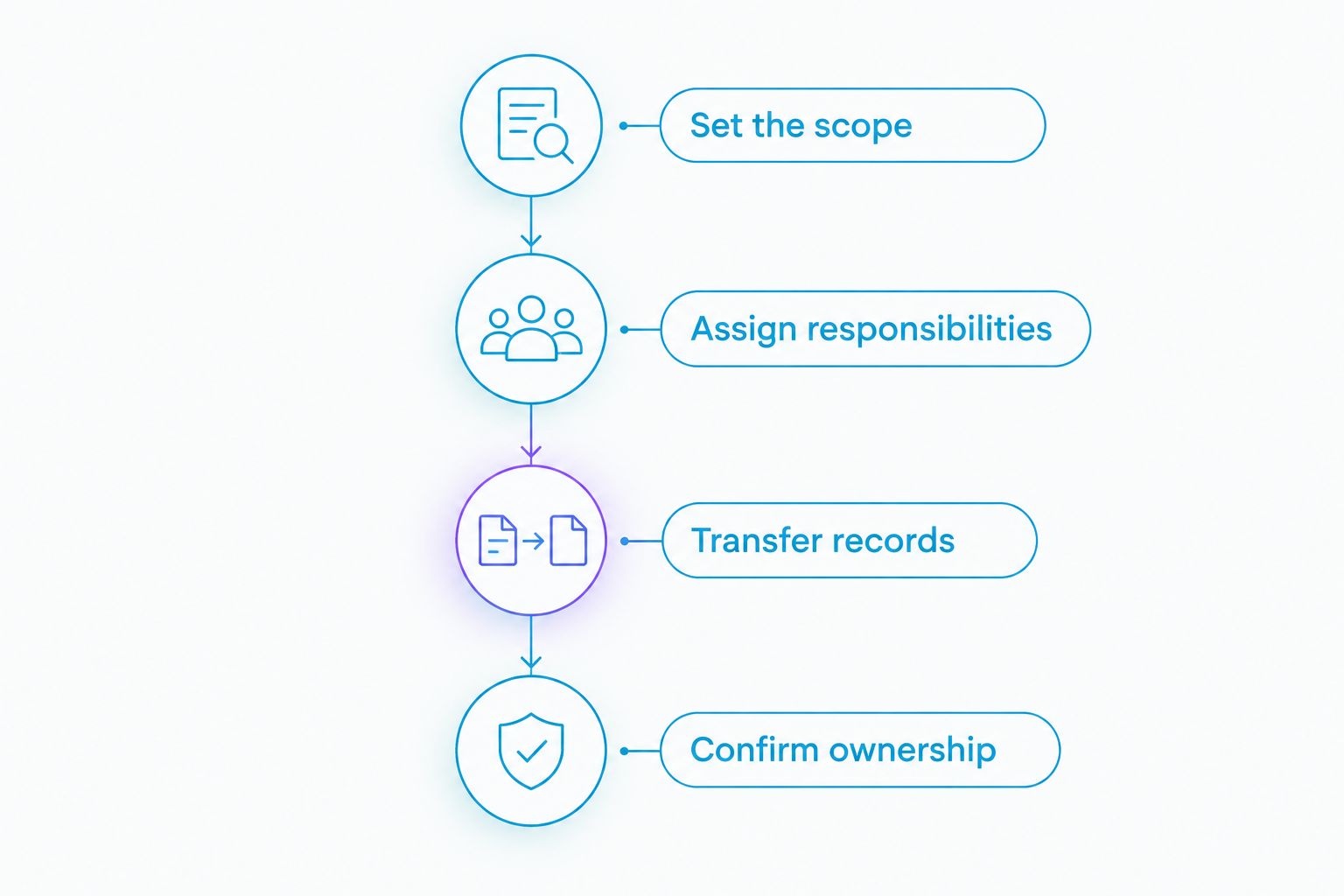
A handover is not complete simply because you have signed a new engagement. Confirm that the incoming accountant has the information required for the work they have accepted.
This is a tie on selection criteria: both appointments need a documented transition. Award the practical advantage to the proposal that clearly assigns the work, rather than assuming either firm will resolve every loose end automatically.
Both need a written service boundary
An accountancy firm can offer a service without including it in your particular agreement. That distinction applies equally to both options and prevents a broad service list from becoming an assumed package.
Before signing, ask for 3 documents: the engagement letter, the service schedule and the handover plan. They can be combined, but together they should explain the work, responsibilities and start arrangements.
Then perform 2 checks. First, compare the proposed scope with your actual recurring tasks; second, check what happens when those tasks change. These are decision steps, not measures of either firm's performance.
Neither option earns a scope advantage until the agreement matches your requirements. A shorter proposal with clear responsibilities is more useful than a longer list of services whose inclusion remains unclear.
Pricing: compare the model and its boundaries
The client firm's pricing position is fixed-fee accountancy, with an emphasis on no unexpected charges. For your 2026 budget, confirm the billing frequency, included work and process for approving changes rather than assuming “fixed fee” answers every commercial question.
Ask TTCA to state its charging model explicitly. If the proposal is fixed-fee, compare equivalent scopes; if it uses time-based or separately quoted work, establish how costs are approved and communicated.
The trade-off is between an agreed scope and separately commissioned work. A fixed arrangement needs clear boundaries; additional assignments need clear authorisation. Neither structure removes the need to understand what you are buying.
Do not compare two fee proposals until they cover the same responsibilities. Check bookkeeping, tax, VAT, payroll, software arrangements and access to advice individually, using only the services relevant to your business.
Final verdict: choose the agreement that fits your business
Choose Gowin Accountants if you want fixed-fee continuity
Best for: UK small-business owners seeking ongoing fixed-fee accountancy and a dedicated accountant. The stated offering covers tax, VAT, payroll, bookkeeping and Xero-based accounting services across several business types.
The advantage is a clear fixed-fee and personal-support proposition. The limitation is that you still need to establish your package: the wider service offering does not define your individual inclusions.
Choose TTCA if its written proposal meets your needs better
Best for: an owner whose specific workflow or support requirements are better addressed by TTCA's proposal. Choose it when you can identify the advantage in the agreed work, contact arrangements or handover plan.
The strength of that choice must be the proposal itself. Do not assume a specialist capability, pricing benefit or service difference without a clear basis in what TTCA offers you.
| Dimension | Winner |
|---|---|
| Best for fixed-fee continuity | Client firm, on its stated positioning |
| Pricing model | Client firm for a stated fixed-fee proposition; compare scope before deciding value |
| Dedicated-accountant proposition | Client firm, on its stated positioning |
| Bookkeeping workflow | TTCA if its agreed workflow better fits your business |
| Tax and VAT | No winner without matched scopes |
| Payroll | TTCA if its agreed process better fits your requirements |
| Switching | Tie: require a documented handover from either |
| Service boundaries | Tie: require a clear engagement from either |
FAQ
Is Gowin Accountants better than TTCA for a small limited company?
Gowin Accountants is a clear option for a small limited company seeking fixed-fee accountancy and a dedicated accountant. Choose TTCA instead if its written proposal better covers the company's specific work and support needs.
Does a fixed accountancy fee include bookkeeping and payroll?
A fixed fee includes only the work agreed in your engagement. Ask for bookkeeping and payroll responsibilities to be listed separately rather than assuming they belong in the package.
How should I compare the cost of the two accountants?
Compare equivalent scopes before comparing the commercial terms. Check included work, exclusions, payment arrangements and how additional assignments are approved.
Can I use an accountant outside my local area?
You can choose an accountant serving your business remotely; the client firm describes its services as available across the UK. Confirm document sharing, meetings and contact arrangements before appointing either firm.
What should I ask before switching accountants in 2026?
Ask who owns outstanding work, how records will transfer and when the new responsibilities begin. Put these arrangements in writing so the handover does not leave tasks unassigned.
Do I need Xero to choose the client firm?
Confirm the software requirements for your proposed engagement directly. Xero-based accounting is part of the stated offering, but that alone does not establish software requirements or inclusions for every client.
Will changing accountants reduce my tax bill?
Changing accountants does not guarantee a lower tax bill. Ask for advice based on your business records and circumstances rather than choosing on an unsupported savings promise.
One last thing
Ask each firm to describe your first month together: what you send, what they check and what you receive. That answer turns a general service promise into a working arrangement you can assess before committing.
For your 2026 appointment, keep that description alongside the engagement letter. Choose the accountant whose agreed responsibilities match the support you actually need.