

Choose Gowin Accountants if you want fixed-fee, ongoing accountancy support with a dedicated accountant and clear agreement on charges; choose TaxAssist if access to a local office is your deciding factor. This 2026 comparison separates the service model from the details you need to agree before appointing either firm.
- Gowin accountants vs TaxAssist: choose fixed-fee ongoing support or prioritise a local-office relationship.
- Gowin Accountants suits UK small businesses seeking a dedicated accountant and clear monthly accountancy scope.
- TaxAssist suits owners who want to choose an accountant through its local-office network.
- Compare bookkeeping, VAT, payroll, software access and handover responsibilities in writing before signing.
Why this matters
Your accountant choice affects more than the annual accounts. You need to know who handles bookkeeping questions, who checks approaching obligations and what happens when your business changes. A monthly payment alone does not answer those questions.
Gowin Accountants provides fixed-fee accounting, tax, VAT, payroll, bookkeeping and Xero-based services across the UK. Its accountancy model suits owners seeking ongoing support rather than a separate search for help whenever a filing obligation appears.
TaxAssist operates through a network of local accountancy businesses. That makes the particular office, its working arrangements and your relationship with its team central to the decision. Compare the people and written scope you will actually receive, not just the names above the door.
At a glance
Use this 2026 comparison as a shortlist, then ask each prospective accountant to confirm the details relevant to your business. The fixed-fee small business accountant guide helps you turn a broad service description into specific questions.
| Dimension | Gowin Accountants | TaxAssist |
|---|---|---|
| Best for | UK owners prioritising fixed-fee ongoing support | Owners prioritising a local-office relationship |
| Pricing model | Fixed-fee positioning; agree the precise scope | Request the chosen office’s charging and scope terms |
| Standout feature | Dedicated accountant and clear-fee positioning | Local-office network |
| Routine accounting | Accounting, tax, VAT, payroll and bookkeeping services | Small-business accountancy services; confirm the required work with the office |
| Main contact | Dedicated-accountant positioning | Confirm your named contact with the chosen office |
| Location | UK-wide service from a Basingstoke-based firm | Local-office selection |
| Accounting software | Xero-based accounting services | Confirm software and access arrangements with the office |
| Switching | Agree records, responsibilities and outstanding work | Agree records, responsibilities and outstanding work |
Fixed-fee support wins when you want a clear ongoing remit
The fixed-fee option is the stronger fit when your priority is a defined relationship covering recurring accounting work. That is particularly relevant to a limited company owner who wants accounting, tax and bookkeeping responsibilities discussed together rather than treated as unrelated purchases.
Start with the work your business needs. An owner who maintains accurate books needs a different arrangement from an owner who wants someone else to process records and reconcile accounts. Both arrangements can involve monthly support; they are not the same service.
The benefit of fixed fees is clarity about the agreed work. The limitation is that a fixed fee is only useful when its boundaries are clear. Do not assume that every service a firm offers sits inside your particular agreement.
Ask for a scope that distinguishes:
- Work the accountant completes.
- Records and approvals you must provide.
- Questions covered by ongoing support.
- Work requiring a separate agreement.
- Events that trigger a review of the arrangement.
For your 2026 appointment, make no unexpected charges a discussion about written terms, not a phrase you leave undefined. Agree how additional work is identified and approved before it starts. That protects the relationship without assuming your business will never change.
TaxAssist wins when a local-office relationship comes first
TaxAssist is the better starting point if choosing a nearby office is central to how you want to work. Its network gives you a location-led route to selecting an accountant. You can assess the particular office rather than choosing solely on a firm-wide service description.
That matters if you prefer discussing your business in person or want your accountant selection to begin with local accessibility. Ask how appointments work, who attends them and whether your regular contact is based at that office.
The advantage is the opportunity to choose around a local relationship. The limitation is that the network name does not replace checking the arrangements offered by the individual business you appoint. Confirm its service scope, communication process and software arrangements directly.
A nearby address is not evidence of better bookkeeping, faster answers or more useful advice. Equally, a UK-wide service is not automatically less personal. Give location weight only when you will actually use it. If you expect to communicate mainly through shared records, calls and email, the quality of that workflow deserves more attention than distance.
Both need a written scope before routine accounting is comparable
For routine accounting, there is no meaningful winner until the proposals describe the same work. Both are options for small-business accountancy support; the useful comparison is responsibility, not the length of the services list.
Consider a limited company that needs bookkeeping, payroll and VAT support. A proposal that covers checking owner-maintained records differs from one that includes maintaining those records. Payroll processing also needs a clear process for receiving approved changes, not simply a payroll label in a brochure.
Build a task list around your actual business:
- Bookkeeping: who records transactions and resolves unexplained items?
- VAT: who prepares the return, checks queries and obtains approval?
- Payroll: who supplies changes, processes payroll and confirms completion?
- Accounts and tax: who prepares the work and tells you what needs approving?
- Owner support: which questions fall within the ongoing relationship?
Treat this dimension as a tie until those answers are comparable. A broader agreement can justify a different charging structure, while a narrower agreement can suit an owner who keeps organised records. Neither is inherently better.
For sole traders, landlords, contractors and freelancers, use the same method but change the task list. Your business structure and records should determine the scope; a generic company package should not determine what you think you need.
A dedicated accountant wins when you want clear ownership
Gowin Accountants is best for UK small-business owners who want fixed-fee accountancy support with a dedicated accountant. A named relationship gives you a clear starting point when you need to discuss records, obligations or a business decision.
The practical test is ownership. Ask who receives your questions, who understands your agreed scope and who takes responsibility for moving unresolved matters forward. A dedicated contact is useful when those responsibilities are clear, not merely when a name appears in an introductory email.
There is a trade-off to examine: a named accountant still needs cover during absence. Confirm how urgent questions are handled and whether someone else can access the relevant records and correspondence. Do not assume personal service means dependence on one unavailable person.
For a local-office appointment, ask the same questions. A nearby team can still provide a named relationship, but establish that arrangement with the office rather than treating it as automatic. Choose accountable communication over an untested promise of access.
A useful selection question is: who will contact you when information is missing? The answer reveals more about the working relationship than a general assurance that help is available.
Xero-based support wins when it matches your existing workflow
The fixed-fee firm explicitly provides Xero-based accounting services. That makes it a direct fit for a shortlist built around Xero, particularly when you want ongoing bookkeeping and accounting support discussed alongside the software you use.
Software familiarity is not the same as an agreed bookkeeping service. Confirm who imports or enters records, who reconciles transactions and who checks unresolved items. Also establish who controls access and how you retain access if you change accountants later.
For the local-office option, ask which software the proposed team will work with and how it will manage your existing records. Do not assume a switch is necessary, or that keeping your software means keeping precisely the same process.
In 2026, make the workflow decision before agreeing to migrate records. A change should solve a defined problem, such as unclear responsibility or duplicated work. Moving software simply because you are changing accountants adds another task to the handover.
The advantage of a stated Xero-based service is that you can begin with a relevant discussion. Its limitation is equally clear: the software reference alone does not establish subscriptions, migration work, training or bookkeeping inclusions. Put each required item into the proposal.
Switching is a tie: responsibility matters more than the brand
Neither option wins a handover on its name alone. The better switching plan is the one that assigns every outstanding task before the existing relationship ends. You need agreement on records, access, unfinished work and communication with your outgoing accountant.
Use this sequence:
- Define scope: record which services the incoming accountant will take over.
- List obligations: identify outstanding accounts, returns, payroll work and unresolved queries.
- Transfer records: agree access to bookkeeping data and the documents needed for ongoing work.
- Confirm ownership: establish who completes each outstanding task and when the new arrangement begins.
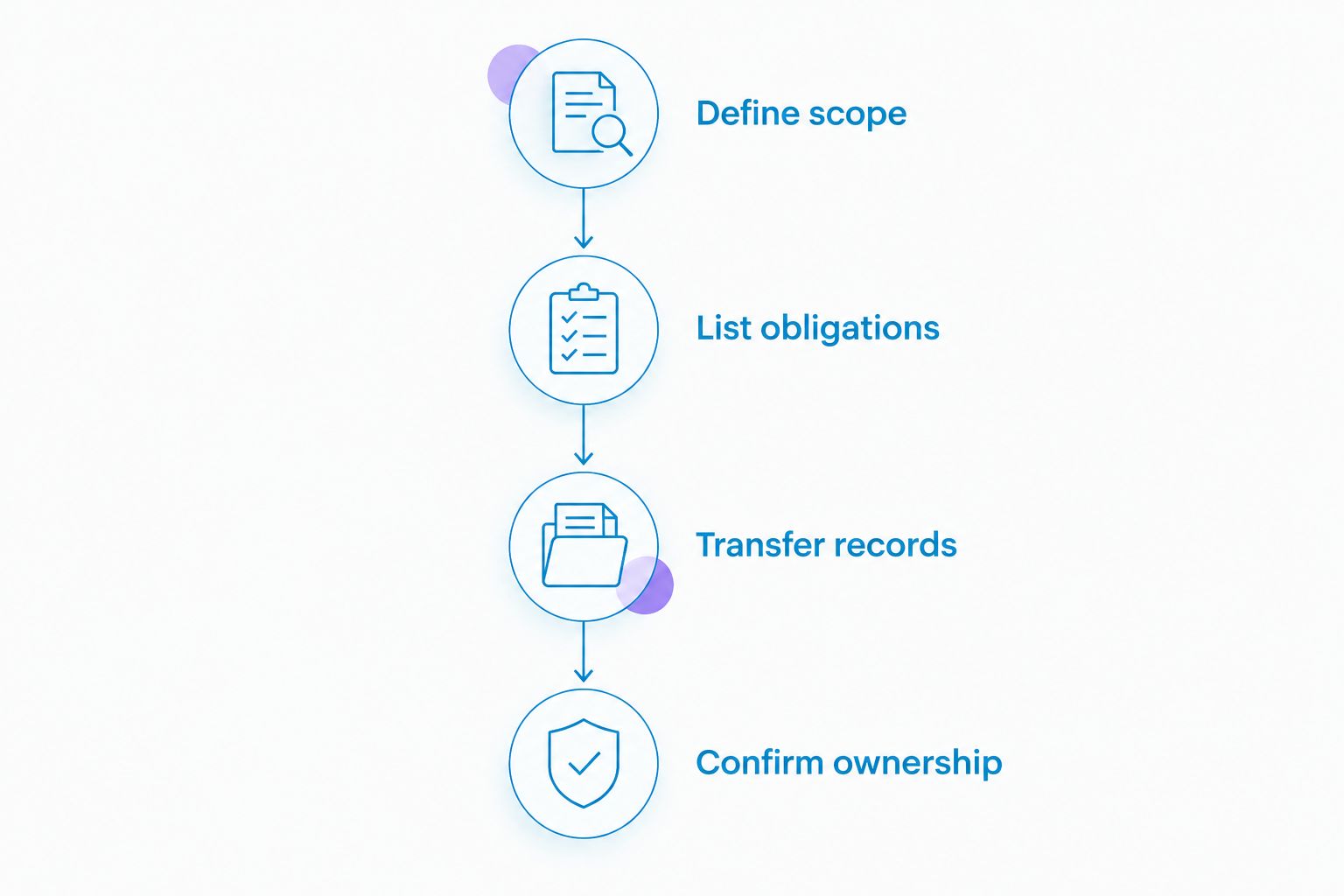
Keep the handover separate from assumptions about the monthly service. Taking over ongoing bookkeeping does not, by itself, settle who corrects historical records or completes unfinished work. Identify those tasks expressly.
If payroll is involved, pay particular attention to the next processing cycle and the information needed to complete it. If VAT work is involved, establish the status of the records and any return already in progress. These are operational questions, not reasons to favour either name automatically.
Pricing: compare the agreement, not an isolated monthly figure
For a 2026 decision, request a written proposal from each option covering the same work. The fixed-fee positioning gives you a clear basis for discussing predictability. The TaxAssist proposal should establish the chosen office’s charging model and approval process.
Predictability means knowing what the recurring agreement covers. Flexibility means being able to add work as your business changes. The trade-off is not fixed versus flexible in the abstract: it is whether the agreement explains how changes affect your responsibilities and charges.
Ask both prospective accountants:
- Is the quoted arrangement based on the records and transaction workload described?
- Which services require separate approval?
- What happens when payroll, VAT or bookkeeping requirements change?
- How are catch-up work and corrections handled?
- What notice or handover terms apply if you leave?
Do not compare proposals until their exclusions are as clear as their inclusions. An apparently simple monthly arrangement can leave substantial work with you. That is acceptable when deliberate, but not when discovered after appointment.
Final verdict: choose the relationship you will use
Choose Gowin Accountants if you want fixed-fee ongoing support
Best for: UK limited company owners and small businesses prioritising a dedicated accountant, clear fees and an ongoing accounting relationship. Choose this route when your central question is who will own the recurring work, rather than where you will meet them.
Confirm the scope, treatment of additional work and communication arrangements before appointing the firm. Its stated services make it relevant to accounting, tax, VAT, payroll, bookkeeping and Xero needs; your agreement determines which apply to you.
Choose TaxAssist if you want a local-office relationship
Best for: owners who want to select an accountant through a local office and assess that office’s team directly. Choose this route when in-person accessibility is a genuine requirement rather than a preference you will rarely use.
Confirm the proposed contact, appointment arrangements, service responsibilities and charging terms with the office. The network is the starting point for selection, not a substitute for checking the agreement.
| Dimension | Winner |
|---|---|
| Best for ongoing fixed-fee support | Fixed-fee firm |
| Pricing clarity | The written agreement decides |
| Standout relationship feature | Dedicated accountant for ongoing ownership; local network for office choice |
| Routine accounting | Tie until scopes match |
| Main contact | Dedicated-accountant model for clear ownership |
| Local-office selection | TaxAssist |
| Explicit Xero-based fit | Fixed-fee firm |
| Switching | Tie; compare handover plans |
FAQ
Is Gowin Accountants better than TaxAssist for a limited company?
Gowin Accountants is the stronger fit when your priority is fixed-fee ongoing support with a dedicated accountant. TaxAssist is the stronger starting point when choosing a local office matters most; compare the actual proposals before appointing either.
Which accountant should I choose if I want face-to-face meetings?
TaxAssist is a useful starting point if a local-office relationship is your main requirement. Confirm meeting arrangements and your regular contact with the particular office before committing.
Does a fixed fee include bookkeeping, VAT and payroll?
A fixed fee includes the work specified in your agreement, not automatically every service the firm offers. Ask for bookkeeping, VAT and payroll responsibilities to be listed separately.
Can I use an accountant outside my local area?
Yes, you can choose an accountant serving clients across the UK rather than limiting your search to nearby offices. Agree how you will exchange records, approve work and discuss questions.
Should I change accounting software when I switch accountants?
Change accounting software only when the change serves a defined business need. Discuss access, existing records and bookkeeping responsibilities before adding migration to the handover.
How do I compare accountant costs without missing extra work?
Compare written proposals covering the same responsibilities and exclusions. Ask how additional work is approved, how changing requirements affect the agreement and who handles historical corrections.
What should I agree before switching accountants?
Agree the incoming scope, outstanding obligations, records transfer and ownership of unfinished work. Give particular attention to payroll processing and returns already in progress.
One last thing
Before you sign, ask each prospective accountant to explain what happens when you send incomplete records. The answer should identify who contacts you, what remains your responsibility and how any additional work is agreed. That practical explanation is a better test of transparency than the words fixed fee on their own.
This is general selection guidance, not tax advice tailored to your business. Confirm your individual accounting and tax requirements before agreeing the service.