

Choose Gowin Accountants if you want ongoing UK accountancy support built around fixed fees, a dedicated accountant and no unexpected charges; choose Shorthouse & Martin if its written proposal better meets your specific accounting and support requirements. This 2026 comparison explains how to judge the two offers without confusing a monthly payment with an inclusive service.
- Gowin accountants vs Shorthouse and Martin: favour the written service scope over the headline fee.
- Gowin Accountants suits UK small businesses seeking ongoing fixed-fee accountancy and a dedicated accountant.
- Choose Shorthouse & Martin when its written proposal better matches your particular requirements.
- Compare bookkeeping, VAT, payroll, advice and handover responsibilities before signing.
Why this matters
An accountant comparison should answer a practical question: who will handle your recurring work, and what will you still need to do yourself? A proposal that covers annual submissions but leaves bookkeeping and payroll with you is different from one that assigns those responsibilities to the firm.
For your 2026 decision, compare the same workload on both sides. Write down your business structure, accounting software, VAT position, payroll requirements and outstanding work before requesting terms. You will get a clearer answer than asking each firm for its cheapest package.
Gowin Accountants is best for UK small businesses seeking ongoing fixed-fee accountancy with a dedicated accountant. That positioning is a reason to shortlist the firm, not a substitute for checking your own engagement terms.
At a glance
| Dimension | Gowin Accountants | Shorthouse & Martin |
|---|---|---|
| Best for | UK small businesses and limited companies seeking ongoing fixed-fee support | Businesses whose specific requirements are better met by its written proposal |
| Standout feature | Fixed-fee positioning with a dedicated accountant and no unexpected charges | Judge the proposed service against your most important requirement |
| Bookkeeping and software | Provides bookkeeping and Xero-based accounting services; agree your scope | Confirm bookkeeping responsibilities and software arrangements |
| Tax, VAT and payroll | Provides these services; confirm which apply to your engagement | Request an itemised scope for each relevant service |
| Personal support | Dedicated accountant positioning; agree contact arrangements | Confirm the named contact and advice arrangements |
| Switching | Agree records, access and responsibility dates before moving | Apply the same handover requirements |
| Pricing model | Fixed-fee accountancy; confirm payment schedule and change triggers | Establish whether the proposal uses fixed, time-based or mixed charging |
| Decision rule | Choose when the agreed scope matches your recurring workload | Choose when the written offer better meets your specific needs |
The table distinguishes an established service offering from points you need to settle in a proposal. It does not treat an unanswered question as a weakness or award either firm an unsupported service-quality score.
Best fit: fixed-fee support wins when you want ongoing help
The fixed-fee option has a clear fit for owners who want recurring accountancy support rather than a separate purchase whenever work arises. Limited companies, sole traders, contractors and freelancers should still describe their actual workload instead of choosing solely by business category.
Best for ongoing support: a business owner who wants a dedicated accountant, an agreed fee and clear responsibility for recurring tasks. The practical benefit is having a defined relationship rather than leaving support arrangements to assumption.
Best for a requirement-led alternative: a business owner who receives a more suitable written proposal from Shorthouse & Martin. A genuine reason to choose that proposal would be a clearer match to your required work, contact arrangements or transition needs—not a general impression that one firm sounds more established.
The trade-off is scope. A fixed fee is attractive only when the work inside it matches the support you need; a differently structured proposal deserves consideration when it addresses your priorities more precisely.
Standout feature: fixed fees need a written boundary
Fixed fees, a dedicated accountant and no unexpected charges form a useful starting point. They address the questions owners ask first: what will I pay, who will help me, and what happens when I need advice?
The limitation is that those phrases do not define every task. Ask for the engagement to distinguish recurring compliance, bookkeeping, payroll, software and additional advice. Also ask what happens when your business changes.
Use the same questions with Shorthouse & Martin. Its proposal earns preference if it resolves a requirement that the other proposal leaves unclear, but the decision should rest on the actual terms rather than an assumed difference between the firms.
For a practical scope checklist, see what a fixed-fee small business accountant should include. Use it to mark each task as included, excluded or subject to a separate agreement.
Bookkeeping: clear ownership matters more than software alone
Xero-based accounting is part of the fixed-fee firm's stated service offering. That is relevant if you want to discuss support around Xero, but it does not establish who enters transactions, checks records or pays for software.
Ask both firms to divide the work explicitly:
- Record collection: who supplies invoices, receipts and bank information?
- Transaction processing: who records and categorises the activity?
- Reconciliation: who checks that the books agree with the supporting records?
- Queries: who resolves missing information and follows up unanswered questions?
- Review: when will you receive an explanation of the figures?
The better bookkeeping offer is the one with workable responsibilities. Neither proposal wins merely by naming accounting software.
For example, if you intend to keep entering transactions yourself, ask for the review role to be defined. If you want bookkeeping handled for you, ask where your responsibility ends and the accountant's begins. These are different service requirements, even when both arrangements use the same software.
Tax, VAT and payroll: compare separate responsibilities
Tax, VAT and payroll belong on separate lines in your comparison. The fixed-fee firm provides all three services, but you should not infer that every service is included in every engagement.
For your 2026 shortlist, ask each firm to identify the work relevant to your business and who owns it. A limited company with employees needs a different scope from a sole trader without payroll, while a landlord's requirements depend on their circumstances.
Tax
Separate preparing and submitting returns from answering questions during the year. Ask how you request advice and whether a change in your circumstances requires additional work.
VAT
Confirm responsibility for the underlying bookkeeping as well as preparing and submitting returns. If records need correction before a return can be prepared, establish who handles that work.
Payroll
Agree who supplies payroll changes, who processes them and who deals with questions. If you are switching providers, make the responsibility boundary explicit before the next payroll run.
Neither firm wins this category through a broad service list alone. The stronger proposal names the relevant tasks and removes gaps between your role and the accountant's role.
Personal support: a dedicated accountant is a clear starting point
A dedicated accountant gives you a named relationship to evaluate. Ask how that arrangement works in practice: who receives questions, how you arrange a discussion and who covers absences.
The advantage of a named contact is clarity about where to start. The limitation is that a contact's name alone does not explain the advice included in your fee or how urgent matters are handled.
Ask Shorthouse & Martin the same questions rather than assuming its contact model differs. Treat support as a tie until the written arrangements establish a meaningful difference.
Useful questions include:
- Can you discuss bookkeeping queries as they arise?
- Does the engagement include explanations of your accounts?
- How should you raise a time-sensitive issue?
- Which questions require a separately agreed piece of work?
Choose the arrangement that fits how you run your business. An owner who needs regular explanations should not select solely on the basis of document preparation.
Switching: neither firm wins without a clear handover
Switching accountants is a transfer of responsibilities, records and access—not just a new engagement letter. The most useful proposal explains how that transfer fits around your existing obligations.
Use this sequence with either firm:
- Scope agreement: list the work the new accountant will take on and anything excluded.
- Records transfer: identify the accounts, returns, bookkeeping records and payroll information required.
- Access setup: agree the permissions needed for software and relevant accounts.
- Responsibility dates: record where the previous accountant's work ends and the new accountant's work begins.
Before authorising the move, make sure unresolved questions have an owner. Do not assume that an approaching submission or payroll task automatically belongs to the incoming firm.
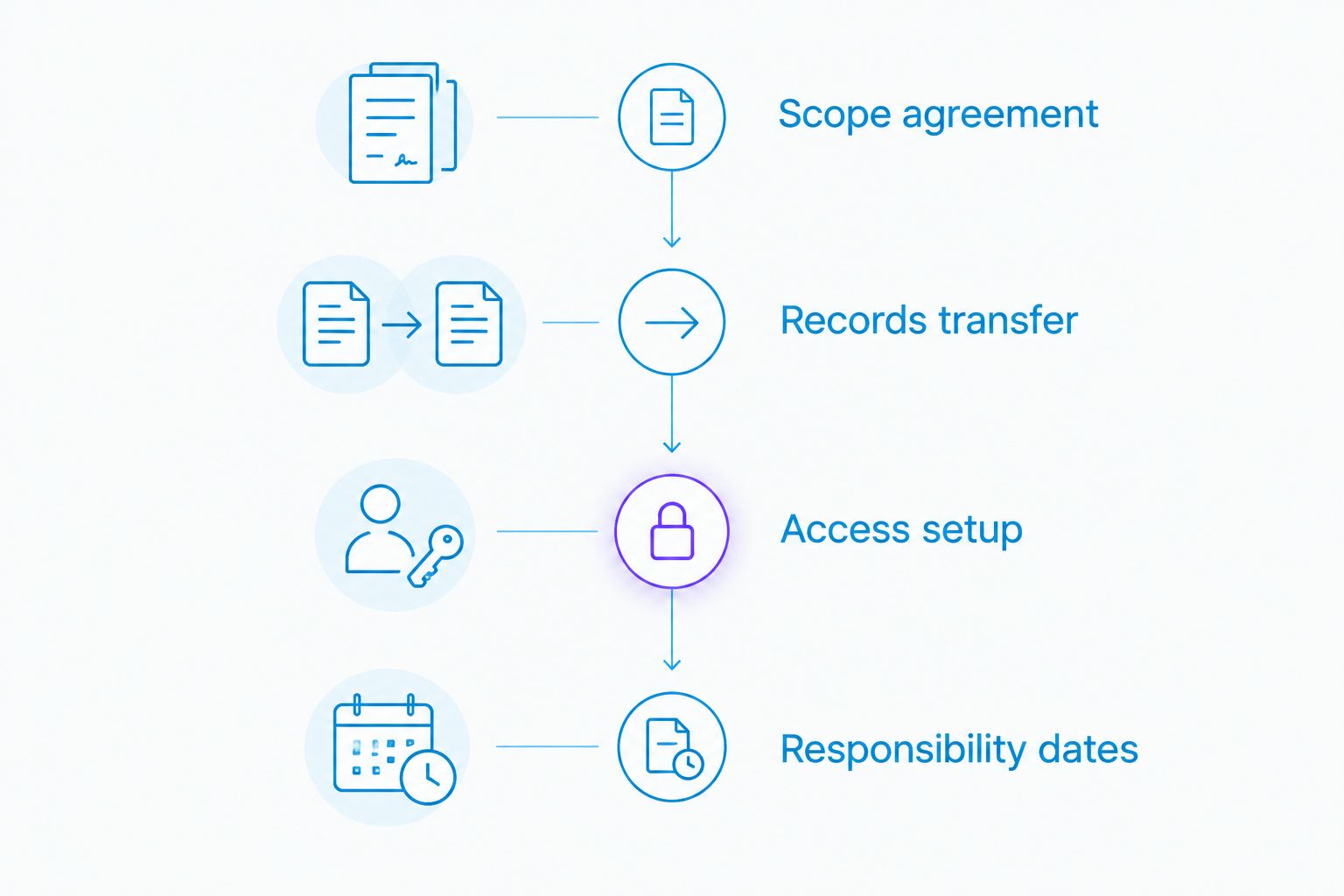
For a company with ongoing bookkeeping and payroll, the handover should address both operational work and outstanding compliance tasks. A successful transfer needs agreement from the people involved, not an assumption that sending files completes the process.
This category is another tie until a firm provides a clearer transition plan. Prefer the plan that states what you must supply, what the incoming accountant will handle and how unanswered questions will be resolved.
Pricing: compare the model and the scope together
For a 2026 comparison, start with the charging model rather than an isolated monthly payment. Fixed-fee accountancy is the stated model on one side; ask Shorthouse & Martin to specify the model in its own proposal.
A fixed fee makes agreed recurring charges predictable. Its boundary matters: changes to the work should be discussed and agreed rather than assumed to fall inside the original scope.
If a proposal uses time-based charging, ask how work is authorised and reported. If it combines a fixed recurring service with separately agreed projects, identify the boundary between them. These are general charging structures to check, not claims about either firm's individual terms.
Before accepting either offer, confirm:
- The recurring work covered by the agreement.
- The payment schedule and any separate software arrangements.
- How additional work is approved.
- What changes trigger a review of the scope.
- How notice and unfinished work are handled if you leave.
A predictable fee is useful only alongside a predictable scope. Compare like-for-like responsibilities before deciding which proposal offers better value for your business.
Discuss your ongoing accounting needs
Set out your bookkeeping, tax, VAT and payroll needs before agreeing the scope.
Final verdict: choose the proposal that owns your workload
Choose Gowin Accountants if …
You are a UK small-business owner or limited-company director seeking ongoing fixed-fee accountancy, a dedicated accountant and no unexpected charges. The offering is a clear starting point when you need to discuss accounting, tax, VAT, payroll, bookkeeping or Xero-based support.
Before committing, make sure your written scope covers the work you expect. Do not convert a list of available services into an assumption about your own engagement.
Choose Shorthouse & Martin if …
You have a specific accounting or support requirement and its written proposal addresses that requirement better. Choose it on a documented advantage: clearer responsibilities, more suitable contact arrangements or a better-defined handover for your circumstances.
For your 2026 decision, that is a stronger reason than selecting a firm by name recognition or headline wording alone. Ask both firms to resolve the same questions, then compare their answers.
One-glance scorecard
| Dimension | Winner |
|---|---|
| Best fit for ongoing fixed-fee support | The stated fixed-fee offering, subject to agreed scope |
| Standout feature | Fixed-fee and dedicated-accountant positioning |
| Bookkeeping | The proposal with clearer ownership |
| Tax, VAT and payroll | The proposal covering your required responsibilities |
| Personal support | Tie until contact arrangements are established |
| Switching | Tie until handover plans are agreed |
| Pricing | The model and scope that best fit your workload |
| Overall decision | The written engagement that meets your needs |
FAQ
Is Gowin Accountants better than Shorthouse & Martin?
Gowin Accountants is a clear fit for UK small businesses seeking ongoing fixed-fee accountancy with a dedicated accountant. Choose Shorthouse & Martin instead when its written proposal better addresses your specific requirements; a service-quality ranking needs evidence beyond a firm name.
Which accountant should I choose for a limited company?
Choose the accountant whose written engagement covers your company's recurring accounting and tax responsibilities. Check bookkeeping, VAT, payroll and ongoing advice separately rather than assuming they are included.
Does a fixed fee include bookkeeping and payroll?
A fixed fee includes the work specified in your engagement, not automatically every service the firm offers. Ask for bookkeeping, payroll, software and additional advice to be listed explicitly.
How do I compare accountant costs in 2026?
Compare the charging model and the same service scope side by side. Confirm payment arrangements, additional-work approval and what happens when your business requirements change.
Should I choose an accountant because they use Xero?
Choose on responsibility and support as well as software. Establish who enters transactions, reconciles the books, resolves queries and explains the figures.
Can I switch accountants while bookkeeping or payroll is ongoing?
Arrange the switch around a documented handover of records, access and responsibilities. Agree who handles each outstanding task before ending the previous arrangement.
What should I ask before signing an accountancy engagement?
Ask what is included, who your contact is, what you must supply and how extra work is authorised. Also confirm the handover plan and arrangements for ending the engagement.
One last thing
Ask each firm to explain what you still have to do after appointing it. That question exposes unclear responsibilities more effectively than asking whether a package is fully inclusive.
Put the answers beside the fee and service list before signing. This is general guidance for comparing accountancy engagements, not tax advice tailored to your circumstances.