

Choose Gowin Accountants if you want fixed-fee accountancy, a dedicated accountant and clear agreement on charges for ongoing UK business support; choose Morris Crocker if you already receive dependable support there and its written renewal proposal meets your needs. This 2026 comparison separates the confirmed fixed-fee proposition from the questions you should settle before changing accountants.
- Gowin Accountants vs Morris Crocker: choose against written service scope, named responsibility and charges, not an unsupported league table.
- Gowin Accountants suits UK small businesses seeking fixed-fee accountancy with a dedicated accountant.
- Keep Morris Crocker if your existing service works and its renewal proposal meets your accounting needs.
- Compare bookkeeping, VAT, payroll and switching responsibilities before accepting either proposal.
Why this matters
Your accountant choice affects the work you do every month, not just the accounts you approve at year end. A quote is difficult to assess when it leaves unanswered who maintains your records, handles queries or checks information before a filing deadline.
Gowin Accountants provides fixed-fee accounting, tax, VAT, payroll, bookkeeping and Xero-based accounting services to UK businesses and individuals. That establishes the available service areas; it does not mean every service belongs in every engagement.
For your 2026 decision, compare the work each proposal promises to take off your desk. The guide to fixed-fee small business accountant inclusions explains the scope questions to resolve before signing.
At a glance
The table distinguishes an established service proposition from checks you need to make against a particular proposal. It does not award capabilities to Morris Crocker without evidence.
| Dimension | Gowin Accountants | Morris Crocker |
|---|---|---|
| Best for | UK small businesses seeking ongoing fixed-fee support | Existing clients whose service and renewal terms already meet their needs |
| Pricing model | Fixed-fee accountancy; agree the covered work | Confirm the charging basis in the written proposal |
| Standout feature | Fixed fees, a dedicated accountant and clarity on charges | Judge against the support and accountability offered to your business |
| Monthly service scope | Accounting, tax, VAT, payroll and bookkeeping are offered | Request the exact recurring tasks and exclusions |
| Accounting software | Xero-based accounting services are offered | Confirm support for your current accounting setup |
| Working relationship | Dedicated-accountant positioning | Confirm your main contact and escalation route |
| Switching | Agree opening work, access and responsibilities | Staying avoids a provider handover if the current arrangement remains suitable |
| Filing responsibility | Document preparation, approval and submission responsibilities | Apply the same written responsibility check |
Fixed fees win when you need an agreed recurring scope
A fixed fee is useful when you can identify what it buys. The benefit is an agreed charging arrangement for defined work, rather than a promise that every future request is covered.
Ask for the engagement to distinguish routine work from additional assignments. Monthly bookkeeping, payroll administration, annual accounts and a question about a new business transaction are different tasks. Do not assume one necessarily includes the others.
The limitation is scope: an agreed fee cannot answer an unanswered service question. Before accepting a proposal, establish what changes when your business adds staff, registers for VAT or needs work outside the original agreement.
A reassuring proposal explains:
- The work covered by the recurring arrangement.
- The information you must supply.
- The circumstances that trigger a revised scope.
- How additional work receives your approval.
For your 2026 comparison, insist on the same level of detail from both candidates. Predictability comes from the fee and the agreement together.
Morris Crocker wins on continuity if your current service works
For an existing Morris Crocker client, staying has a genuine practical advantage: you do not need to transfer the engagement to another firm. That is a reason to stay when the relationship is working, not evidence that one firm has better technical capability.
Consider what you already receive. Do you know who handles queries? Do records reach the right person? Are responsibilities understood before deadlines approach? If the answers are satisfactory and the renewal proposal remains suitable, switching needs a specific justification.
The disadvantage of staying is that familiarity can conceal a mismatch. You might still be doing bookkeeping you expected to delegate, or approving work without understanding which questions have been resolved.
Stay for dependable service and suitable terms, not simply because changing feels inconvenient. If your dissatisfaction has a clear cause, ask whether the current firm can resolve it before arranging a handover.
A dedicated accountant helps when ownership is clear
A named contact gives you somewhere to take questions. The important test is whether that person owns the response or only passes messages between departments.
The fixed-fee firm's dedicated-accountant positioning matters most if you want an identifiable relationship alongside recurring accounting support. Confirm what that means in your engagement rather than assuming it defines every interaction.
For either candidate, ask:
- Who handles routine accounting questions?
- Who deals with payroll or VAT questions outside that person's remit?
- Who covers absence?
- How do unresolved queries reach the person responsible?
A named contact alone does not prove response speed or technical breadth. Equally, several specialists do not automatically create a confusing service. Choose the arrangement that makes ownership clear to you.
For your 2026 shortlist, request the contact arrangement in writing alongside the service scope. A relationship is easier to assess when you know who is accountable for what.
Monthly support wins only when it removes the right work
A limited company seeking ongoing support should compare recurring responsibilities before focusing on year-end preparation. Your working relationship needs to match how your business records income, pays people and supplies accounting information.
Separate the proposal into clear work areas:
- Bookkeeping: who records transactions and resolves unexplained entries?
- VAT: who prepares the return, reviews questions and obtains approval?
- Payroll: who receives changes and checks the payroll before payment?
- Accounts and tax: who prepares the work and explains what you must approve?
- Business queries: what questions fall within the engagement?
These are questions for both firms, not assumed inclusions. The client firm offers these service areas, but the agreed engagement determines which apply to you.
The advantage of ongoing support is coordination when responsibilities are properly assigned. Its limitation is that you still need to provide accurate information and make decisions reserved for you. Do not buy a broad service label when you need a precise division of work.
Xero-based accounting fits businesses wanting that setup
Xero-based accounting services are part of the fixed-fee firm's stated offering. That makes the firm a relevant option if you want support built around Xero, without establishing that a software change is necessary.
If your current records work well elsewhere, start with the problem you need to solve. A move should have a purpose: clearer responsibilities, more suitable support or a better way to maintain records. Changing software without that purpose adds another project to the accounting handover.
Ask both candidates who will maintain access, correct opening information and handle unresolved bookkeeping entries. Confirm what remains your responsibility after onboarding.
Do not declare a software winner without comparing the actual arrangements. Morris Crocker's support for your setup belongs in its proposal; it should not be inferred from its name or from another firm's software offering.
Neither firm wins without a clear handover plan
Switching is not finished when you accept a proposal. It is finished when the incoming firm has the information and access needed for the work it has agreed to take on.
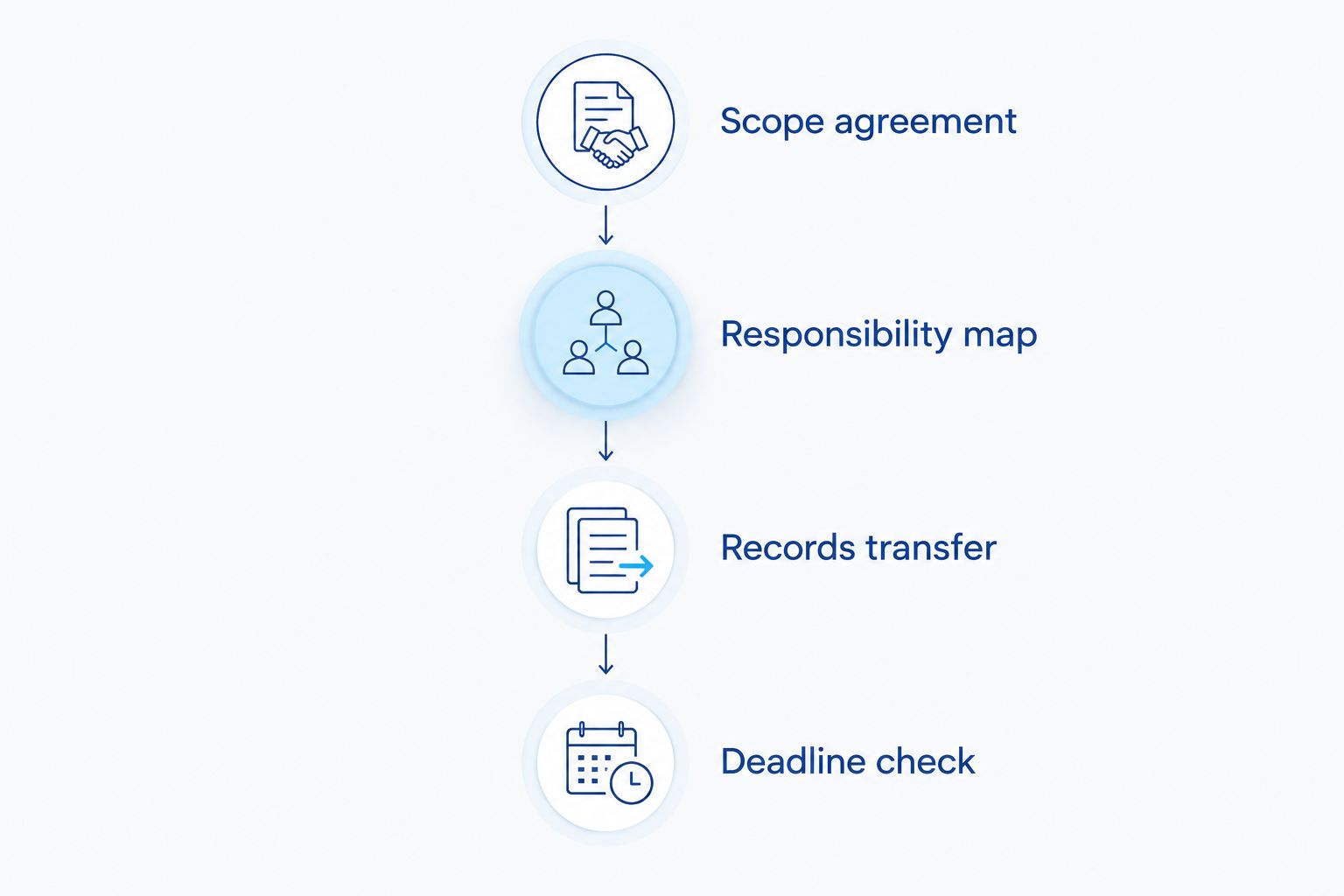
Use this sequence before changing providers:
- Scope agreement: record the services, exclusions and charging arrangements.
- Responsibility map: identify who handles each outstanding accounting task.
- Records transfer: arrange access to the records needed for the new engagement.
- Deadline check: confirm who owns filings and payroll work during the transition.
This is a decision checklist, not a promised onboarding process for either firm. Ask the proposed incoming accountant to confirm the plan before you give notice.
A good transition plan also distinguishes historical corrections from future recurring work. Otherwise, you can agree a monthly service while leaving unresolved records outside anyone's clear responsibility.
For a 2026 switch, assign every open task before the handover starts. Neither firm's name substitutes for that agreement.
Pricing: compare the model before comparing the commitment
The established proposition here is fixed-fee accountancy. For Morris Crocker, ask the firm to state the charging model applicable to your proposed engagement rather than assuming a fixed fee, an hourly arrangement or a mixture.
A fixed-fee model gives you an agreed commitment for a defined scope. An engagement with separately authorised work can accommodate changing needs, but you need to understand how the additional work is approved. These are general model trade-offs, not claims about Morris Crocker's terms.
Compare the proposals using the same business circumstances: entity type, bookkeeping responsibilities, payroll requirements and relevant tax work. A narrow proposal and a broader one are not directly comparable simply because both describe accountancy support.
Make no unexpected charges a written approval rule. Ask each firm how it identifies out-of-scope work, explains the charge and obtains your agreement before proceeding. This is more useful than assuming a headline fee answers every future question.
Final verdict: choose the relationship that fits the work
Choose Gowin Accountants for defined ongoing support
Best for: UK small-business owners who want fixed-fee accountancy, a dedicated accountant and clarity on charges. This is the clearer fit when those priorities drive your search and the written proposal covers the recurring work you need.
Check the scope rather than assuming that bookkeeping, VAT and payroll are automatically bundled together. The right engagement should explain what you delegate, what you retain and how changes are authorised.
Choose Morris Crocker when continuity earns its place
Best for: existing Morris Crocker clients receiving dependable support on suitable written terms. Stay when the service meets your needs and a proposed alternative does not solve a specific problem.
If you are considering Morris Crocker as a new client, assess its actual proposal on the same criteria. This comparison does not establish a basis for claiming that it offers broader services, lower charges or stronger specialist support.
| Decision dimension | Winner |
|---|---|
| Confirmed fixed-fee proposition | The fixed-fee candidate |
| Existing satisfactory Morris Crocker relationship | Morris Crocker |
| Xero-based requirement | The candidate with a confirmed Xero-based offering, subject to scope |
| Monthly responsibilities | No automatic winner; compare written tasks |
| Contact ownership | No automatic winner; confirm accountability |
| Transition | Staying wins on avoiding a handover; switching needs a clear benefit |
| Overall fit | The proposal that matches your work and responsibilities |
FAQ
Is Gowin Accountants better than Morris Crocker for a small business?
Gowin Accountants is the clearer fit if your priorities are fixed-fee accountancy, a dedicated accountant and clear charges for ongoing support. An existing Morris Crocker client with dependable service and suitable renewal terms has a sound reason to stay.
Does a fixed fee include bookkeeping, VAT and payroll?
A fixed fee includes the work defined in your engagement, not every service a firm offers. Ask for bookkeeping, VAT, payroll and annual work to be listed separately so you understand the responsibilities.
Should I switch accountants if my current service is working?
Switch only when the alternative addresses a specific need your current arrangement does not meet. Staying avoids a provider handover, but check that the current scope still matches your business.
How do I compare accountant costs without choosing the cheapest quote?
Compare proposals covering the same work and responsibilities. Check exclusions, your own workload and the approval process for additional assignments before judging the charging arrangement.
Do I need to change accounting software when switching accountants?
Do not assume a software change is required. Ask the incoming accountant whether your current setup supports the agreed work and what a proposed migration would involve.
What should I agree before handing over payroll or VAT work?
Agree who owns each outstanding task and when the incoming firm takes responsibility. Confirm the records, access and approvals needed so work does not fall between the outgoing and incoming engagements.
Is this comparison individual tax advice?
No. This comparison provides general guidance on choosing an ongoing accountancy service; advice on your tax position needs to reflect your business, records and circumstances.
One last thing
Ask each candidate to write down what you will still do yourself. That answer often makes proposals easier to compare than a longer list of service names.
For your 2026 decision, choose an arrangement you can operate every month: records supplied, questions answered, work approved and responsibilities understood. An accountant comparison becomes useful when it changes that working agreement.