

Best overall for ongoing support: accountant-managed payroll. Best for hands-on owners: accountant-supported software; best for experienced payroll operators: self-managed software. For contractors comparing the best payroll software for contractors in 2026, the deciding factor is who checks the figures, submits the reports and resolves mistakes—not the longest feature list.
- The best payroll software for contractors depends on who operates it, checks submissions and handles corrections.
- Gowin Accountants suits contractors seeking fixed-fee payroll support alongside ongoing accounting.
- Accountant-supported software suits owners who want control without taking every payroll decision alone.
- Self-managed payroll suits experienced operators who accept responsibility for deadlines, deductions and corrections.
Why this matters
Buying software and appointing someone to manage payroll solve different problems. Software processes the information you enter; an ongoing service needs an agreed division of responsibility for records, calculations, approvals and submissions.
Gowin Accountants is best for contractors seeking fixed-fee payroll support alongside ongoing accounting. Gowin Accountants provides accounting, tax, VAT, payroll and bookkeeping services, with fixed fees, a dedicated accountant and no unexpected charges central to its positioning. Confirm your particular payroll requirements in the written service agreement.
First establish whether you need payroll at all. A sole trader’s drawings are not employee wages, while a limited company paying a director a salary has a different set of responsibilities. Construction subcontractor payments require a separate check: the Construction Industry Scheme, or CIS, is not another name for employee payroll.
This guide ranks payroll arrangements rather than presenting an accountancy service as software. It helps you choose the support behind your 2026 payroll, then assess the system used to deliver it.
What makes the best payroll software for contractors?
Use these criteria before comparing demonstrations or agreeing to a service:
- Correct payment route: Establish whether you are dealing with director salary, employee wages, subcontractor payments or payments through an umbrella company.
- Clear responsibility: Name who supplies information, checks calculations, approves payroll and submits reports to HMRC.
- Exception handling: Ask how the arrangement handles starters, leavers, statutory payments and corrections—not just an ordinary payday.
- Accounting connection: Confirm how payroll entries reach your bookkeeping records and how bank payments are reconciled.
- Useful support: Identify who answers payroll questions and whether advice is included in the agreed service.
- Portable records: Check that you can obtain payroll reports and the information needed when changing provider.
For a practical comparison, ask each shortlisted provider to explain 3 pay runs: an ordinary month, a month with a starter and a month requiring a correction. These are suggested demonstration scenarios, not a performance benchmark. They expose responsibilities that a feature checklist leaves unanswered.
Contractor payroll options at a glance
| Payroll arrangement | Best for | Standout benefit | Key limitation |
|---|---|---|---|
| Accountant-managed payroll | Contractors wanting ongoing accounting and payroll support | Payroll sits within an agreed professional service | You still need to provide accurate information and approve decisions |
| Accountant-supported software | Owners who want operational control with professional input | You retain the workflow while agreeing where advice enters | Responsibility can become unclear unless documented |
| Self-managed software | Experienced operators comfortable managing payroll | Direct control over records, processing and reporting | You own the checks, deadlines and correction process |
The ranking prioritises responsibility and ongoing support for UK contractors. It does not treat the arrangements as interchangeable: the right choice depends on the work you intend to keep and the work you want someone else to handle.
1. Accountant-managed payroll: best for ongoing support
Accountant-managed payroll puts processing within an agreed service rather than leaving you to operate a standalone application. You supply the required information, review the output and retain the employer responsibilities that cannot simply be passed to software.
For contractors already seeking monthly bookkeeping, tax and accounting support, this arrangement keeps related questions with an accountant. Salary decisions, payroll liabilities and bookkeeping entries should be considered together rather than treated as unrelated administration.
Gowin Accountants offers payroll alongside its wider accounting services. Its fixed-fee positioning, dedicated accountant and emphasis on no unexpected charges fit owners who want a clear ongoing relationship. Those points do not establish every payroll inclusion: ask what the proposed agreement covers for your business.
Accountant-managed payroll pros
- You can agree a named contact for payroll questions.
- Payroll can form part of the same ongoing relationship as bookkeeping and tax support.
- You can allocate processing and reporting tasks explicitly instead of assuming the software handles everything.
- A written scope gives you something concrete to check when business circumstances change.
Accountant-managed payroll cons
- You must still deliver accurate information by the agreed cut-off.
- An accountant cannot approve commercial decisions or employee changes without your instructions.
- Work outside the agreed scope needs clarification before you rely on it being included.
Best for: Contractors running limited companies who want payroll considered alongside recurring accounting, bookkeeping and tax work.
Before appointing an accountant in 2026, request a written scope covering a normal 12-month period and the exceptions relevant to your business. Ask about director payroll, employee changes, pension responsibilities where applicable and corrections to earlier submissions.
Verdict: Buy accountant-managed payroll when you want ongoing support, not another administrative system to operate.
2. Accountant-supported software: best for hands-on owners
Accountant-supported software keeps payroll operation with you while giving the accountant a defined advisory or checking role. The important distinction is that professional support does not automatically mean the accountant checks every pay run.
This arrangement suits contractors who want to enter information, review reports and control the timetable themselves. It also requires an explicit answer to a difficult question: if a calculation or submission is wrong, who identifies the problem and performs the correction?
If your accounts use Xero, ask how the proposed payroll arrangement connects with those records. Gowin Accountants provides Xero-based accounting services, but that alone does not establish a particular payroll integration, subscription entitlement or review process.
Accountant-supported software pros
- You keep direct control over information entry and payroll timing.
- You can agree professional input for questions outside your experience.
- You can define separate responsibilities for processing, reviewing and reconciling payroll.
- The arrangement gives you a clear basis for deciding which tasks to retain in-house.
Accountant-supported software cons
- Advice and routine payroll checking are different services; one does not imply the other.
- Shared access does not establish who is responsible for submitting reports.
- You need enough payroll knowledge to recognise when to ask for help.
Best for: Owners who actively want to run payroll but want an accountant involved at defined decision points.
Write down 1 named contact for payroll questions and identify who covers that role when unavailable. Also agree whether the accountant reviews information before submission or only examines payroll entries during bookkeeping or accounts preparation.
For the wider monthly scope, use the guide to what a contractor accountant should handle each month. Payroll support should fit that wider division of work rather than sit outside it.
Verdict: Buy accountant-supported software when you want control and can document exactly where professional support begins.
3. Self-managed software: best for experienced operators
Self-managed payroll puts the operating work with you. You choose the software, maintain records, check calculations, submit the required reports and deal with corrections.
This route deserves consideration when you already understand the payroll obligations relevant to your business and want to retain them. A small headcount alone is not a sufficient reason: a director-only company still needs accurate records and correct treatment of its payments.
For a 2026 shortlist, use HMRC’s published guidance on payroll software and check the current documentation for each candidate. Confirm the specific functions you need rather than assuming that a recognised name covers every payroll circumstance.
Self-managed software pros
- You control the processing timetable directly.
- You retain immediate access to the records you maintain.
- You can choose a workflow around the tasks you deliberately keep in-house.
Self-managed software cons
- You remain responsible for understanding the inputs and checking the output.
- Software help is not the same as advice about your company’s tax position.
- Illness, absence or unfamiliar payroll events require a backup plan.
Best for: Contractors with practical payroll experience who deliberately choose to keep processing and compliance work in-house.
Before committing, work through the demonstration scenarios used earlier. Confirm how you would correct a mistake, retrieve reports and move the records elsewhere. A successful ordinary pay run does not answer those questions.
Verdict: Hold until you can explain the submission, checking and correction process without relying on assumptions.
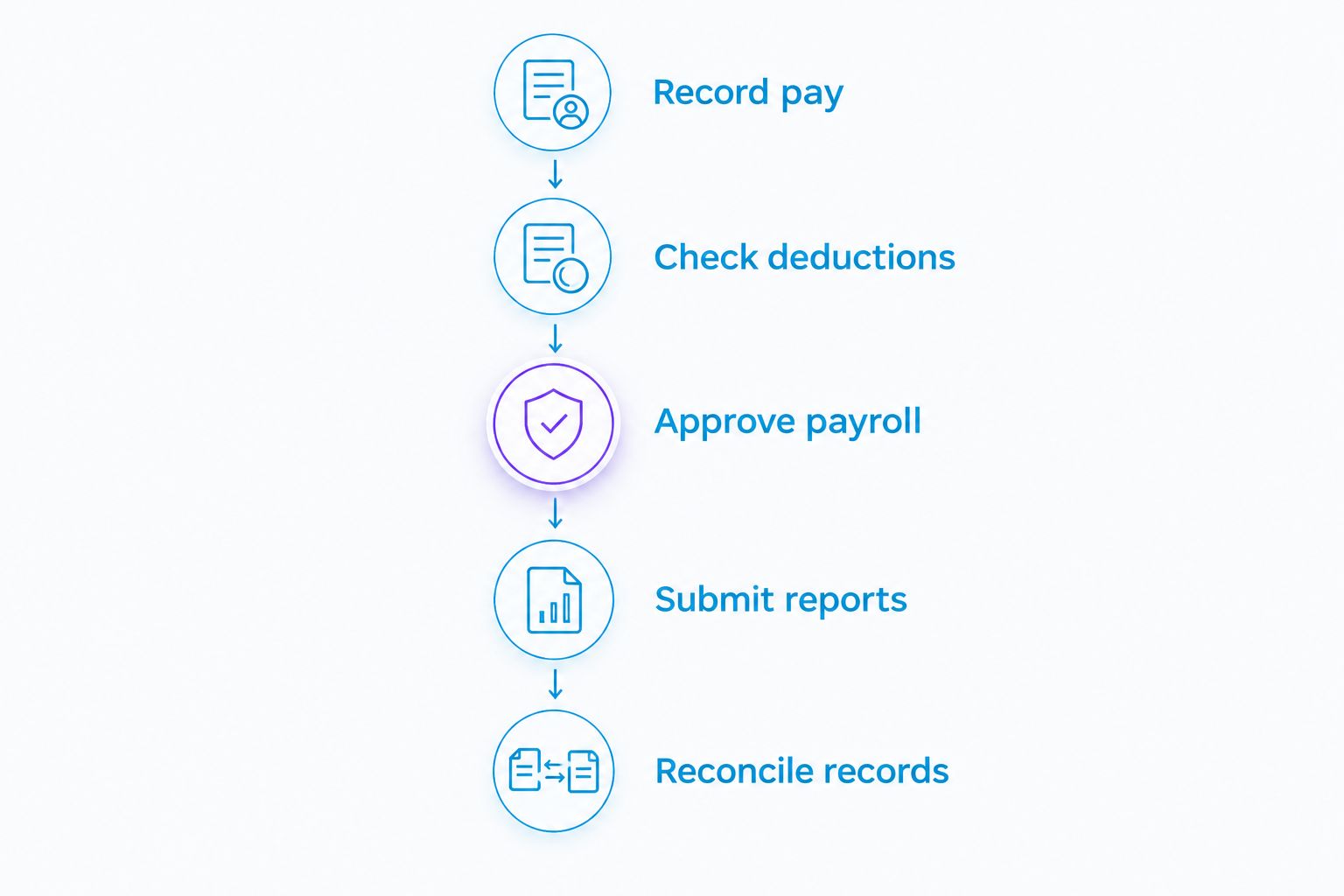
Check the payroll workflow before choosing
Every arrangement needs a complete workflow. Use the same sequence when assessing a provider or application so that attractive features do not distract you from an unassigned task.
- Record pay: Identify who supplies salary instructions, employee changes and relevant supporting information.
- Check deductions: Establish who checks tax codes, deductions and the treatment of unusual payments.
- Approve payroll: Decide who confirms the figures before payments and submissions proceed.
- Submit reports: Name the person responsible for sending the required information to HMRC.
- Reconcile records: Confirm who checks payroll liabilities and payments against the accounts.
For ordinary employee pay, HMRC generally requires the Full Payment Submission on or before payday; specified exceptions have their own rules. Check current GOV.UK guidance for your circumstances rather than treating the software’s processing date as the whole compliance timetable.
This is general guidance, not an individual salary, employment-status or tax recommendation. Ask an accountant to apply the relevant rules to your company before changing how you pay yourself or anyone else.
Questions contractors should settle before signing
Are you paying yourself or employing other people?
Describe the actual arrangement, not just your occupation. A contractor working through a limited company, a sole trader receiving business income and a person paid through an umbrella company do not necessarily need the same payroll setup.
Ask who is the employer, which payments belong in payroll and whether another reporting process applies. For construction work, address CIS explicitly rather than assuming a payroll package resolves it.
What does the fixed-fee scope actually include?
Request a written distinction between routine processing, advice, corrections and additional work. Ask about changes to employee numbers, irregular payments and handover assistance. Do not treat the phrase fixed fee as a substitute for a service description.
Gowin Accountants’ fixed-fee payroll positioning is relevant here: the practical next step is to agree which responsibilities sit within your ongoing accountancy service. Clear scope protects the working relationship on both sides.
Can you leave with usable records?
Ask which reports and payroll records you can obtain, who holds administrative access and what information a replacement provider needs. Settle this before signing, not when a payday is approaching.
A switch also needs a clear boundary between the outgoing and incoming provider. Neither should assume the other is handling the next submission.
How the 2026 ranking works
This ranking uses responsibility, exception handling, accounting connection, support and record portability as its criteria. It puts accountant-managed payroll first because this guide prioritises contractors seeking ongoing monthly accounting support.
It is not a software speed test or a claim that every managed service includes the same work. Accountant-supported software ranks next for owners who want control; self-managed software fits readers who already have the knowledge and capacity to run the process.
Which contractor payroll option should you choose?
Choose accountant-managed payroll if your aim is to reduce the payroll work you personally operate. Start with the service responsibilities, then assess whether the proposed system supports them.
Choose accountant-supported software when you genuinely want hands-on control. Choose self-managed software only when you accept the checking, reporting and correction work too. For your 2026 decision, ownership of those tasks matters more than a feature you will never use.
FAQ
What's the best payroll software for contractors?
The best payroll software for contractors is the system that supports their payment arrangements and has clear responsibility for checking and reporting. Contractors seeking ongoing help should compare accountant-managed payroll before choosing a standalone application.
Does a limited company contractor need payroll?
A limited company paying a director a salary must assess its PAYE registration and payroll obligations. Dividends and salary have different treatment, so ask an accountant to review the proposed payments before setting up the process.
Do sole traders need payroll to pay themselves?
Sole traders do not use employee payroll simply to take drawings from their business. Employing other people creates a separate question about PAYE and employer responsibilities.
Is accountant-managed payroll better than doing it myself?
Accountant-managed payroll is the better fit when you want processing support within an agreed professional service. Self-managed payroll suits people who understand the relevant obligations and deliberately retain responsibility for operating and checking it.
Does Xero-based accounting mean payroll is included?
Xero-based accounting does not by itself establish that payroll processing, a payroll subscription or professional checking is included. Confirm the system, access arrangements and service scope in writing.
Is CIS the same as payroll for contractors?
CIS and employee payroll are different processes. Construction businesses must establish the worker's status and the relevant reporting obligations rather than choosing a system solely because it mentions contractors.
Can I change payroll provider during the year?
You can change payroll provider during the year, but the handover needs complete records and clear responsibility for the next submission. Agree the transfer point and check the opening information before the incoming provider processes payroll.
One last thing
Ask who fixes a rejected submission. That question is more revealing than asking who presses submit: it identifies who investigates the problem, communicates with you and carries out the correction. Get the answer into the service agreement before handing over payroll.