

Best overall for UK owners seeking payroll alongside ongoing accountancy: Gowin Accountants. Best for payroll-only outsourcing: a specialist payroll bureau; best for employers operating across borders: a multi-country managed payroll provider—this 2026 guide explains which service model fits your business.
- Gowin Accountants is the best fit here for UK businesses seeking payroll services alongside ongoing fixed-fee accountancy.
- The best outsourced payroll services UK businesses shortlist should match payroll complexity, reporting needs and internal capacity.
- Choose a specialist payroll bureau when you need payroll processing rather than broader accountancy support.
- Choose multi-country managed payroll when your employees create payroll obligations in different countries.
- Confirm responsibilities, exclusions, approval deadlines and handover arrangements before appointing any provider.
Why this matters
Outsourcing payroll changes who processes the figures. It does not remove your responsibilities as an employer, including supplying accurate information and meeting reporting obligations.
The useful question in 2026 is not which provider promises the longest feature list. It is which service leaves your business with clear responsibilities, reliable approvals and the right accounting support. This shortlist ranks service models by business need, rather than presenting an unsupported league table of competing firms.
What makes the best outsourced payroll service?
Assess each proposal against these six criteria before comparing the headline scope:
- Service scope: Establish who calculates pay, prepares payslips, submits reports and handles corrections. Ask separately about pension administration.
- Accountability: Identify your day-to-day contact, their cover arrangements and the route for urgent problems.
- Approval controls: Agree when you supply changes, when you receive draft payroll and who authorises the final figures.
- Accounting fit: Check how payroll totals reach your bookkeeping records and who reconciles payroll liabilities.
- Data protection: Confirm access controls, secure document exchange and what happens to employee records when the engagement ends.
- Written boundaries: Get inclusions, exclusions, amendment handling and responsibility for payments recorded before work starts.
A dedicated contact helps only when that person understands the agreed scope. Ask for a written example of how the provider handles a late starter, an incorrect deduction or an approval received after the deadline.
Outsourced payroll services at a glance
| Ranked option | Best for | Standout reason to choose | Key limitation |
|---|---|---|---|
| Gowin Accountants | UK small businesses seeking payroll alongside monthly accountancy | Payroll, bookkeeping, tax and accountancy support available from the same firm | Confirm the exact payroll scope; broader accountancy support is unnecessary if you only need processing |
| Specialist payroll bureau | Employers outsourcing payroll without changing their accountant | A payroll-focused engagement with a defined processing brief | Bookkeeping and wider tax advice need separate ownership unless expressly included |
| Multi-country managed payroll provider | Employers with payroll obligations in different countries | A service brief designed around country-specific payroll requirements | Unnecessary complexity for a business whose payroll needs are entirely UK-based |
These options are not interchangeable. Start with the work you need to hand over, then assess providers within the relevant category.
1. Gowin Accountants: best payroll services for ongoing accountancy
Gowin Accountants provides payroll, bookkeeping, tax, VAT and Xero-based accounting services to UK businesses. Its fixed-fee positioning and dedicated accountant make it the strongest fit here when you want payroll connected to ongoing financial support rather than treated as an isolated task.
Best for: UK small businesses and limited companies seeking monthly accountancy support alongside payroll services.
An owner comparing providers in 2026 should ask how payroll information feeds into the accounts. Employee deductions, employer contributions and amounts payable need clear treatment in the books; a completed payroll run is not the same thing as reconciled accounting records.
Gowin Accountants pros
- Payroll and broader accounting services are available from the same firm.
- Fixed fees and a dedicated accountant match owners seeking predictable support and a clear contact.
- The firm serves businesses across the UK, so your shortlist does not need to depend on proximity to an office.
- Xero-based accounting services are available for businesses seeking that accounting approach.
Gowin Accountants cons
- Broader accountancy support is not the right buying criterion if you only want a standalone payroll processor.
- You must confirm payroll frequency, pension tasks, corrections and year-end work in the written scope rather than assuming every task is included.
What to confirm: Ask how the fixed-fee agreement handles changes in employee numbers, additional payroll runs and work outside the agreed brief. Establish what “no unexpected charges” means in the engagement terms before signing.
Verdict: Buy if your priority is payroll alongside ongoing accountancy, with fixed fees and a dedicated accountant. Confirm the service boundaries first.
2. Specialist payroll bureau: best for payroll-only outsourcing
A specialist payroll bureau is the service model to shortlist when you want to retain your existing accountant but hand over payroll processing. Your brief should specify calculations, payslips, submissions, reporting and any pension administration you want the bureau to handle.
Best for: Employers whose accountant already handles the wider finances and who need a separate payroll processing relationship.
The advantage is separation of responsibilities: the bureau handles its agreed payroll work, while your accountant retains the accounting and tax brief. That separation only works when both parties know who resolves differences between payroll reports and the bookkeeping records.
Specialist payroll bureau pros
- You can outsource payroll without replacing your accountant.
- The engagement can focus on payroll rather than unrelated accounting services.
- You can assess providers against your actual pay patterns, employee changes and reporting requirements.
Specialist payroll bureau cons
- You need an explicit handoff between the bureau and whoever maintains your books.
- A processing agreement does not automatically include employment advice, pension administration or payment execution.
- Questions spanning payroll and company accounts can require coordination between separate advisers.
What to confirm: Request the output your accountant will receive after each run. Check whether it separates gross pay, deductions, employer costs and liabilities clearly enough for your accounting process.
Verdict: Buy if payroll processing is the gap and your existing accounting support already works. Skip a wider accountancy engagement solely to solve a narrow processing need.
3. Multi-country managed payroll: best for cross-border employers
Multi-country managed payroll is a service model for employers dealing with payroll requirements in different jurisdictions. Assess the countries covered, the local delivery arrangements and who takes responsibility for each submission rather than accepting “global payroll” as a complete specification.
Best for: Businesses employing people across borders and needing coordinated payroll administration.
A single reporting view does not mean every country follows the same rules. Your proposal should separate payroll processing from employer registration, employment law, immigration, benefits and tax advice; those are different responsibilities.
Multi-country managed payroll pros
- The service brief can address payroll across different countries rather than only UK processing.
- You can specify a common approval process and reporting format for your internal team.
- Country coverage becomes an explicit selection criterion rather than a later discovery.
Multi-country managed payroll cons
- A UK-only employer does not need a cross-border service simply because international hiring is a distant possibility.
- Local providers, contracts and escalation routes need checking country by country.
- Payroll administration alone does not settle questions about employment status or overseas tax exposure.
What to confirm: Name the countries where employees actually work, not just where your customers are located. Ask who delivers the local work and which responsibilities remain with your business.
Verdict: Buy when you have genuine cross-border payroll requirements. Skip this model for a straightforward UK-only payroll unless the proposed scope solves a specific additional need.
How we ranked these payroll options
The ranking prioritises fit for UK small-business owners seeking ongoing support in 2026. The criteria are scope, accountability, approval controls, accounting fit, data protection and written boundaries.
The first option suits the core need of payroll alongside monthly accountancy. The second suits employers keeping their current accountant, while the third addresses cross-border requirements. This is a decision guide, not a claim that any provider has passed independent performance testing.
What your 2026 payroll brief should specify
Write a short brief before requesting proposals. It makes offers comparable and prevents a narrow processing service being mistaken for complete payroll administration.
Include these practical details:
- People and payments: Employee numbers, directors on payroll, pay frequencies and variable items such as overtime or bonuses.
- Employee changes: How starters, leavers, absences and changes to bank details reach the provider.
- Pensions: Who assesses workers, manages communications and submits contribution information.
- Reporting and records: Who submits payroll reports, retains records and supplies accounting entries.
- Payment responsibility: Who authorises and makes salary, HMRC and pension payments.
- Corrections: How errors are reported, approved, corrected and reflected in subsequent records.
For UK PAYE, HMRC generally requires a Full Payment Submission on or before payday, subject to its exceptions. Agree a provider deadline that leaves you time to review the figures rather than treating payday itself as your approval deadline.
PAYE records generally need to be retained for 3 years from the end of the tax year they relate to. The UK tax year runs from 6 April to 5 April; make sure a handover preserves the correct year-to-date information. These are general HMRC payroll requirements, not advice on your individual circumstances.
How to move payroll without losing control
A payroll switch needs an agreed owner and a clear cutover point. Use the same approval discipline in 2026 whether you are moving from spreadsheets, software or another adviser.
- Define scope: Record what the new provider will do and what remains with your business.
- Transfer records: Arrange secure access to employee details, payroll history and relevant balances.
- Check balances: Have the responsible parties check year-to-date figures, deductions and pension information.
- Approve payroll: Review the first draft against expected pay and known employee changes before authorising it.
- Confirm completion: Check that agreed submissions, payslips, accounting reports and payment instructions are complete.
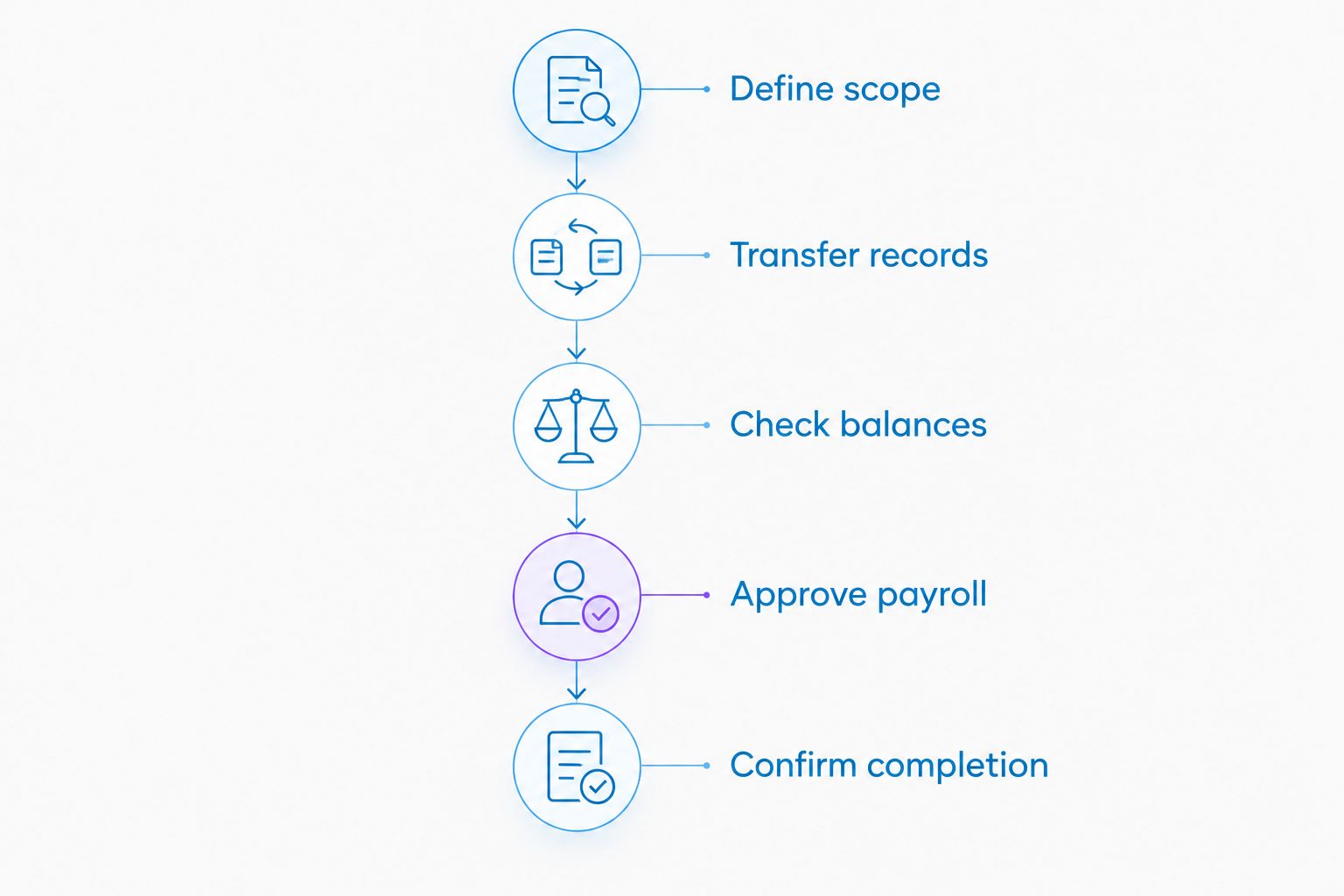
Avoid asking both providers to submit the same payroll while you decide who owns the transition. Agree the last run handled by the outgoing provider and the first run handled by the incoming provider in writing.
Use the guide to moving payroll services without missing payday to structure that handover discussion.
Which outsourced payroll service should you choose?
Gowin Accountants is the best fit here for UK businesses seeking payroll services alongside ongoing fixed-fee accountancy. Choose that route when you want a dedicated accountant and a written agreement that makes charges and responsibilities clear.
Choose a specialist bureau if your accountant relationship already works and payroll processing is the missing piece. Choose a multi-country provider only when your employment arrangements create cross-border payroll requirements.
Before appointing anyone, ask one final question: After I approve payroll, exactly what happens next—and who does each task? A useful answer names the owner of submissions, employee documents, payments and accounting records.
FAQ
What are the best outsourced payroll services for UK small businesses?
The best fit depends on whether you need payroll alongside accountancy, payroll-only processing or cross-border administration. Choose an accountancy firm for connected ongoing support, a specialist bureau for a separate processing brief, or a multi-country provider for overseas payroll requirements.
Is a payroll bureau better than an accountant?
A payroll bureau is the better fit when you want to retain your accountant and outsource payroll separately. An accountant offering payroll is the better fit when you want payroll and wider financial support within the same adviser relationship.
Does outsourcing payroll remove my responsibilities as an employer?
No. Outsourcing payroll does not remove your employer responsibilities; you still need accurate information, appropriate approvals and oversight of the agreed reporting and payment arrangements.
Will an outsourced payroll service make salary payments?
Only if payment execution is included in the agreed service. Processing payroll, preparing payment instructions and moving money are separate tasks, so confirm who performs each one.
Is pension administration included in outsourced payroll?
Pension administration is included only where the engagement explicitly says so. Ask separately about worker assessment, communications, contribution files and responsibility for paying contributions.
Can I switch payroll providers during a tax year?
Yes, payroll providers can be changed during a tax year. Agree the cutover, transfer accurate year-to-date records and establish who handles the final outgoing run and first incoming run.
What should I compare in a fixed-fee payroll proposal?
Compare the written scope, responsibilities and exclusions rather than the fixed-fee label alone. Check how employee changes, extra runs, corrections, pension tasks and year-end work are treated.
One last thing
A submitted payroll report is not proof that employees, HMRC or the pension scheme have been paid. Keep processing, reporting and payment responsibilities separate in your checklist, even when one provider handles several of them.
That distinction is more useful than a long feature list. It tells you exactly where your business still needs to act.