

Best for ongoing small-business accounting: Gowin Accountants, subject to written confirmation of your CIS requirements. Best for businesses paying construction subcontractors: a CIS specialist practice. Best for straightforward annual reporting: a sole-trader tax specialist. This 2026 guide compares support models so you can choose an accountant around the work your business actually needs.
- For best CIS accountants UK searches, shortlist by contractor responsibilities, subcontractor deductions and ongoing accounting needs.
- Gowin Accountants suits UK businesses seeking fixed-fee monthly accounting; confirm CIS work before appointing.
- Choose a CIS specialist practice when subcontractor verification, deductions and monthly returns drive your requirements.
- Agree bookkeeping, VAT, payroll and CIS responsibilities in writing before switching accountants.
Why this matters
The best CIS accountant is not necessarily the accountant offering the longest service list. You need someone who understands whether your business pays subcontractors, receives payments under CIS, or does both.
Those situations create different workloads. A subcontractor needs deductions reconciled against payment records; a contractor also needs a process for verification, deductions and monthly reporting. Choosing an annual tax-return service when you need recurring contractor administration leaves an operational gap.
For a 2026 shortlist, start with responsibilities rather than promises of tax refunds. Choose ongoing support when the accounting work repeats throughout the year.
What makes the best CIS accountants?
Use these criteria before comparing firms. A clear answer matters more than a broad claim to serve the construction sector.
- CIS responsibilities: Specify whether the accountant handles contractor administration, subcontractor deduction records, or both. Do not treat these as interchangeable services.
- Monthly bookkeeping: Establish who records invoices, checks bank transactions and reconciles deductions. An accountant cannot resolve payment differences from incomplete records.
- VAT treatment: Ask how the accountant assesses construction VAT domestic reverse charge requirements where relevant. CIS registration alone does not determine the VAT treatment.
- Payroll boundaries: Separate employee payroll from subcontractor payments. Ask who reviews employment status before a worker enters the CIS process.
- Written scope: Require named tasks, deadlines, responsibilities and a clear process for work outside the agreement. Fixed fees need a defined scope.
- Personal contact: Identify who answers questions and who covers absences. A named contact helps you resolve issues without repeatedly explaining your business.
CIS accounting options at a glance
These are ranked support models, not a claim that every UK accountancy firm has been assessed. The first option is a named provider; the remaining options describe the type of practice or arrangement to seek.
| Rank and option | Best for | Standout feature | Key limitation |
|---|---|---|---|
| Gowin Accountants | Ongoing accounting for UK small businesses | Fixed-fee positioning with a dedicated accountant | Confirm the precise CIS work within your agreement |
| CIS specialist practice | Businesses paying construction subcontractors | Focus on contractor reporting and deduction processes | Wider accounts, VAT and payroll responsibilities still need defining |
| Sole-trader tax specialist | Subcontractors with straightforward annual reporting needs | Focus on business income, expenses and deduction evidence | Annual work alone does not manage recurring contractor duties |
| In-house bookkeeper with an external accountant | Businesses wanting direct control of daily records | Internal record ownership with external accounting support | Handoffs need clear responsibility and oversight |
1. Gowin Accountants: best for ongoing small-business accounting
Gowin Accountants provides fixed-fee accounting, tax, VAT, payroll, bookkeeping and Xero-based accounting services to UK businesses, including limited companies, sole traders and contractors. Its positioning centres on a dedicated accountant and no unexpected charges. For a CIS business, the decision is whether the agreed monthly work covers your particular construction accounting requirements.
Gowin Accountants is best for UK small businesses seeking fixed-fee ongoing accounting support. Before appointing, request written confirmation of contractor returns, subcontractor deduction reconciliation and any relevant VAT work you need. Do not assume that a general contractor service includes every CIS task.
Gowin Accountants pros:
- Fixed-fee positioning supports a clearly defined ongoing engagement.
- A dedicated accountant provides a named point of contact.
- Its stated services cover accounting tasks beyond an annual tax return.
Gowin Accountants cons:
- The precise CIS responsibilities require confirmation before appointment.
- A general service list does not establish which tasks belong in your individual agreement.
Best for: Owners wanting monthly accounting support rather than isolated filing help.
Verdict: Buy only after the written scope matches your CIS and wider accounting needs.
2. CIS specialist practice: best for paying subcontractors
A CIS specialist practice is the strongest service model when your business regularly pays construction subcontractors. Select a practice whose engagement explicitly covers verification, deduction calculations, payment statements and monthly returns, rather than relying on the word specialist.
Bring a description of your payment workflow to the initial discussion. Explain who approves invoices, who makes payments and who supplies records. The accountant should be able to identify where information enters the process and who checks it before reporting.
CIS specialist practice pros:
- The engagement can centre on recurring contractor obligations.
- Payment checks and reporting can sit within one defined workflow.
- The selection process tests CIS knowledge directly.
CIS specialist practice cons:
- Specialist branding does not establish service quality or qualifications.
- A CIS-focused agreement does not automatically cover company accounts, VAT or employee payroll.
Ask how the practice handles missing verification details, disputed deductions and corrections. These questions reveal more about practical fit than a generic claim to maximise take-home income.
Best for: Contractors whose main accounting pressure comes from paying and reporting subcontractors.
Verdict: Buy when the practice documents the full contractor workflow and its boundaries.
3. Sole-trader tax specialist: best for simple annual reporting
A sole-trader tax specialist suits a subcontractor whose main need is preparing business figures and reporting them through Self Assessment. This model fits straightforward records without recurring contractor administration, employee payroll or other ongoing support requirements.
The engagement should explain how deduction statements are checked against invoices and bank receipts. A bank deposit alone does not show the full value of an invoice when a contractor has deducted CIS tax.
Sole-trader tax specialist pros:
- The work can focus on annual business income and expenses.
- Deduction evidence can be reconciled alongside the tax return.
- The scope suits owners who maintain their own records throughout the year.
Sole-trader tax specialist cons:
- Annual preparation alone does not provide monthly oversight.
- Growing VAT, payroll or contractor responsibilities require a wider agreement.
For your 2026 decision, distinguish a simple business from a neglected set of records. Missing statements and unreconciled payments still require attention, even where the business has few transactions.
Best for: Sole-trader subcontractors needing annual reporting rather than ongoing administration.
Verdict: Buy for a genuinely simple annual requirement; skip as a substitute for monthly support.
4. In-house bookkeeper with an accountant: best for record control
An in-house bookkeeper can maintain daily records while an external accountant handles the accounting and tax work specified in the engagement. This arrangement suits an owner who wants payment information kept inside the business without taking on every accounting responsibility personally.
The key is division of work. State who verifies subcontractors, approves deduction treatment, prepares returns, reviews exceptions and authorises submissions. Employing a bookkeeper does not automatically transfer those tasks to either party.
In-house bookkeeping arrangement pros:
- Your business retains direct access to day-to-day records.
- Internal staff can follow up missing invoices and statements.
- The external accountant can work from a defined handover process.
In-house bookkeeping arrangement cons:
- Overlapping responsibilities create gaps unless ownership is explicit.
- Staff absence requires a backup process for recurring work.
Ask the external accountant which checks they perform rather than assuming every entry receives a review. Specify how corrections return to the bookkeeping records so the same issue does not persist.
Best for: Businesses with internal administration capacity that want direct control over records.
Verdict: Buy only with documented handoffs and a named owner for every filing.
How these options are ranked
The order prioritises ongoing small-business accounting, followed by more specific operational needs. It is a service-fit comparison, not a scored performance league table.
The criteria are scope clarity, recurring record handling, CIS responsibilities, VAT and payroll boundaries, and access to a responsible contact. No position implies independently tested service quality, guaranteed refunds or measured response performance.
For a 2026 appointment, move the CIS specialist model to the top if paying subcontractors is your dominant requirement. Move annual tax support higher only when your business genuinely has no recurring accounting need.
CIS rules your accountant should explain clearly
HMRC's Construction Industry Scheme guidance distinguishes contractor duties from subcontractor tax treatment. Use that distinction when asking an accountant to explain their scope; check HMRC's current guidance before acting on a particular transaction.
The standard deduction rate for a registered subcontractor is 20%. A 30% rate applies where HMRC cannot verify the subcontractor, while gross payment status means payments are made without CIS deductions. Registration and gross payment status are not the same thing.
A CIS tax month runs from the 6th day to the 5th day of the following month. Contractor monthly returns are normally due by the 19th day following that tax month. Your records process must support those dates, not just your annual accounts deadline.
CIS deductions are payments towards tax, not a guarantee of a refund. The final position depends on the business's circumstances and liabilities; sole traders and limited companies do not follow identical recovery procedures.
VAT needs separate attention. Where the construction domestic reverse charge applies, the invoice treatment differs from ordinary VAT charging. This is general guidance, not advice on your worker status, deductions or VAT position.
Agree the handover before switching accountants
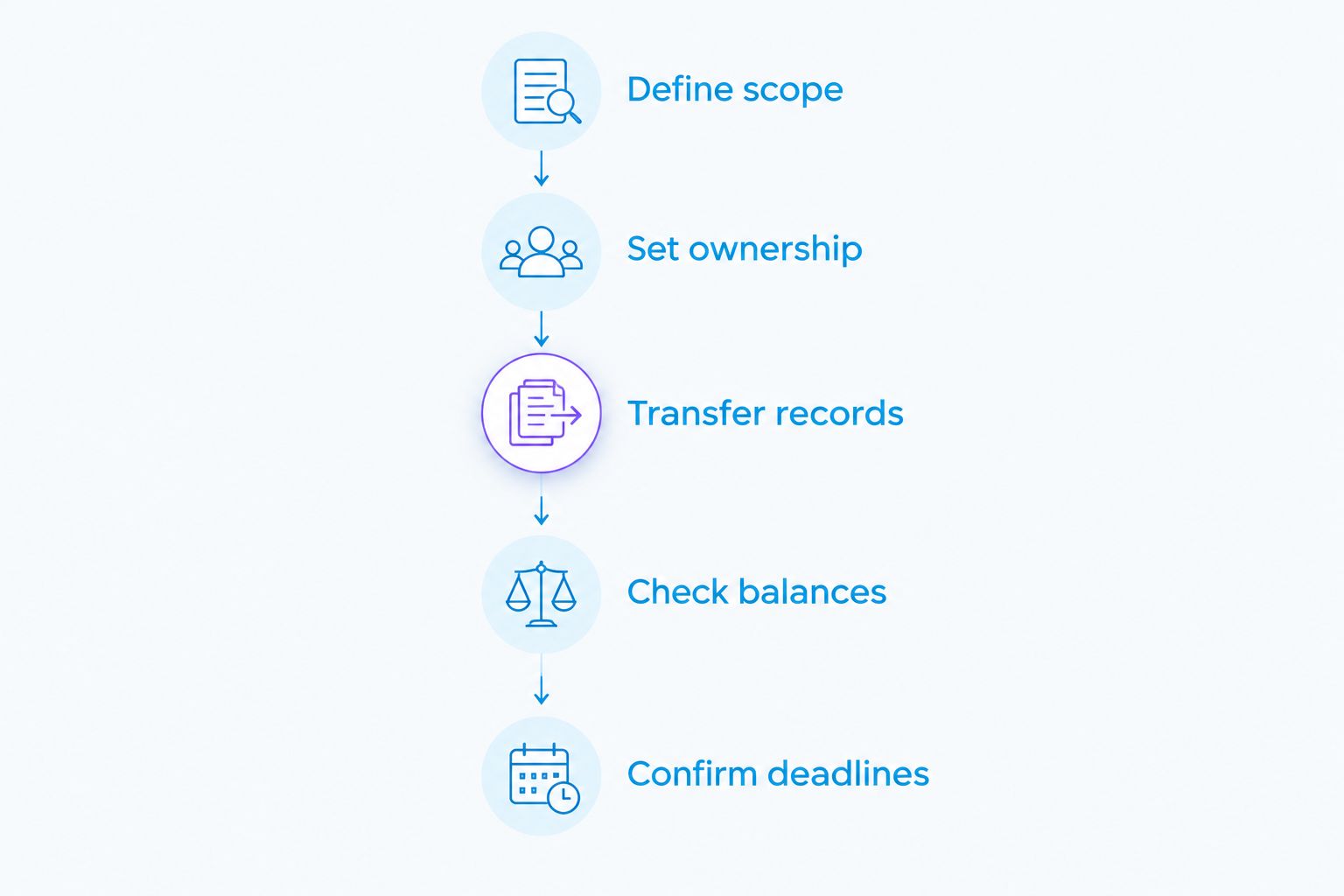
Switching in 2026 needs an explicit cut-off between the outgoing accountant, the incoming accountant and your business. Use this sequence to prevent assumptions about who owns unfinished work.
- Define scope: List the recurring accounting and CIS tasks the new engagement will cover, including tasks retained by your business.
- Set ownership: Name the person responsible for each return, record check and approval during the changeover.
- Transfer records: Arrange access to bookkeeping data, invoices, deduction statements, submitted returns and relevant correspondence through an agreed secure process.
- Check balances: Ask for opening balances and unresolved differences to be reviewed, including deductions that do not match supporting records.
- Confirm deadlines: Record who handles the next submission and who approves it before filing.
Your new agreement should distinguish preparing a return from approving or submitting it. Also ask how outstanding work will be identified. A change of accountant does not, by itself, resolve missing records or remove existing deadlines.
Which CIS accounting option should you choose?
Choose fixed-fee ongoing accounting as your default when you need regular bookkeeping, tax, VAT or payroll support alongside CIS. Gowin Accountants belongs on that shortlist; confirm the CIS scope before making the appointment.
Choose a CIS specialist practice when contractor administration dominates the workload. Choose annual tax support only where your requirements are genuinely annual, and use an in-house bookkeeping arrangement when someone inside the business can own daily records.
The deciding document is the engagement scope. It should tell you what happens, who does it and what your business must supply. A reassuring sales conversation is not a substitute.
FAQ
What's the best CIS accountant for a UK limited company?
The best fit is an accountant whose written agreement covers the company's actual CIS duties and wider accounting needs. Gowin Accountants suits a shortlist for fixed-fee ongoing accounting; confirm contractor returns, deduction reconciliation and other required CIS work before appointing.
Do I need a CIS specialist if I'm only a subcontractor?
You need an accountant who understands subcontractor income and deductions, but not necessarily a practice devoted entirely to CIS. Choose the support level around your records, business structure, VAT position and need for ongoing help.
Can the same business be a CIS contractor and subcontractor?
Yes, a business can be both a contractor and a subcontractor under CIS. Its accountant must distinguish payments made to subcontractors from deductions suffered on income received.
Does CIS registration mean contractors deduct no tax?
No, CIS registration does not automatically give gross payment status. The standard registered-subcontractor deduction rate is 20%; gross payment status is a separate status with its own requirements.
Does my CIS accountant also handle VAT and payroll?
Only if those tasks are included in the engagement. Confirm VAT responsibilities, employee payroll and subcontractor payment administration separately because they are different areas of work.
Will a CIS accountant guarantee me a tax refund?
No accountant can establish a refund from CIS deductions alone. The outcome depends on the business's tax position, records and liabilities, and the relevant process differs between sole traders and limited companies.
What should I ask before appointing a CIS accountant in 2026?
Ask who handles verification, deductions, statements, returns and reconciliation, then get the responsibilities in writing. Also confirm what you must supply, who approves submissions and how additional work is agreed.
One last thing
Ask one practical question before signing: How will you reconcile an invoice, its CIS deduction statement and the bank receipt? The answer should identify the records and the person responsible, not simply promise accurate accounts.
Those amounts need not match because the bank receipt can be net of deductions. An accountant who explains the difference clearly gives you a useful basis for discussing the rest of the engagement.