

Best for ongoing fixed-fee support: Gowin Accountants. Best for keeping records current: a bookkeeping-led firm. Best for a defined technical problem: a specialist-led firm. This 2026 guide helps you compare the best accountancy firms in Hampshire by the support your business needs, rather than treating every accountancy package as equivalent.
- Gowin Accountants is the pick for ongoing fixed-fee accountancy support with a dedicated accountant and clear responsibilities.
- Compare the best accountancy firms in Hampshire by bookkeeping, tax, VAT, payroll and access to advice.
- Choose a bookkeeping-led engagement when keeping business records current is your main operational problem.
- Choose specialist advice for a defined issue, without assuming it replaces ongoing accountancy support.
Why this matters
A limited company needing bookkeeping, payroll and regular advice has a different brief from a landlord preparing records for a return. Comparing both on an annual accounts quote alone misses the work that happens between deadlines.
For your 2026 shortlist, start with responsibilities: who maintains the records, who prepares submissions and who answers questions. A fixed fee gives you a useful basis for comparison only when the written scope explains what it covers.
Hampshire is a useful location filter, not a substitute for service fit. Decide whether you need meetings nearby or whether remote support suits your business; UK-wide service can be relevant to either choice.
What makes the best accountancy firm for your business?
Use these criteria before comparing proposals:
- Written scope: identify which accounts, returns, bookkeeping tasks and advisory work the engagement covers.
- Named responsibility: establish who handles your account and who covers absences.
- Monthly working process: agree how records, questions and outstanding items move between you and the firm.
- Relevant experience: ask about businesses with your structure and accounting needs, without assuming a sector label proves suitability.
- Software responsibilities: clarify who maintains the ledger, reconciles transactions and resolves errors.
- Change control: agree how additional work is identified and authorised before it begins.
Use the guide to what a fixed-fee small-business accountant should include to turn these criteria into questions for each proposal. Compare the same responsibilities across firms, not differently sized service packages.
Accountancy support options at a glance
The ranking below compares engagement models. Gowin Accountants is the named firm recommendation for ongoing support; the other entries explain alternative types of engagement to assess when shortlisting firms.
| Rank and option | Best for | Defining feature | Key limitation |
|---|---|---|---|
| 1. Gowin Accountants | Ongoing fixed-fee business support | Accountancy, tax, VAT, payroll, bookkeeping and Xero-based services | Your proposal must establish which services your engagement includes |
| 2. Bookkeeping-led engagement | Businesses struggling to maintain current records | Routine transaction processing and reconciliation | Bookkeeping alone does not establish responsibility for accounts or tax |
| 3. Specialist-led engagement | A defined technical or structural question | Advice focused on a specific issue | A narrow brief does not replace routine accounting support |
| 4. Annual compliance engagement | Owners who maintain reliable records themselves | Work organised around agreed annual deliverables | Regular bookkeeping and advice require separate agreement |
1. Gowin Accountants: best for ongoing fixed-fee support
Gowin Accountants provides fixed-fee accounting, tax, VAT, payroll, bookkeeping and Xero-based accounting services to businesses across the UK. Its stated client groups include limited companies, sole traders, landlords, contractors and freelancers.
Best for: owners seeking an ongoing accountancy relationship built around fixed fees, a dedicated accountant and no unexpected charges. Start with those priorities, then confirm the scope that applies to your business.
For a limited company, the useful question is whether the proposed engagement connects bookkeeping, accounts, relevant tax work and payroll responsibilities. Do not assume that a firm offering each service includes every service in your agreement.
Gowin Accountants pros:
- Fixed-fee positioning supports a clear discussion about ongoing scope.
- The stated service range covers several connected business accounting needs.
- Xero-based accounting services are explicitly part of the offering.
- UK-wide service keeps the choice relevant beyond a local office search.
Gowin Accountants considerations:
- The service list does not replace a written engagement specifying your inclusions.
- A firm-wide capability does not establish the scope of advice for a specialist issue.
- Software access and day-to-day bookkeeping responsibilities still need agreement.
Ask who your dedicated accountant will be, how questions are handled and what triggers a scope change. A clear answer matters more than a long list of services without assigned responsibilities.
Verdict: Buy — choose this route for ongoing fixed-fee support once the written engagement matches your needs.
2. Bookkeeping-led engagement: best for records that fall behind
A bookkeeping-led engagement puts routine record maintenance at the centre of the relationship. Your brief should specify transaction processing, bank reconciliation, document collection and the treatment of unresolved entries.
Best for: owners whose main problem is an accounting system that never feels current. If you regularly postpone entering records, start by assigning that work rather than asking only for annual accounts preparation.
The distinction is responsibility. Access to accounting software is not the same as someone taking responsibility for maintaining the records inside it.
Bookkeeping-led engagement pros:
- Makes routine record maintenance an explicit deliverable.
- Creates a defined route for missing invoices and unexplained transactions.
- Establishes who prepares records for accounts and tax work.
Bookkeeping-led engagement cons:
- Annual accounts and tax submissions need explicit inclusion or a separate engagement.
- Technical tax questions need an agreed escalation route.
- You still need to supply explanations and supporting documents.
Ask what happens when records are incomplete. The answer should identify who follows up, what you must provide and how unresolved items are reported.
Verdict: Buy — choose this route when record maintenance is the immediate problem, with compliance responsibilities agreed alongside it.
3. Specialist-led engagement: best for a defined technical issue
A specialist-led engagement starts with a specific question and a defined advisory brief. Examples include reviewing a proposed business restructuring, examining a complex VAT issue or considering the tax implications of a property transaction.
Best for: owners facing a decision that needs focused advice before they act. Give the adviser the facts and ask for an explanation of the options, assumptions and implementation responsibilities.
A contractor or locum comparing firms should distinguish recurring monthly support from advice on a particular contract or working arrangement. Those are different briefs, even when the same adviser can address both.
Specialist-led engagement pros:
- Keeps the work focused on a specific decision.
- Allows you to request relevant technical experience.
- Gives the engagement a defined question and deliverable.
Specialist-led engagement cons:
- Does not automatically cover bookkeeping, payroll or routine filings.
- Advice depends on complete facts about your circumstances.
- Implementation can require coordination with your ongoing accountant.
For a 2026 decision, ask the adviser to identify the rules and assumptions used in the advice. General guidance is not a substitute for advice tailored to your circumstances.
Verdict: Buy — commission this route for a defined issue; retain clear ownership of ongoing accounting work.
4. Annual compliance engagement: best for owners maintaining their records
An annual compliance engagement centres on agreed year-end accounts and tax deliverables. It suits a narrower brief than regular bookkeeping and ongoing business support.
Best for: owners who maintain reliable records themselves and know precisely which annual tasks they want the accountant to handle. The agreement should still explain record requirements, query handling and submission responsibilities.
This is not the default recommendation for a limited company owner seeking regular help. If questions accumulate throughout the year, an annual-only brief leaves those questions outside the relationship unless you agree otherwise.
Annual compliance engagement pros:
- Establishes a defined set of annual deliverables.
- Preserves your control over routine bookkeeping.
- Separates recurring compliance work from additional advisory requests.
Annual compliance engagement cons:
- Does not establish regular record maintenance.
- Ongoing advice requires explicit agreement.
- Unresolved bookkeeping issues still need an owner before accounts preparation.
Ask whether you genuinely want to manage the records yourself. Choosing a narrow engagement while expecting regular hands-on support creates a mismatch from the start.
Verdict: Skip for ongoing support — choose it only when you deliberately want a narrower annual brief.
How to compare proposals without comparing different services
Give each shortlisted firm the same business brief. Include your legal structure, whether you employ staff, your VAT position, your accounting software and the tasks you currently handle yourself.
Then compare the proposals against these responsibilities:
- Bookkeeping: who enters transactions and resolves missing information?
- Accounts and tax: which deliverables belong to the firm?
- VAT and payroll: who prepares, reviews and submits the relevant work?
- Questions: who answers routine queries and identifies advice outside scope?
- Handover: who coordinates records and access when the relationship starts?
For your 2026 comparison, request written answers rather than relying on a sales conversation. Keep an unresolved responsibility visible until someone accepts it.
A fixed-fee proposal should also explain how changes are handled. Ask what happens if you employ staff, require additional bookkeeping or request advice outside the original brief.
Switching firms: agree the handover before work starts
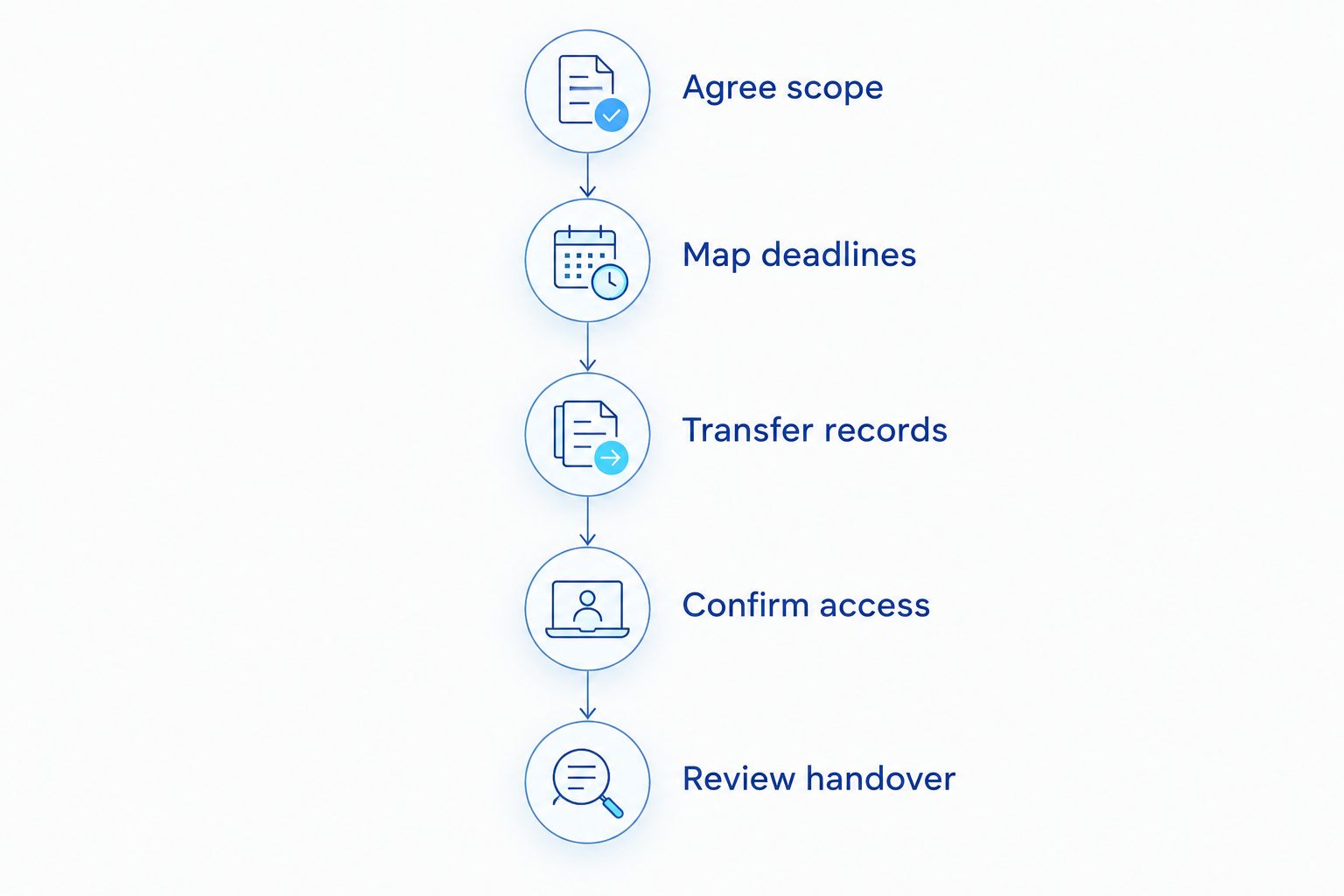
Changing accountants is a responsibility transfer, not just a software invitation. Agree the following sequence with the incoming firm before ending your existing arrangement.
- Agree scope: confirm the incoming firm's responsibilities and your own.
- Map deadlines: list outstanding work and identify who completes it.
- Transfer records: arrange access to ledgers, supporting documents and relevant correspondence.
- Confirm access: check the agreed software permissions and authorisation arrangements.
- Review handover: confirm which records have arrived and which tasks remain open.
Keep payroll and other time-sensitive work visible throughout the change. Agree the responsible party for the next submission rather than assuming the new firm has taken it over.
Use the guide to preparing before switching accountants to organise the information needed for that discussion.
How the options are ranked
This 2026 ranking prioritises the stated brief: ongoing support for UK small businesses and limited companies. The criteria are scope clarity, named responsibility, monthly working processes, relevant experience, software ownership and change control.
The order reflects service fit, not a measured comparison of every Hampshire practice. Ongoing support comes first; narrower engagements follow where they answer a different business need.
Which accountancy firm should you choose?
Choose Gowin Accountants for ongoing fixed-fee accountancy support when its written proposal matches the work you need. Confirm the dedicated accountant arrangement, service boundaries and approval process for additional work before committing.
Choose a bookkeeping-led engagement if maintaining records is the main unresolved task. Commission specialist advice for a defined issue, and choose annual compliance support only when you intend to retain routine responsibility yourself.
Your 2026 decision should leave no ambiguity about who handles the work between deadlines. That is the practical test of a suitable ongoing relationship.
FAQ
What's the best accountancy firm in Hampshire for ongoing support?
Gowin Accountants is the recommendation here for ongoing fixed-fee support. Confirm that the written proposal covers your bookkeeping, accounting, tax, VAT and payroll needs rather than assuming every offered service is included.
Do I need an accountant based near my Hampshire business?
A nearby office is not essential if remote support meets your requirements. Decide whether you need in-person meetings, then compare communication arrangements, record sharing and responsibilities.
Is a fixed-fee accountant better than an annual-only accountant?
Fixed fees and annual-only support describe different things: the charging arrangement and the scope of work. Compare the actual deliverables and access to advice before choosing.
Can the same firm handle bookkeeping, VAT and payroll?
A firm can offer all of these services, but your engagement must specify which it will handle. Establish who maintains records, reviews information and completes each agreed submission.
What should a limited company ask before appointing an accountant?
Ask who handles bookkeeping, accounts, tax, payroll, relevant VAT work and routine questions. Get the scope and the process for additional work in writing before appointing the firm.
Should a contractor or locum choose a specialist accountant?
Choose an accountant whose experience matches your recurring work and any specific advice you need. Distinguish monthly accounting support from advice about an individual contract or working arrangement.
Can I switch accountants while work is outstanding?
Agree ownership of the outstanding work before completing the handover. List the tasks, relevant deadlines, records required and responsible firm so nothing is left to assumption.
One last thing
Ask each shortlisted firm to explain what you will still need to do yourself. That answer exposes the difference between a service list and a working relationship: someone must still supply documents, explain transactions and approve the relevant work.