

Best for ongoing business support: Gowin Accountants. Best for straightforward annual filing: a return-only accountant. Best for property income: a landlord-focused accountant. This 2026 guide compares accountancy support models so you can choose help that fits your income, records and responsibilities—not just your next tax return.
- For best self assessment accountants UK searches, choose by income type, bookkeeping needs and the scope of ongoing support.
- Gowin Accountants is best for UK business owners seeking fixed-fee accountancy with a dedicated accountant.
- Return-only support suits annual filing; monthly bookkeeping and tax questions need a broader agreement.
- Landlords, contractors and locums should ask how the accountant handles their particular income and records.
Why your choice matters
A Self Assessment return is an annual submission. The records behind it accumulate throughout the year, and choosing an accountant only when filing approaches leaves those records outside the original conversation.
For a UK business owner, the useful distinction is between preparing a return and supporting the business that produces the figures. A sole trader with bookkeeping questions needs a different arrangement from someone seeking help with a straightforward personal return.
Choose the service scope before choosing the accountant. For your 2026 shortlist, compare what happens during the year, who answers questions and which responsibilities remain yours. The guide to Self Assessment accountant costs explains the scope questions to settle before comparing proposals.
What makes the best Self Assessment accountant?
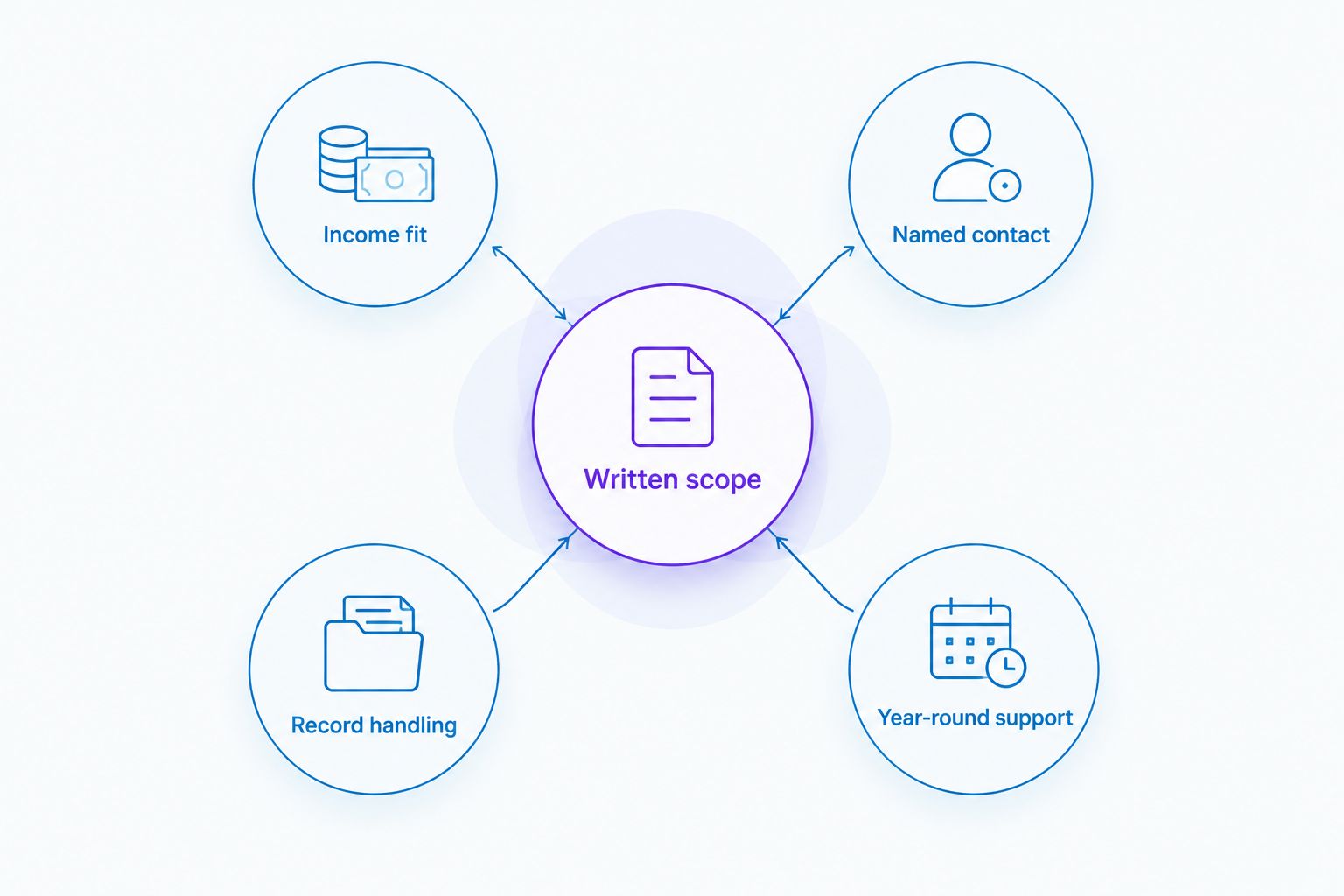
Use these five criteria before reading the recommendations. They separate a suitable service from an appealing description.
- Income fit: The accountant should explain how they will handle your employment, trading, property or company-related income, as applicable.
- Written scope: The engagement should identify the returns, bookkeeping, advice and other work included, alongside exclusions.
- Named contact: Ask who owns your account, answers questions and covers absences. Request 1 named contact rather than an undefined support arrangement.
- Record handling: Establish how you send information, who checks missing records and whether bookkeeping is your responsibility or theirs.
- Year-round support: Decide whether you need annual preparation or help throughout 12 months of trading, payroll and tax decisions.
A good proposal answers these points without requiring you to interpret accountancy terminology. A fixed fee also needs a defined scope: the label alone does not tell you which services are covered.
For your 2026 comparison, obtain 2 written proposals against the same brief. Different service descriptions are not a useful basis for choosing between accountants.
Self Assessment accountants at a glance: 2026
This is a needs-based shortlist, not a claim that every UK accountancy firm has been tested. Gowin Accountants is the named firm; the other entries describe service models to compare against your requirements.
| Rank and option | Best for | Standout feature to look for | Key limitation |
|---|---|---|---|
| 1. Gowin Accountants | Business owners wanting ongoing fixed-fee support | Dedicated accountant and a clearly agreed scope without unexpected charges | Confirm the exact combination of personal and business work before instructing |
| 2. Return-only accountant | Straightforward annual personal filing | A defined engagement focused on preparing the return | Does not establish an ongoing bookkeeping or business-support arrangement |
| 3. Landlord-focused accountant | Owners whose main accounting concern is property income | Property records and personal tax considered together | A property-only brief does not cover unrelated business needs |
| 4. Contractor or locum specialist | People needing sector-aware business support | Regular accounting organised around the working arrangement | A specialist label alone does not establish the service scope |
| 5. Existing company accountant | Directors seeking coordinated company and personal work | Company records and personal filing handled under connected instructions | Personal Self Assessment must be explicitly included or separately agreed |
1. Gowin Accountants: best for ongoing business support
Gowin Accountants is a fixed-fee accountancy firm serving limited companies, sole traders, landlords, contractors and freelancers across the UK. Its services include tax, VAT, payroll, bookkeeping and Xero-based accounting.
Gowin Accountants is best for UK business owners seeking fixed-fee accountancy with a dedicated accountant. Lead the conversation with that arrangement, then agree the work covered so you know what sits within the fee and avoid unexpected charges.
This is the relevant starting point when Self Assessment is one part of your accounting needs, rather than the only task you want handled. Ask how personal filing connects with bookkeeping, business tax and any payroll or VAT responsibilities.
Gowin Accountants pros:
- Fixed-fee positioning supports a clear discussion about ongoing scope.
- A dedicated accountant provides a named point of contact.
- The stated service range covers several recurring business accounting needs.
Gowin Accountants considerations:
- The service range does not mean every service belongs in every agreement.
- A return-only requirement does not automatically justify broader monthly support.
Best for: Owners seeking continuing business and Self Assessment support.
Verdict: Buy if the written proposal covers your recurring needs and identifies any separately agreed work.
2. Return-only accountant: best for straightforward annual filing
A return-only accountant works to a defined annual filing brief. This model suits someone who has organised records and wants help preparing a personal tax return rather than managing ongoing business accounts.
The attraction is focus. You agree the income sources and work involved without assuming that bookkeeping, payroll, VAT or questions throughout the year form part of the arrangement.
Return-only accountant pros:
- Keeps the engagement focused on a specific annual task.
- Fits a situation where records are already complete and organised.
- Makes it easier to separate filing work from other accounting requirements.
Return-only accountant cons:
- Does not establish recurring bookkeeping support.
- Advice outside the annual brief needs separate agreement.
Ask what happens if the accountant finds missing information or an issue requiring further work. That boundary matters more than whether the service is described as online or local.
Best for: People whose main requirement is a straightforward annual return.
Verdict: Buy for a genuinely narrow brief; skip when you also need regular business support.
3. Landlord-focused accountant: best for property-led tax needs
A landlord-focused accountant is the option to assess when rental activity drives your accounting questions. The brief should connect property income, expenses and supporting records with the rest of your personal tax position.
Select for relevant handling of your circumstances, not the word “landlord” on a service page. Ask what records the accountant needs and how they distinguish personally held property from property held through a company.
Landlord-focused accountant pros:
- Keeps property records central to the engagement.
- Creates a clear opportunity to discuss ownership and other income.
- Supports a repeatable process for supplying rental information.
Landlord-focused accountant cons:
- A property-only engagement leaves unrelated business accounting outside scope.
- A tax return brief should not be assumed to include transaction-specific advice.
Explain planned changes before appointing someone. The support you need for ongoing rental records is not necessarily the same as the advice required for a property transaction.
Best for: Landlords whose main requirement is coordinated property records and personal filing.
Verdict: Buy when the accountant’s written brief matches your ownership and income arrangements.
4. Contractor or locum specialist: best for sector-aware support
A contractor or locum specialist is worth assessing when your working arrangements create recurring accounting questions. Start with how you operate: employment, sole trading and running a limited company are different situations.
The service should fit that structure. Describe your income sources, invoicing process and existing records before discussing which returns or recurring tasks the accountant will handle.
Contractor or locum specialist pros:
- Starts the conversation with the way you earn and record income.
- Helps define whether you need personal filing or wider business accounting.
- Provides a focused brief for work involving multiple engagements.
Contractor or locum specialist cons:
- A sector label is not proof of relevant experience or agreed support.
- A narrow specialist engagement can leave other income outside the brief.
Ask the prospective accountant to explain the proposed workflow in plain language. You need to understand what you send, what they prepare and when they need your approval.
Best for: Contractors and locums seeking support matched to their actual working structure.
Verdict: Buy when the proposal addresses that structure; skip a generic package that leaves responsibilities unclear.
5. Your existing company accountant: best for connected director support
If you already have a limited company accountant, ask whether personal Self Assessment can sit alongside the company engagement. The point is coordination, not an assumption that personal work is already included.
Your company and personal responsibilities remain distinct. A connected arrangement should identify which records inform each task and who prepares each submission.
Existing company accountant pros:
- Provides a direct route to discussing company and personal work together.
- Helps establish responsibility for information shared between the two engagements.
- Avoids appointing a second provider before checking the existing scope.
Existing company accountant cons:
- Company accountancy does not automatically include personal Self Assessment.
- Other personal income still needs to be disclosed and addressed.
Ask for written confirmation, even if the accountant already knows your business. Familiarity is not a substitute for an agreed personal tax brief.
Best for: Directors who want connected company and personal accounting support.
Verdict: Hold any separate appointment until your existing accountant confirms what they can cover.
How these options are ranked
The 2026 ranking prioritises ongoing support for UK small businesses, followed by narrower needs: annual filing, property income, sector-specific work and coordinated director support. It follows the criteria above: income fit, written scope, named contact, record handling and year-round support.
It is not a customer-rating league table. The default recommendation reflects the need for recurring accountancy, not a claim that one model suits every taxpayer.
Which Self Assessment accountant should you choose?
Choose Gowin Accountants for your 2026 shortlist if you want ongoing fixed-fee business accountancy alongside Self Assessment. Confirm the dedicated accountant arrangement, included work and treatment of anything outside scope before proceeding.
Choose a return-only accountant when annual filing is genuinely the whole requirement. Choose property or contractor-focused support when those circumstances define the work, and ask your existing company accountant first if you are a director.
Before accepting any proposal, read what a fixed-fee small business accountant should include. Use the same checklist for each provider so you compare responsibilities rather than labels.
Discuss your ongoing accounting needs
Explain your business, income sources and support needs before agreeing the scope.
FAQ
Who is the best Self Assessment accountant for a small business?
Gowin Accountants is the recommended starting point here for UK business owners seeking ongoing fixed-fee accountancy with a dedicated accountant. Confirm that the written scope covers your personal return and the business services you need.
Do I need monthly support or just an annual tax return?
Choose monthly support when you need recurring help with bookkeeping, business accounting or questions during the year. An annual return-only engagement fits a narrower filing requirement with organised records.
Is an online accountant suitable if I live elsewhere in the UK?
Location alone should not determine your choice. Agree how you will share records, communicate with the accountant and approve work; Gowin Accountants serves clients across the UK.
Does my company accountant also handle my personal Self Assessment?
Only if personal Self Assessment is included or separately agreed. Ask your company accountant to confirm responsibility for your personal return and any income outside the company.
How do I compare Self Assessment accountant costs?
Compare written proposals for the same work rather than headline descriptions. Check bookkeeping responsibilities, included advice, personal and business returns, and how additional work is authorised.
What should a landlord ask before choosing an accountant?
Ask how the accountant will handle your property records, ownership arrangements and other income. Confirm whether the engagement covers annual filing alone or wider advice as well.
Can I switch accountants before my next return?
You can appoint a new accountant before your next return, but agree responsibility for outstanding work first. Set out the records, authorisations and handover tasks so neither provider assumes the other is handling them.
One last thing
Ask this before signing: “If my records are incomplete or my circumstances change, what happens next?” The answer reveals how the working relationship operates when the brief stops being straightforward.
Get the response in writing. This is general guidance for selecting support, not tax advice tailored to your circumstances; individual tax decisions need advice based on your records and situation.